





Some error occured while loading the Quick View. Please close the Quick View and try reloading the page.
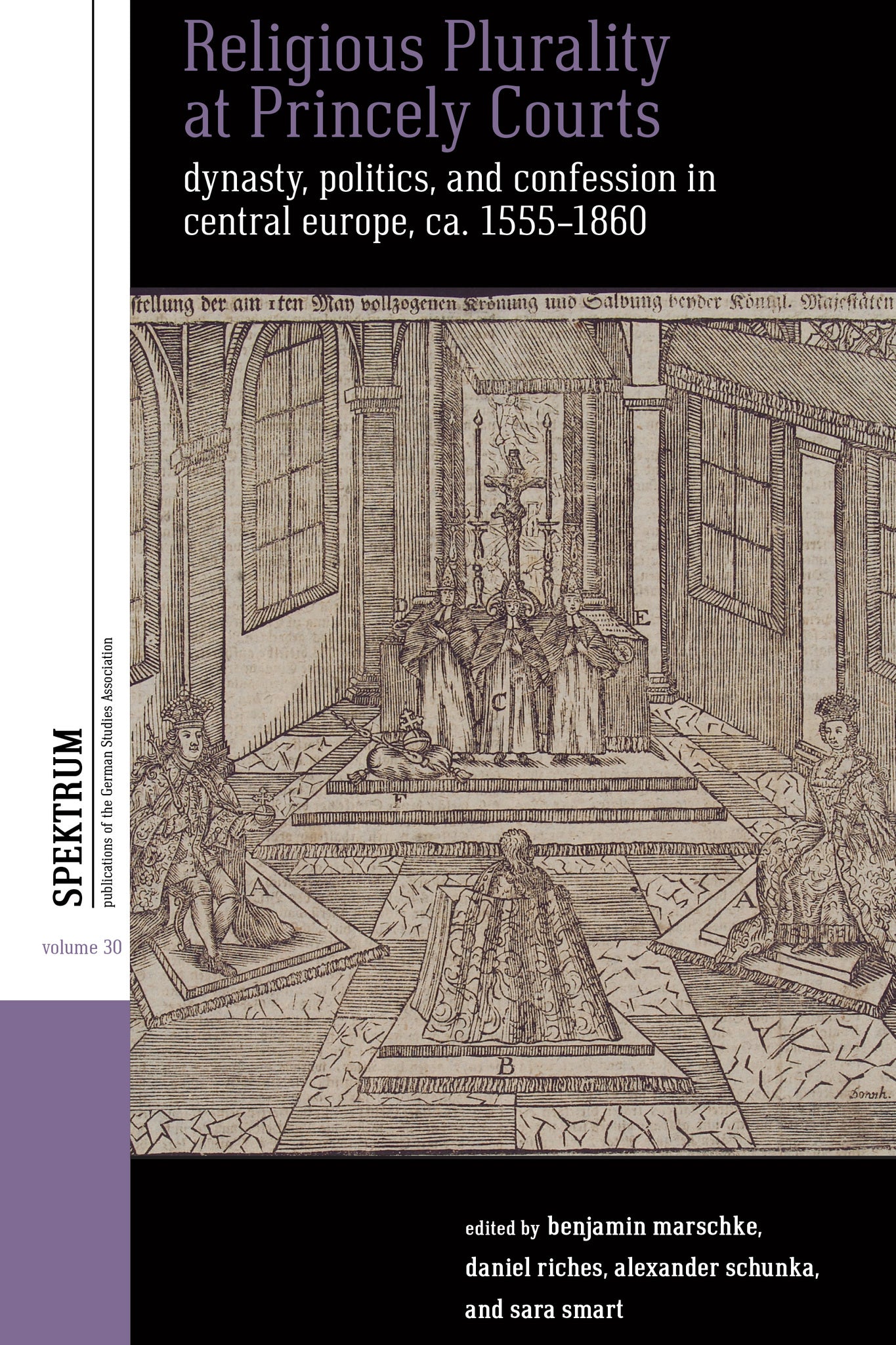
Early modern European monarchies legitimized their rule through dynasty and religion where ideally the divine right of the ruler corresponded with the official confession of the territory. It has thus been assumed that at princely courts only a single confession was present. However, the reality of the confessionalization paradigm commonly involved more than one faith. Religious Plurality at Princely Courts explores the reverberations of bi-confessional or multi-confessional intra-Christian settings at courts on dynastic, symbolic, diplomatic, artistic, and theological levels addressing a significant neglected understanding of interreligious dialogue, religious change, and confessional blending. Incorporating perspectives across European studies such as domestic and international politics, dynastic strategies, the history of ideas, women’s and gender history, and material culture, the contributions to this volume highlight the intersections of religious plurality at court.


List of Figures
Introduction: Religious Plurality at Princely Courts
Benjamin Marschke, Daniel Riches, Sara Smart, and Alexander Schunka
Part I: Bi-Confessional Royal Marriage Strategies
Chapter 1. Confessional Identity, International Protestantism, and Desacralization: Cross-Confessional Marriage Projects in the House of Hohenzollern in the Eighteenth Century.
Benjamin Marschke
Chapter 2. Faith and its Discontents: Mixed-Confessional Dynastic Marriages and Protestant Dialogue in the Holy Roman Empire during the Long Eighteenth Century.
Alexander Schunka
Part II: Conversion and Its Consequences
Chapter 3. How to Represent a Convert Queen. Elisabeth Christine of Braunschweig-Wolfenbüttel’s Conversion as a Challenge for Dynastic Public Relations.
Ines Peper and Marion Romberg
Chapter 4. The Supraconfessional Blend versus Confessional Purity: the Death of Anna of Prussia in 1625, the Dynastic Funeral Volume, and Confessional Relations in Brandenburg-Prussia.
Sara Smart
Chapter 5. Monsieur is Worth a Mass: Changing Attitudes Towards Conversion in Seventeenth-Century French Royal Marriages.
Jonathan Spangler
Part III: Religious Plurality at Court
Chapter 6. Masquerades and Christian Zeal: The Court of Moritz of Hessen-Kassel During the Second Reformation.
Tryntje Helfferich
Chapter 7. Ecclesiastical Courts, Aristocratic Kinship, and Confessional Ambiguity: Osnabrück, Paderborn, Münster, ca. 1555-1650.
David M. Luebke
Part IV: Religious Plurality Beyond the Court
Chapter 8. Dynastic and Religious Ambitions in Johan III of Sweden’s Marriage to Katarina Jagellonica.
Daniel Riches
Chapter 9. Diplomacy and Religious Plurality in the Prussian and British Courts, 1840-1860.
Samuel Keeley
Part V: Concluding Remarks
Chapter 10. Religious Plurality at Princely Courts in a Global Context: A Counterpoint from Outside Europe.
Jeroen Duindam
Conclusion and Avenues for Further Research
Benjamin Marschke, Daniel Riches, Sara Smart, and Alexander Schunka