





Some error occured while loading the Quick View. Please close the Quick View and try reloading the page.
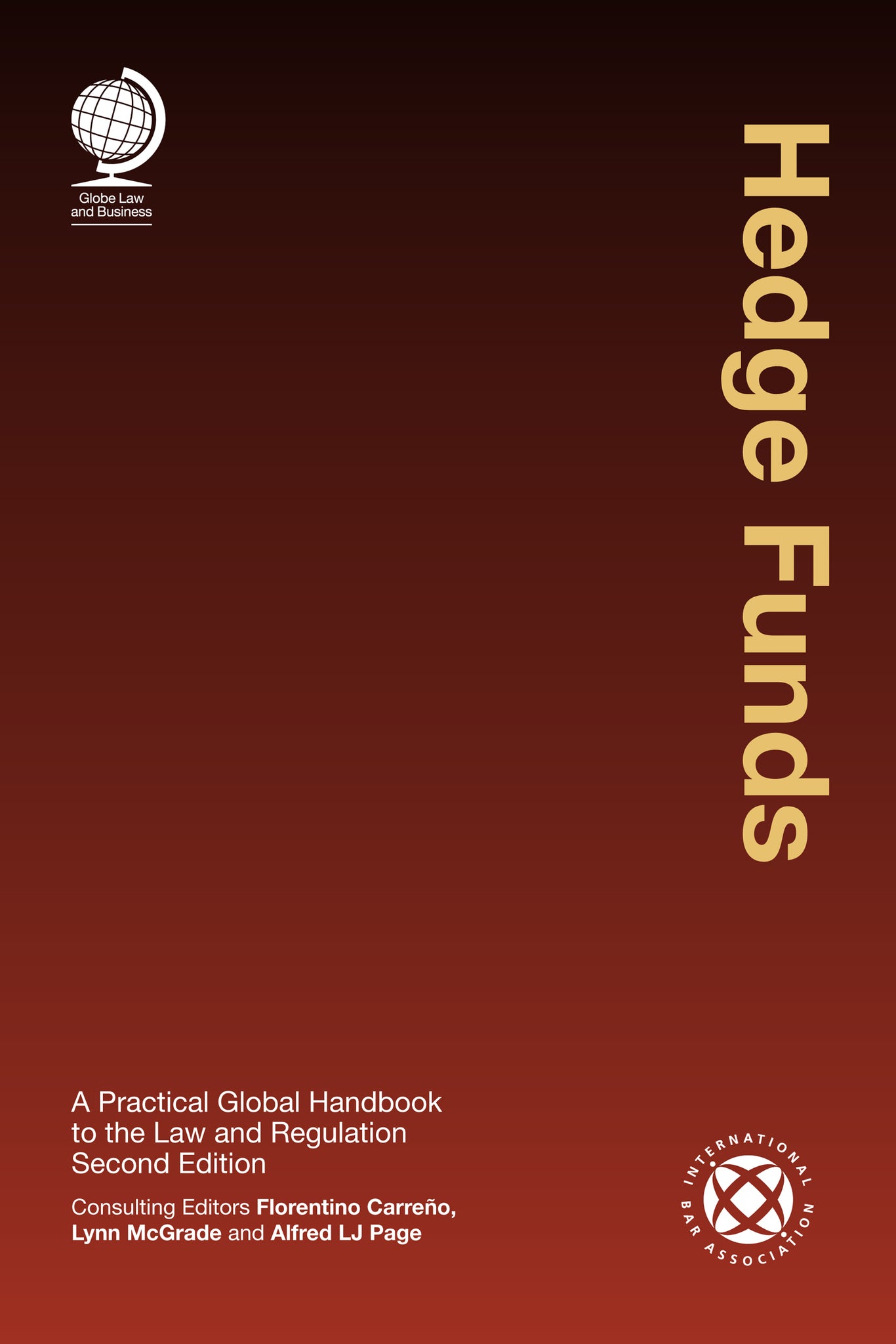
Wherever they are established, the reach, influence and impact of hedge funds on companies and economies are global in nature. Understanding the interaction of the legal and regulatory frameworks that impact on hedge fund operations has become critical for hedge fund sponsors and managers, service providers and stakeholders.
In its first edition, this practical handbook outlined for the first time key trends in the global hedge fund industry. This second edition, published in conjunction with the International Bar Association (IBA), updates its content reflecting the complexity of the markets following the implementation of transparency and application of new technologies. It reviews latest structuring and governance models, as well as operational, litigation, enforcement and key regulatory initiatives in the European Union and United States. The book also features an in-depth analysis of the law and regulation of hedge funds in a number of leading jurisdictions. Each country chapter follows a detailed template for ease of reference for the reader.
Written by expert hedge fund lawyers and industry service providers - from Borden Ladner Gervais, Sullivan & Cromwell and White & Case, among other leading firms - this title provides up-to-date analysis and helpful, practical tools for participants in the hedge fund industry.

Price: £275.00
Pages: 427
Publisher: Globe Law and Business
Imprint: Globe Law and Business
Publication Date:
01 August 2019
ISBN: 9781787423084
Format: eBook
BISACs:

For anyone involved professionally with investing in— or advising on — hedge funds, this book is essential reading.
— Elizabeth Robson Taylor and Philip Taylor MBE
“Healthy discontent is the prelude to progress.” – Mahatma Gandhi There can be little doubt that healthy discontent was one of the many emotions being experienced by hedge fund practitioners and professionals in the year 2012, when Globe Law and Business published the first edition of Hedge Funds. At the time the financial system and the broader economy were both licking their wounds and slowly emerging from the financial crisis that had engulfed the global economy at the end of the previous decade, and the Dodd-Frank Act was still new on the scene, with many of its implementing rules and regulations yet to be promulgated (of course, that is true to an extent even in 2019). It is in 2019 that Globe Law and Business has published the second edition of its eminently useful guide. As Hedge Funds reminds the reader, the global hedge fund industry’s assets under management increased over 61% between the publication of its first and second editions. During that period not only have domestic regulatory authorities issued many of the rules and regulations contemplated by Dodd-Frank, their foreign counterparts have also issued and revised numerous rules and regulations affecting the hedge fund industry. It is against this backdrop of growth and maturation both of the hedge fund industry and of the regulatory framework governing it that the second edition of Hedge Funds was published earlier this year. The book acknowledges and addresses these changes admirably, serving as a helpful overview for those new to the regulation of hedge funds while also providing much of value to seasoned practitioners. Not only does the book cover fundamental concepts such as hedge fund formation, common fund features and the risks to which hedge funds are subject, it delves into timely areas such as cryptocurrency regulation and the effects of Brexit. The book examines all of these topics alongside a detailed narrative describing the regulatory framework governing hedge funds and that framework’s ongoing evolution. While much of the text is focused on hedge fund regulation in the United States, the book also includes helpful chapters discussing the regulatory environments of numerous other countries, including the Cayman Islands and the United Kingdom, among others. Unlike some of Globe’s other treatises, for example, the excellent Credit Derivatives: Documenting and Understanding Credit Derivative Products, each chapter of Hedge Funds is penned by a different author or authors. While this creates some differences in styles of writing and presentation, the differences are not problematic and the authors are without exception highly qualified and well-versed in the respective subject matters on which they write. Whether or not the issuance of more rules and regulations is considered “progress” will depend upon the perspective of the reader, but there exists a reasonable argument that more targeted, appropriate regulation of the hedge fund industry will benefit hedge funds and investors alike. Likewise, inasmuch as growth is considered progress it is clear that the hedge fund industry itself is progressing. And while progress may not be inevitable, change is, and the practitioner looking to keep up with the regulation of hedge funds and changes in that respect would do well to have a copy of Hedge Funds available on his or her bookshelf.
— Kurt Leeper, Partner
The new second edition of this volume provides a fresh and dynamic perspective over the law and practice of hedge funds.
— Vincenzo Bavoso
— Elizabeth Robson Taylor and Philip Taylor MBE
“Healthy discontent is the prelude to progress.” – Mahatma Gandhi There can be little doubt that healthy discontent was one of the many emotions being experienced by hedge fund practitioners and professionals in the year 2012, when Globe Law and Business published the first edition of Hedge Funds. At the time the financial system and the broader economy were both licking their wounds and slowly emerging from the financial crisis that had engulfed the global economy at the end of the previous decade, and the Dodd-Frank Act was still new on the scene, with many of its implementing rules and regulations yet to be promulgated (of course, that is true to an extent even in 2019). It is in 2019 that Globe Law and Business has published the second edition of its eminently useful guide. As Hedge Funds reminds the reader, the global hedge fund industry’s assets under management increased over 61% between the publication of its first and second editions. During that period not only have domestic regulatory authorities issued many of the rules and regulations contemplated by Dodd-Frank, their foreign counterparts have also issued and revised numerous rules and regulations affecting the hedge fund industry. It is against this backdrop of growth and maturation both of the hedge fund industry and of the regulatory framework governing it that the second edition of Hedge Funds was published earlier this year. The book acknowledges and addresses these changes admirably, serving as a helpful overview for those new to the regulation of hedge funds while also providing much of value to seasoned practitioners. Not only does the book cover fundamental concepts such as hedge fund formation, common fund features and the risks to which hedge funds are subject, it delves into timely areas such as cryptocurrency regulation and the effects of Brexit. The book examines all of these topics alongside a detailed narrative describing the regulatory framework governing hedge funds and that framework’s ongoing evolution. While much of the text is focused on hedge fund regulation in the United States, the book also includes helpful chapters discussing the regulatory environments of numerous other countries, including the Cayman Islands and the United Kingdom, among others. Unlike some of Globe’s other treatises, for example, the excellent Credit Derivatives: Documenting and Understanding Credit Derivative Products, each chapter of Hedge Funds is penned by a different author or authors. While this creates some differences in styles of writing and presentation, the differences are not problematic and the authors are without exception highly qualified and well-versed in the respective subject matters on which they write. Whether or not the issuance of more rules and regulations is considered “progress” will depend upon the perspective of the reader, but there exists a reasonable argument that more targeted, appropriate regulation of the hedge fund industry will benefit hedge funds and investors alike. Likewise, inasmuch as growth is considered progress it is clear that the hedge fund industry itself is progressing. And while progress may not be inevitable, change is, and the practitioner looking to keep up with the regulation of hedge funds and changes in that respect would do well to have a copy of Hedge Funds available on his or her bookshelf.
— Kurt Leeper, Partner
The new second edition of this volume provides a fresh and dynamic perspective over the law and practice of hedge funds.
— Vincenzo Bavoso
Formation and structuring of hedge funds
Sarah Gardiner
Ronald Kosonic
Borden Ladner Gervais LLP
Regulatory initiatives affecting US hedge fund managers
Whitney Chatterjee
Joseph Hearn
Katie McGavin
Sullivan & Cromwell LLP
Litigation in the hedge fund world
Raif Hassan
John Reynolds
White & Case LLP
Recent developments in SEC enforcement
Charles Clark
Noah Gillespie
Craig Warkol
Peter White
Schulte Roth & Zabel LLP
Hedge fund activation
Judit Budia
Matthew Francis
Szecskay Attorneys at Law
Role of prime brokers
Miguel Sanchez Mongo
Cuatrecasas, Gonçalves Pereira
Countries
Australia
Nathan Cahill
Henry Wong
Minter Ellison
Brazil
Pedro Augusto A Asseis
Lawson Miralha
Pinheiro Neto Advogades
Canada
Scott McEvoy
Lynn McGrade
Borden Ladner Gervais LLP
Cayman Islands
Jeremy Bomford
Iain McMurdo
Maples & Calder
China
Zhiyi Ren
Fangda Partners
France
Jerome Sutour
CMS Bureau Francis Lefebvre
Germany
Felcitas Mayer-Theobald
Stefan Suss
Latham & Watkins LLP
Hong Kong
Julia Charlton
Charltons Law
Italy
Alessandro Portolana
Chiomenti
Japan
Kei Ito
Ryuichi Sakamoto
Nashimura & Asahi
Luxembourg
Henning Schwabe
Arendt & Medernach
Singapore
Jerry Koh
Danny Tan
Allen & Gledhill LLP
Spain
Jorge Canta
Cuatrecasas, Gonçalves Pereira
Switzerland
Markus Pfenniger
Pascal Zysset
Walder Wyss LTD
United Kingdom
Sam Brooks
Macfarlanes LLP
United States
Sari A El-Abboud
Nicholas S Hodge
K&L Gates