





Some error occured while loading the Quick View. Please close the Quick View and try reloading the page.
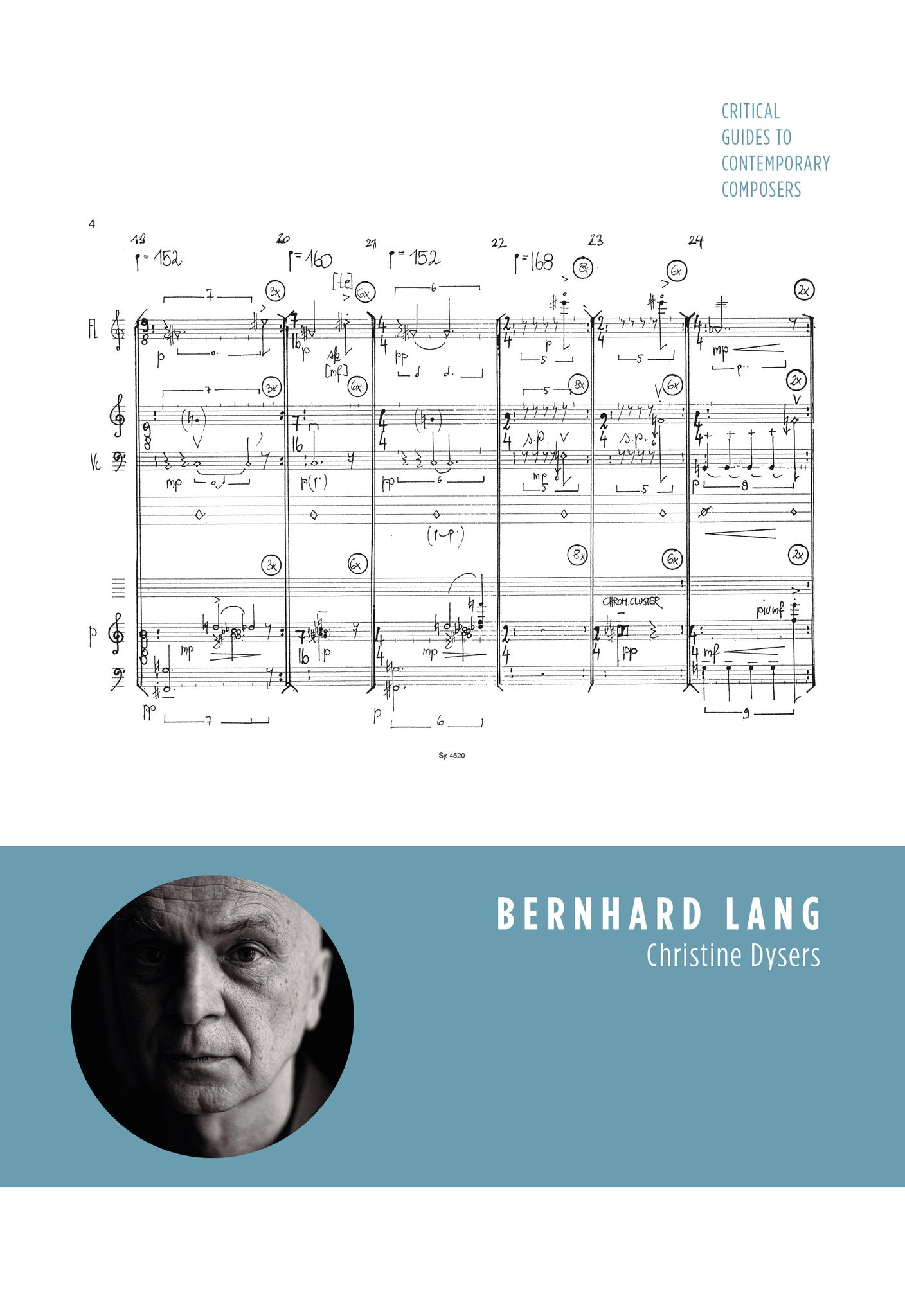
Bernhard Lang: Critical Guides to Contemporary Composers offers a critical guide and introduction to the work of Austrian composer Bernhard Lang (b. 1957). It identifies the phenomenon of repetition as a central concern in Lang’s thinking and making. The composer’s artistic practice is identified as one of ‘loop aesthetics’: a creative poetics in which repetition serves not only as methodology, but also as material, language, and subject matter.
The book is structured around the four central thematic nodes of philosophy, music, theatre, and politics. After introducing Lang as a composer whose work is thoroughly influenced by philosophical thought, the book develops a typology of musical repetition as it is explored and activated in Lang’s oeuvre.
Pointing towards the several repetitions within the performance of Lang’s works, the book explores the heavily trans-medial nature of the repeat across domains such as literature, dance, and theatre. Finally, the book investigates Lang’s use of textual quotation and musical borrowing.
Christine Dysers is a musicologist specialising in contemporary music aesthetics. Her research centres around repetition, politics, absence, the liminal, and the uncanny. This is the first full-length study of the works of Bernhard Lang and is a new volume in the Critical Guides to Contemporary Composers series from Intellect.


'This perceptive volume offers the first sustained, book-length treatment of Bernhard Lang that manages to be at once accessible and intellectually ambitious... Dysers’s prose is an exemplar of scholarly clarity: she avoids needless obscurantism while still conducting a theoretically informed inquiry. Her interdisciplinary horizon, which crosses philosophy, theatre studies, and political aesthetics, is not artificial but functional; it helps make Lang’s music intelligible on its own terms. Equally important, the work fills a genuine gap in contemporary musicology: Lang has been comparatively overlooked in English-language scholarship, and Dysers’s volume should act as a corrective and as an invitation to further research. This book will be of value to a diverse readership: composers and performers interested in process-based composition, and musicologists who wish to expand the analytic toolbox for contemporary repertories. Dysers gives us an interpretative vocabulary that will make listening to Lang’s music richer and more exacting. The book is a model of how to write about a living composer without resorting to hagiography, and it should be required reading for anyone seeking to understand the aesthetics, philosophy, and method behind one of Europe’s most inventive contemporary composers.'
— Riccardo Wanke, Music and Letters
'Dysers explores the concept of repetition, insightfully examining Lang's use of textual quotation, and his practice of musical borrowing. She argues that while repetition is commonly treated as reiteration of a previously explored idea, this is too reductive. She treats it more as radical instability. [...] The book is indebted to music theory, psychology and post-structuralist philosophy, and Dysers has engaged in extended interviews with the composer.'
— Andy Hamilton, The Wire
'Dysers’s insightful study into Bernhard Lang, one of Austria’s pre-eminent living composers, is a worthwhile read for anyone interested in the specific compositional and musicological aspects of contemporary music.
Dysers’ study on Lang [...] focuses on the phenomenon of repetition as critical juncture in Lang’s creative output. In her extensive research as part of her PhD project at City University of London (2015–20), the author traced the fundamental change in Lang’s musical language, which can be described as a ‘loop aesthetic’. Her research also included interviews with the composer himself, which makes the publication especially insightful.'
— Matthias Wurz, Austrian Studies
Dr Christine Dysers is an Assistant Professor in Music at Aalborg University. Her research is broadly concerned with music after 1989, with a particular focus on the aesthetics of repetition, music and the political, and the notion of the uncanny. Christine holds a PhD in music from City, University of London. Previously, she was affiliated with Columbia University as a Fulbright Visiting Scholar (2021) and with Uppsala University as a postdoctoral researcher (2022-25).
List of Figures vii
Acknowledgements xi
Introduction xiii
1. Philosophies of Repetition 1
Discovering Deleuze 4
Circular thinking 12
Seriality and the rhizomatic oeuvre 26
2. Different Repetitions 32
The same, again 34
The paradox of repetition 42
The same, but different 50
Calculating the unforeseen 62
3. Acts of Repetition 70
Stories about repetition 73
Repetitive stories 75
Repetitive gestures 78
Repetitive scenographies 87
4. Politics of Repetition 99
It’s all about history 109
Take the power back 119
The analytic faculty 124
The limits of the intertext 133
Epilogue 137
Notes 143
References 150
Index 163