





Some error occured while loading the Quick View. Please close the Quick View and try reloading the page.
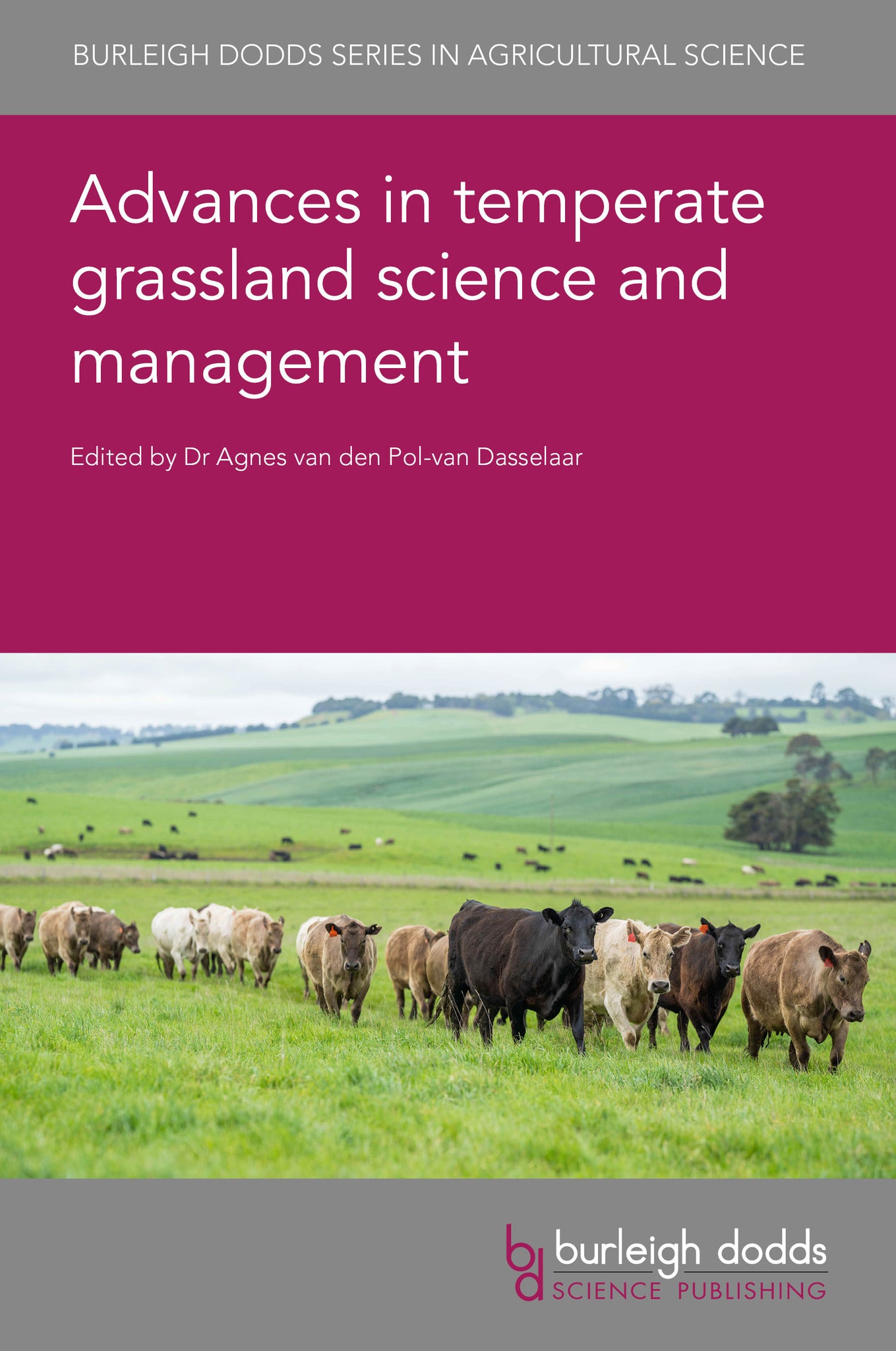
While grasslands face a number of challenges, such as land-use competition and the impact of climate change, there is a growing recognition of the critical role they play in supporting the transition to more resilient, sustainable and circular agricultural systems.
Advances in temperate grassland science and management reviews the wealth of research addressing these challenges and opportunities. The book highlights the potential of grasslands to deliver multiple benefits to farmers and society at large, illustrated through practical regional case studies on grassland management.
This book builds on a successful earlier volume by Burleigh Dodds Science Publishing: Improving grassland and pasture management in temperate agriculture (2018).


Part 1 The role of grasslands in agricultural systems
- 1.The societal role of grasslands: the case of northwest Europe: N. van Eekeren, J. de Wit, M. van den Hout, M. Bruinenberg, J. Pijlman and N. Hoekstra, Louis Bolk Institute, The Netherlands;
- 2.Grasslands and climate change: Martin Lukac and Chris Reynolds, University of Reading, UK;
- 3.Harnessing the power of grasslands in mixed farming/crop–livestock systems: F. Taube, Christian-Albrechts-University Kiel, Germany and Wageningen University, The Netherlands; J. K. Nyameasem, Christian-Albrechts-University Kiel, Germany and University of Bonn, Germany; and S. Verma, Christian-Albrechts-University Kiel, Germany and Aarhus University, Denmark;
Part 2 Grassland dynamics and management
- 4.Plant–soil–animal interactions and nutrient cycling in grazed grasslands: Lynn E. Sollenberger, University of Florida, USA; Marta M. Kohmann, University of Wisconsin-Madison, USA; K. Roger Trumpp and Jose C.B. Dubeux, Jr, University of Florida, USA;
- 5.Advances in grazing management: Michael O'Donovan, Teagasc, Ireland;
- 6.The use of precision technologies in grassland management: Laurence Shalloo and Paula Molina Palma, Teagasc, Ireland; and Deirdre Hennessy, University College Cork, Ireland;
- 7.The long path from data collection to sustainable grassland management: Nina Buchmann, ETH Zurich, Switzerland; Panu Korhonen, Natural Resources Institute Finland, Finland; Carsten Stefan Malisch, Aarhus University, Denmark; and Paul Newell Price, ADAS, UK;
- 8.From data collection to decision support tools for the sustainable management of grasslands: Magali Jouven, Institut Agro Montpellier, France; Audrey Michaud, VetAgro Sup, France; and Pascal Carrère, INRAE, France;
- 9.Advances in managing grassland weeds: Maria-Teresa Sebastià, Forest Science and Technology Centre of Catalonia – University of Lleida (UdL-CTFC), Spain; Ana Fossas, Forest Science and Technology Centre of Catalonia (CTFC), Spain; and Cristina Chocarro, University of Lleida (UdL-Agrotecnio), Spain;
Part 3 Grasslands, grazing and animal nutrition: effects on health and product quality
- 10.Quantifying forage quality to improve nutrient use efficiency in ruminant feeding: Martin Gierus, BOKU University, Austria;
- 11.The effects of pasture grazing on milk quality: Anjo Elgersma, Independent Scientist, The Netherlands;
- 12.Grasslands and One Health: the human health component: Frédéric Leroy, Vrije Universiteit Brussel, Belgium; Peter J. Ballerstedt, Grass Based Health LLC, USA; and Stefaan De Smet, Ghent University, Belgium;
Part 4 Development in botanical composition of grasslands
- 13.Improving biodiversity in agricultural grassland systems: Irina Herzon, University of Helsinki, Finland; James M. Bullock, UK Centre for Ecology and Hydrology, The UK; Jean-Yves Humbert and Raphaël Arlettaz, University of Bern, Switzerland; Péter Török, University of Debrecen, Hungary; and Karin Stein-Bachinger, Leibniz Centre for Agricultural Landscape Research, Germany;
- 14.Designing and developing multispecies swards for future grassland systems: Shona Baker and Thomas Moloney, Teagasc and DLF Ireland, Ireland;
- 15.Plantain (Plantago lanceolata): from weed to multi-functional component in sustainable dairy-farm systems: Ina (J.B.) Pinxterhuis, DairyNZ, New Zealand; Mike (M.B.) Dodd, AgResearch, New Zealand;
- 16.Advances in Epichloë endophyte plant secondary metabolites in grasslands: David E. Hume and Sarah C. Finch, AgResearch Limited, New Zealand; Alan V. Stewart, PGG Wrightson Seeds Limited, New Zealand; and John R. Caradus, Grasslanz Technology Limited, New Zealand;
Part 6 Case studies
- 17.Grasslands in Europe: current status, emerging challenges, and pathways to sustainable futures: A. Van den Pol-van Dasselaar, Aeres University of Applied Sciences, The Netherlands; D. Hennessy, University College Cork, Ireland; and J. Isselstein, University of Göttingen, Germany;
- 18.Challenges facing alpine/mountain grasslands: Giovanni Peratoner, Laimburg Research Centre, Italy; Caren M. Pauler and Manuel K.Schneider, Agroscope, Switzerland; Vibeke Lind, NIBIO, Norway; Andreas Klingler and Andreas Schaumberger, AREC Raumberg-Gumpenstein, Austria; Enrico Sturaro, University of Padova, Italy;
- 19.Grasslands in New Zealand: challenges and solutions: David R. Stevens, AgResearch Ltd, New Zealand;
- 20.Conclusion: pathways to resilient temperate grasslands: Agnes van den Pol-van Dasselaar, Aeres University of Applied Sciences, The Netherlands;