





Some error occured while loading the Quick View. Please close the Quick View and try reloading the page.
Volume II
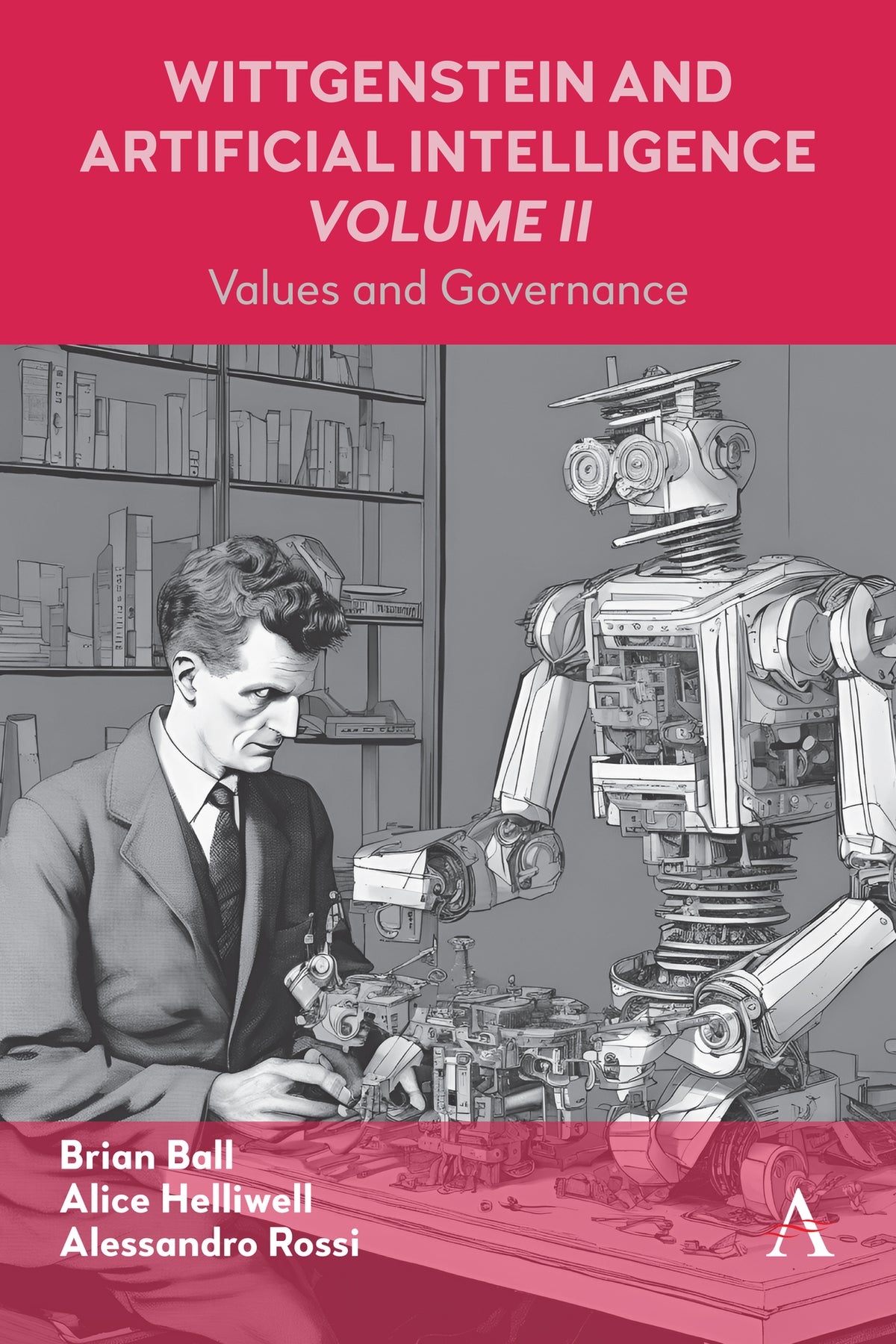
This collection brings together work on the relevance of Wittgenstein’s philosophy to the field of Artificial Intelligence (AI). Over two volumes, our contributors cover a wide range of topics from different disciplinary approaches. In this Volume (II), contributions are centred on two major themes in the philosophy of AI: questions of value and governance. Contributions include chapters on both ethics and aesthetics and AI, as well as questions of the governance of AI systems, including legal and policy issues.


‘This book offers fresh perspectives on AI through Wittgensteinian lenses: meaning as use, secondary meaning, creativity in rule-following, universals as family resemblances, analogical thinking, truthfulness, cognition embodied, language-games anchored in shared ways of living and acting – and thus potentially always more than what can be captured by LLMs.’ — Alois Pichler, Professor at the Department of Philosophy of the University of Bergen, and Head of the Wittgenstein Archives at the University of Bergen (WAB)
‘Questions of mind and language are central to both AI and the philosophy of Wittgenstein. These volumes richly elaborate the key connections, as well as their ethical implications – and in so doing prove the ongoing relevance of philosophy to the cutting edge of developments affecting our world.’ — Professor Anthony Grayling, Principal and Founder, Northeastern University London
‘Thanks to an impressive number of expert contributions covering a wide spectrum of enquiry across scientific disciplines, this collection stands as a compelling testament to the enduring relevance of Wittgenstein’s ideas in contemporary discussions surrounding artificial intelligence, its foundations, risks and transformative potential.’ — Barbara McGillivray, Turing Research Fellow at the Alan Turing Institute, Senior Research Associate at the University of Cambridge and Editor in Chief of the Journal of Open Humanities Data
Brian Ball is Associate Professor in Philosophy at Northeastern University London. His research spans a range of areas, notably the philosophy of mind, language and artificial intelligence, and he has taught the early history of analytic philosophy, including Wittgenstein.
Alice Helliwell is Assistant Professor in Philosophy at Northeastern University London. Her research is focused on computational creativity and AI art, including questions of aesthetics and ethics.
Alessandro Rossi is Assistant Professor in Philosophy at Northeastern University London. His work focuses on logic, metaphysics and the areas in which they intersect.
Introduction; Brian Ball, Alice C. Helliwell and Alessandro Rossi; Chapter 1. Is, Ought and Wittgenstein ; Alessandro Rossi; Chapter 2. When Saying Sorry Is the Hardest Game to Play: Wittgenstein, AI and the Quest for Transparency; Burkhard Schafer; Chapter 3. Wittgensteinian Considerations of the Moral Status of Robots; Paula Sweeney; Chapter 4. Can Machines Act Ethically?; Luca Alberto Rappuoli; Chapter 5. Investigating Deepfakes: The Rise of New Authorities and the Question of Deepfake Regulation; Mehmet Taylan Cüyaz; Chapter 6. AI and the Cluster Account of Art; Alice C. Helliwell; Chapter 7. An Anthropology of the User in the Age of AI; Richard Harper; Chapter 8. Legal and Computer Rules: An Overview Inspired by Wittgenstein’s Remarks; Gianmarco Gori; Chapter 9 Practice Makes Human: Why We Can’t Understand Black-Box Artificial Intelligence; Jean-Charles Pelland, Jasmin Trächtler and Helene Love; Notes on Contributors; Index