





Some error occured while loading the Quick View. Please close the Quick View and try reloading the page.
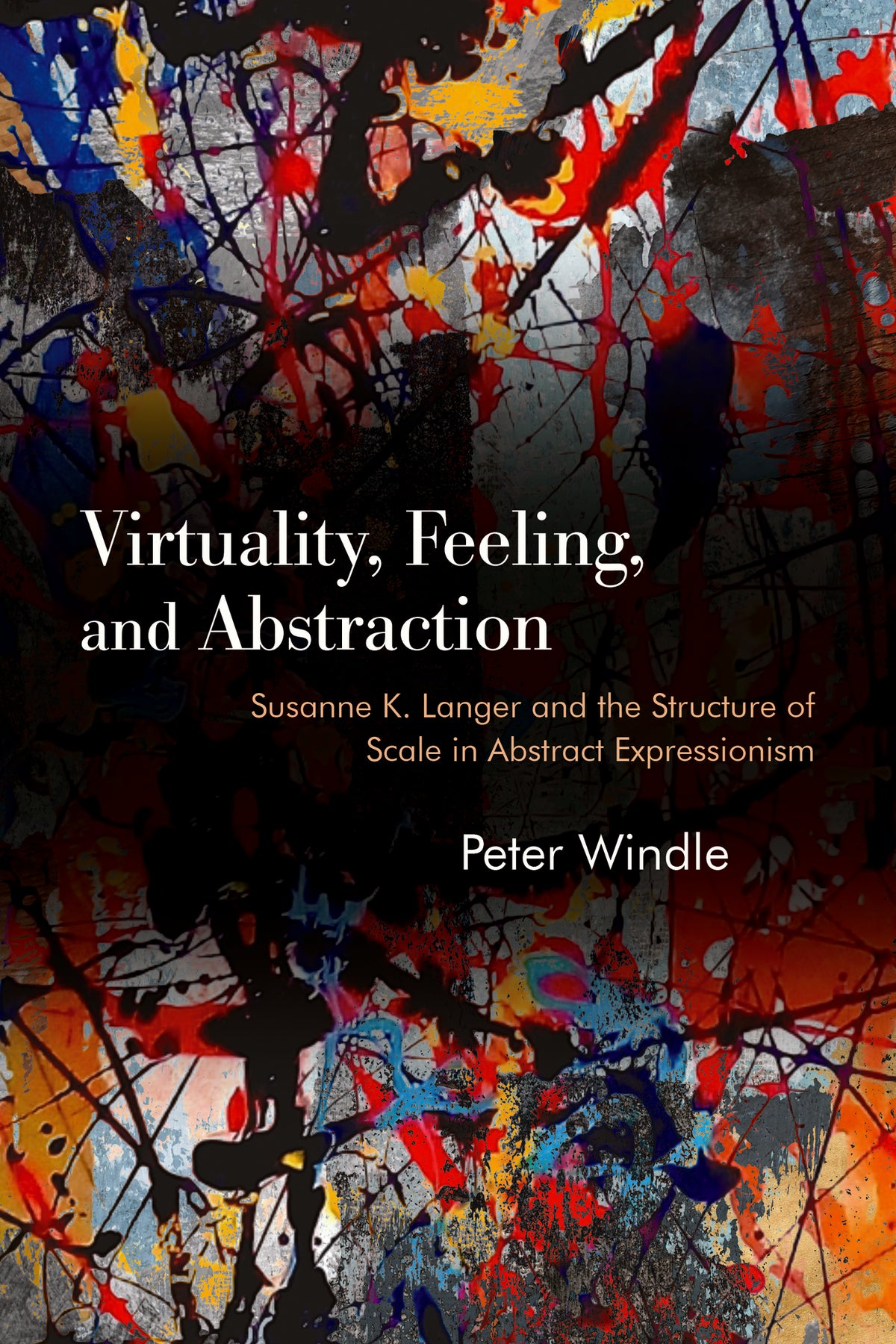
A new account of Abstract Expressionism that uses Susanne K. Langer's philosophy of art to rethink abstraction, feeling, and scale.
Virtuality, Feeling, and Abstraction offers a new account of Susanne K. Langer's philosophy of art and its significance for the study of modern and contemporary art. Peter Windle returns to a fundamental problem in aesthetics and art history: how artworks hold together as meaningful appearances. Drawing on Langer's concept of virtual form and engaging in sustained encounters with individual artworks across a wide historical and geographical field—including Exekias and Guo Xi to Friedrich, Turner, Hilma af Klint, Kandinsky, Malevich, Picasso, Pollock, Rothko, Newman, and Clyfford Still—he argues that artworks are not merely things that depict, express, or acquire status, but are perceptible organizations through which feeling becomes publicly available as form. At the center of Windle's analysis is a new account of abstraction: not simply the abandonment of recognizable subject matter, but a reorganization of visible form through the ambiguity of scale. In doing so, he recovers Langer as a major theorist of visual art and shows why her account of virtual form matters for the history and criticism of abstraction.


"Pioneering in its domain, this is an original work. It enriches the reception of Susanne Langer's thought as well as the fields of philosophy of art and of art history, especially as concerns abstract painting. Comments do not stop at Langer's aesthetic writings but also include her later work." — Anne Bossiére, University of Lille, France
"Peter Windle has written a book that provides a lucid exposition of Susanne Langer's aesthetics. He develops it, makes it compelling for contemporary readers, and, most importantly, challenges it. He guides the reader through philosophy by way of artworks—Abstract Expressionism above all, where his account of scale is deeply original—showing how much is gained by interweaving discursive and presentational thinking. His attitude to Langer is sympathetic, yet he keeps his distance: a rare combination, and the source of the book's strength and this reader's joy." — Tereza Hadravová, Charles University, Prague
Peter Windle is an art historian and aesthetician based between the United Kingdom and China. He received his PhD in History and Philosophy of Art from the University of Kent and his work has appeared in the Internet Encyclopedia of Philosophy and The British Journal of Aesthetics.