





Some error occured while loading the Quick View. Please close the Quick View and try reloading the page.
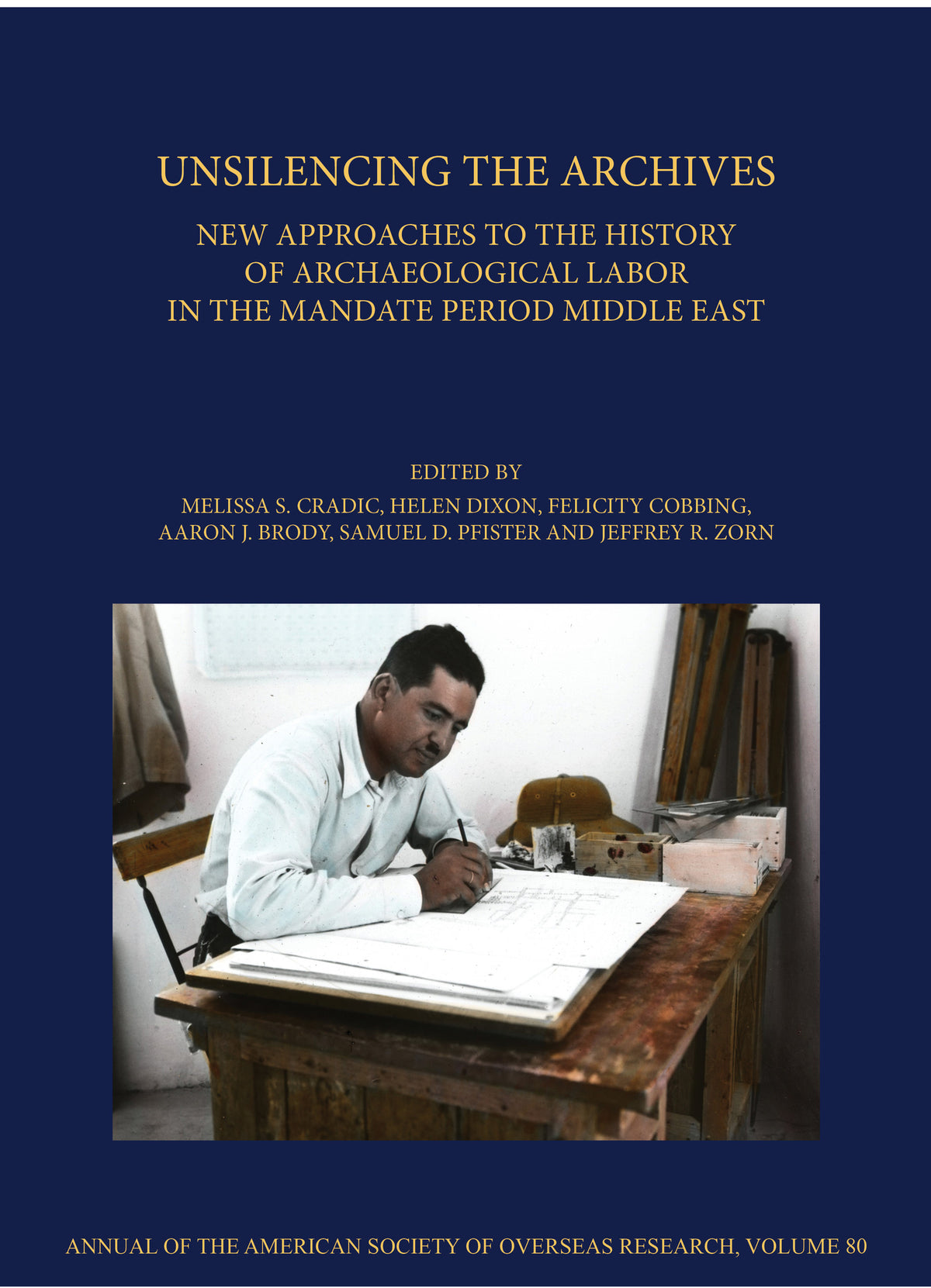
In recognition of this deficiency, and in an effort to begin to ameliorate it, the Badè Museum, the Palestine Exploration Fund and the Archaeological Research Facility (UC Berkeley) came together in 2021 to sponsor a virtual exhibit at the Badè Museum (“Unsilencing the Archives: The Laborers of the Tell en-Nas?beh Excavations (1926-1935)”), created and curated by Dr. Melissa Cradic and Sam Pfister, along with a yearlong series of YouTube lectures on this topic (hosted at the Archaeological Research Facility, UC Berkeley's YouTube channel).
This volume, emerging from the lecture series, is devoted to exploring the agency of many unnamed or underappreciated agents of archaeology within this colonial past. It serves as a kind of festschrift in honour of the often poorly documented, yet important, role(s) played by Middle Easterners during the period of the British Mandate.
The chapters in this book focus geographically on Palestine and the wider Middle East during the British Mandate period (roughly 1918–1948), with particular attention to sites, institutions, and individuals connected to archaeological work in Mandatory Palestine and neighbouring regions such as Egypt, Tunisia and Iran. Methodologically and thematically, the contributions emphasize “unsilencing” archival records by foregrounding marginalized actors—especially local laborers, Palestinian scholars and regional intermediaries—while exploring themes such as knowledge networks, colonial power structures, archival practices, and the socio-economic dimensions of archaeology, including labour, naming, and antiquities circulation.


List of Illustrations
List of Tables
Chapter 1 — Introduction to Unsilencing the Archives: New Approaches to the History of Archaeological Labor in the Mandate Period Middle East (Melissa S. Cradic)
Chapter 2 — The Emergence of the First Generation of Palestinian Archaeologists and Heritage Scholars under British Colonial Rule (1918–1948) (Mahmoud Hawari)
Chapter 3 — Local Knowledge Networks and Archaeological Communities of Practice in British Mandate Palestine (Rachael Thyrza Sparks)
Chapter 4 — “We are glad the prices are so reasonable:” Antiquities Sales by the Palestine Archaeological Museum under British and Jordanian Rule (Sarah Irving)
Chapter 5 — Unsilencing the Archives: The Laborers of the Tell en-Naṣbeh Excavations (1926–1935) (Melissa S. Cradic and Samuel D. Pfister)
Chapter 6 — Unsilencing the Archives and the Politics of Naming (Allison Mickel)
Chapter 7 — The Random Inclusivity of Archives, Images, and Text from an American Excavation in Palestine (1926–1935) (Doug Bailey)
Chapter 8 — The Archaeological Career of Labib Sorial (1917–1935): A “rather unusual Egyptian” (Jeffrey R. Zorn)
Chapter 9 — The Archival Landscape in the Context of Tell et-Tell: Early Archaeological Research (Hamed Salem)
Chapter 10 — Archaeology, Community, and Public Health in Palestine: Insights from the Olga Tufnell Archive, 1927‒1938 (John D. M. Green)
Chapter 11 — Unsilencing the Archives of Armageddon: Further Thoughts and Details on the Quftis of Megiddo (Eric H. Cline)
Chapter 12 — Archaeological Scrapbooks and “Seven Big Cases” of “Souvenirs”: The 1924–25 Excavations at Carthage through the Eyes of Horton O’Neil,Teenage Volunteer (Helen Dixon)
Chapter 13 — Global, Colonial, Local: Archival Perspectives on the University of Chicago’s Persepolis Expedition (Kiersten Neumann)
Chapter 14 — Unsilencing the Archives: Local Knowledge and the Subaltern (Salim Tamari)