





Some error occured while loading the Quick View. Please close the Quick View and try reloading the page.
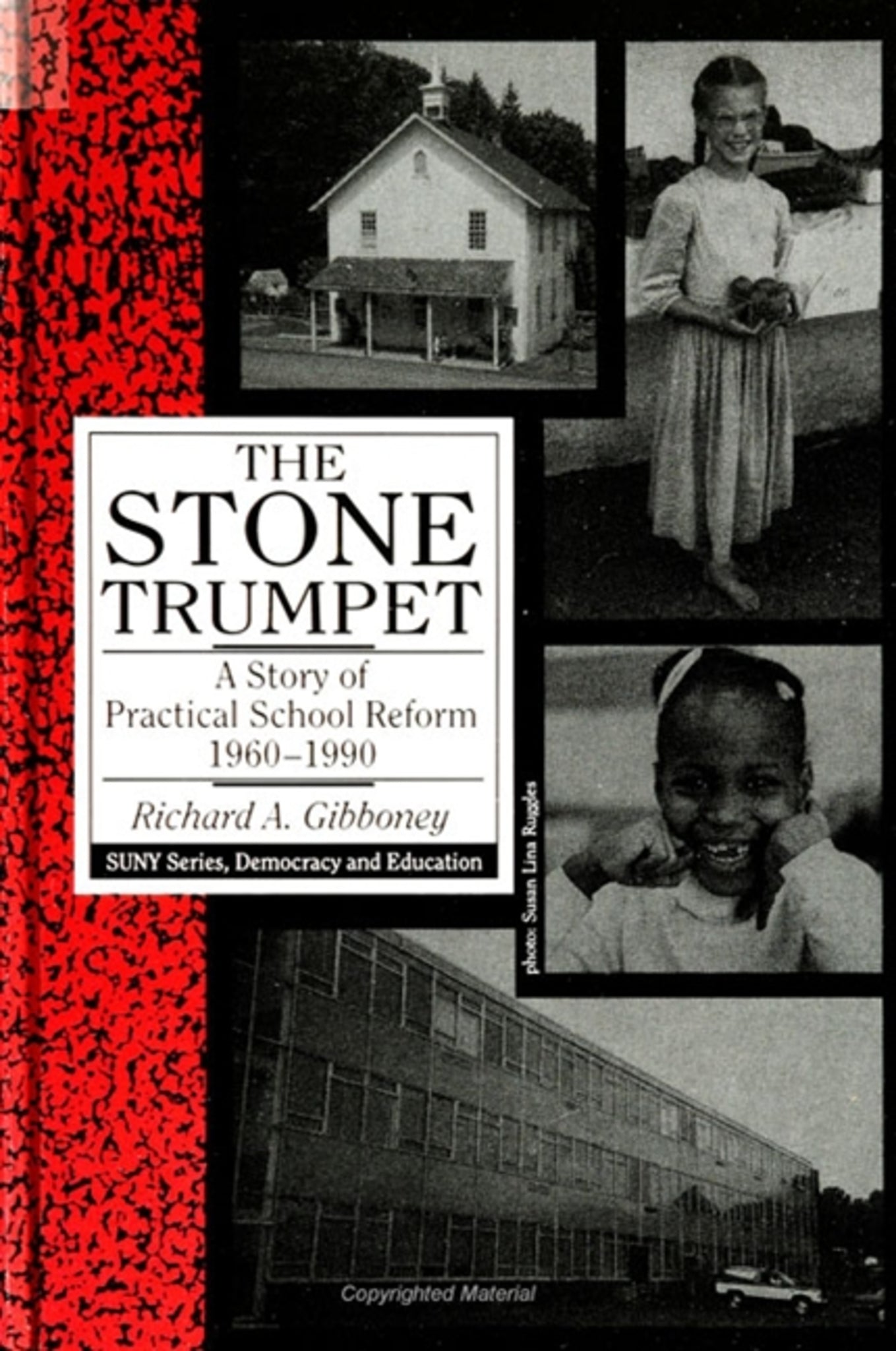
A bold, Deweyan critique of American education reform.
In a field crowded with quick fixes, federal initiatives, and technological "solutions," few works ask the harder question: what counts as genuine educational improvement in the first place?
The Stone Trumpet by Richard A. Gibboney is a bold, wide-ranging examination of American school reform across three turbulent decades. Drawing on a Deweyan-progressive framework, Gibboney challenges readers to rethink not only how reforms are implemented, but whether they are educationally worthwhile at all.
From the New Math and science reforms of the 1960s to competency-based education, Individually Guided Education, and the Coalition of Essential Schools, The Stone Trumpet offers a searching, often irreverent critique of major reform movements. It exposes how "technological" approaches to schooling can displace thoughtful judgment—and how well-intentioned reforms can fail when they lose sight of intellectual and democratic purposes.
Part history, part critique, and part philosophical inquiry, The Stone Trumpet provides richly detailed case studies and a coherent lens for evaluating decades of reform efforts.


"In the last ten years there has been much research on how to implement reforms; too little consideration has been given to what reforms are worth doing in the first place. Gibboney provides a useful Deweyan-progressive framework for assessing the educational value of reforms. The Stone Trumpet gives us insightful critiques of a wide variety of reforms from the new mathematics and science programs of the 1960s to competency-based education, Individually Guided Education and Theodore Sizer's Coalition of Essential Schools. Gibboney's chapter on a range of what he calls 'technological reforms' is especially telling for those policy makers who believe that there are easy, mechanical solutions to better learning and teaching. The Stone Trumpet is a practical book for thoughtful folk who do, think, or write about reform." — William A. Firestone, Rutgers University
"This is a lively and remarkable little history of American school reform of the last third century. I find here a searching, irreverent, and above all, no holds-barred inventory of a host of major reform efforts. Here is an inventive critique, replete with rich description coupled with thoughtful analysis not only of school reform efforts but of the very concept of school reform itself." — Roland S. Barth, Harvard University
"Gibboney's rich case-study detail and coherent theoretical perspective make this book excellent supplementary reading in courses on planned change, organizational influences on reform, and policy studies." — Bruce S. Cooper, Fordham University
Richard A. Gibboney is Associate Professor of Education in the Graduate School of Education at the University of Pennsylvania and holds the Lindback Award for distinguished teaching. He is a former public school teacher, Vermont Commissioner of Education, and Pennsylvania Deputy Secretary of Education.
List of Photographs and Photographic Essays
Foreword
Acknowledgments
1. Taking Reform Seriously: The Anger and the Tears
The Anti-reform Social Environment
the Anti-reform Educational Environment
2. Judging the Worth of Reform: A Deweyan-Progressive Perspective
Two Basic Concepts Used in This Analysis
The Intellectual and Democratic Criterion
The Technological Criterion
Three Decades of Reform
Representative Reforms 1950-1990
Overview of Reform in the 1950s
3. Reform's Green Fields
The New Mathematics and the New Science
The Trump High School
The Open Classroom
Nongraded Schools and Team Teaching
The Coalition of Essential Schools
The Paideia Proposal: A Summary
A National Prepared: A Summary
Concluding Comment on Reform's Green Fields
4. Reforms As Technology: How Technique Displaces Thought
The Promise and the Failure of Federally Funded Remedial Programs in Reading and Arithmetic
Concluding Comment on Remedial Programs
Mastery Learning Chicago Style
Concluding Comment on Mastery Learning
A Critical Review of the Research
Scientific Blues: M. Hunger's Teaching Model and the Research on Effective Teaching
What it All Means
Concluding Comment on the Hunger Model and the Research on Effective Teaching
Technological Curriculums: Moving Backward into the Future
5. How Teachers' and Principals' Ideas Defined the Quality of a Major Reform
The Real Stuff? Individually Guided Education in Adopting Schools
Individually Guided Education in Three Traditional Schools: What Does it Mean?
Individually Guided Education in a Progressive School
Hoes Does IGE Influence a Progressive School?
Flowing Brook: A School without Laughter
How Good is Individually Guided Education as a Reform?
6. Like a Tree Planted by Water
Rain in Sunny California: Five Inferences about Reform
What to Do about Reform Gridlock
The Structure of the Dialogue
The Dialogue's Dynamic Qualities: Gladwyne Elementary School
The Doxology
Appendixes
A. Toward a More Thoughtful School: Twenty-one Deweyan Criteria
B. General Comment
"In this Land of Dolts... " Competency-Based Education
Individually Prescribed Instruction in Reading and Arithmetic
Thinking Skills: CoRT and Instrument Enrichment
C. General Comment
Performance Contracting: The Psychological-Industrial Complex
The Enfeebled Research-Development-Diffusion Model
The Effective Schools Research
Assertive Discipline
Accountability and State Testing Programs
Aligning the Curriculum to the Test
Notes
Selected Bibliography
Index