





Some error occured while loading the Quick View. Please close the Quick View and try reloading the page.
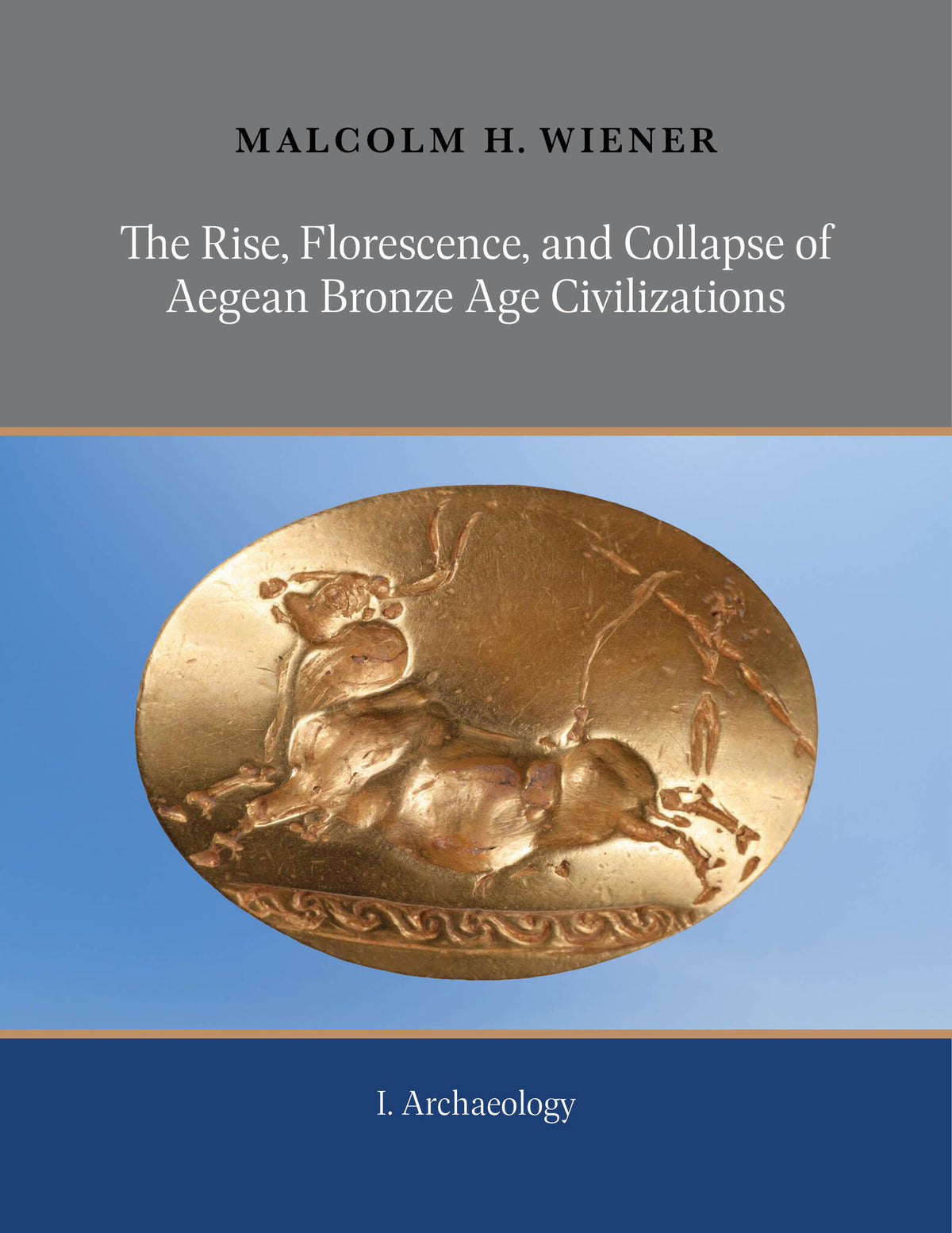
This publication presents the collected scholarly contributions of Malcolm H. Wiener on the subjects of Aegean, Egyptian, and Near Eastern Bronze Age archaeology, chronology, and the collapse of civilizations. The papers in volume I span over forty years (1984–2025) and cover a range of archaeological topics. A prominent theme is the nature and extent of the Minoan thalassocracy, with emphasis on the importance of acquiring metals for Minoan palatial society and the use of ritual to secure influence and power. The realities of such power (warfare, conquest, slavery), Wiener contends, are supported by wide-ranging research in the history of the Mediterranean and by an array of archaeological evidence. Various chapters argue for the preeminence of the palace at Knossos on Crete and its leading role in Minoan diplomatic ties and trade contacts with Cyprus, Egypt, and the Levant. Wiener’s influential concept of the “Versailles Effect”—the development of Mycenaean civilization through the adoption and adaptation of many aspects of Minoan elite culture—is another topic explored. Accounts of Mycenaean palatial society, including the Mycenaean conquest of Crete, international relations, administration and industry, and legacy for later Greece, are highlighted. Several chapters strike a reflective tone and focus on the history, current state, and future of the field of Aegean prehistory.

Price: £95.00
Pages: 845
Publisher: INSTAP Academic Press
Imprint: INSTAP Academic Press
Publication Date:
31 January 2027
ISBN: 9781931534475
Format: Hardcover
BISACs:

Malcolm H. Wiener is the Founder of the Institute for Aegean Prehistory and Chairman Emeritus of the Board of Trustees of the American School of Classical Studies at Athens. He is author of over 50 works on Aegean prehistory, interconnections between Aegean civilizations and those of Egypt and the Near East, the chronology of the ancient Mediterranean world, and the collapse of civilizations.
1. Introduction (Archaeology); 2. Crete and the Cyclades in LM I: The Tale of the Conical Cups; 3. Late Minoan III Knossos Outside the Palace: Another Approach to the Tablet/Destruction Date Debate; 3. The Absolute Chronology of Late Helladic IIIA:2; 4. Trade and Rule in Palatial Crete; 5. Round-Table Comments; 6. The Isles of Crete? The Minoan Thalassocracy Revisited; 7. The Nature and Control of Minoan Foreign Trade; 8. Present Arms / Oars / Ingots: Searching for Evidence of Military or Maritime Administration in LM IB; 9. Pots and Polities; 10. Palatial Potters in Mycenaean Greece; 11. Homer and History: Old Questions, New Evidence; 12. Neopalatial Knossos: Rule and Role; 13. Locating Ahhiyawa; 14. The Homer Encyclopedia: Blegen, Evans, and Mycenae; 15. Conical Cups: From Mystery to History; 16. Contacts: Crete, Egypt, and the Near East ca. 2000 b.c.; 17. Realities of Power: The Minoan Thalassocracy in Historical Perspective; 18. The Mycenaean Conquest of Minoan Crete; 19. The Scientific Study of Antiquity; 20. Aegean Warfare at the Opening of the Late Bronze Age in Image and Reality; 21. Beyond the Versailles Effect: Mycenaean Greece and Minoan Crete; 22. Helladic Pairs of Cups; 23. The Mycenaean World and Homer; 24. Helladic Greece from the Middle Bronze Age to ca. 1350 b.c.; 25. The Contribution of Archaeological Science to the Study of Animals in Aegean Prehistory; 26. The Fateful Century: From the Destruction of Crete ca. 1450–1440 to the Destruction of Knossos ca. 1350–1340; 27. Minoan Colonization; 28. Processions Aplenty: From Elite Palatial Parades to Mass Population Pilgrimages in Middle and Late Minoan Crete; 29. Late Bronze Age Aegean Seaports, in Particular Nafplion; 30. Between the Eruption of Thera and the Helladic Conquest of Crete: Known Unknowns; 31. Minoan and Cypro-Minoan: “Linguae Francae”?; 32. On Time: An Introduction; 33. Separate Lives: The Ahmose Tempest Stela and the Theran Eruption; 34. The Absolute Chronology of Late Helladic IIIA:2; 35. The White Slip I of Tell el-Daba and Thera: Critical Challenge for the Aegean Long Chronology; 36. The Absolute Chronology of Late Helladic IIIA:2 Revisited; 37. Report on the Final General Discussion: Introductory Remarks; 38. Time Out: The Current Impasse in Bronze Age Archaeological Dating; 39. Chronology Going Forward (With a Query about 1525/24 B.C.); 40. Egypt & Time; 41. Times Change: The Current State of the Debate in Old World Chronology; 42. Cold Fusion: The Uneasy Alliance of History and Science; 43. The State of the Debate About the Date of the Theran Eruption; 44. Problems in the Measurement, Calibration, Analysis, and Communication of Radiocarbon Dates (with Special Reference to the Prehistory of the Aegean World); 45. Radiocarbon Dating of the Theran Eruption; 46. Dating the Emergence of Historical Israel in Light of Recent Developments in Egyptian Chronology; 47. Dating the Theran Eruption: Archaeological Science Versus Nonsense Science; 48. Oh, No—Not Another Chronology!; 49. The Significance of Recent Developments in Egyptian Chronology for the Absolute Chronology of Late Helladic I–III and the Middle, Recent, and Final Bronze Age Chronology of Italy; 50. The Dating Game: The History and Present State of the Controversy Concerning the Date of the Theran Eruption; 51. Dating Events and Objects in the Aegean Bronze Age; 52. On Collapse: An Introduction; 53. Cretan Connections: External Actors and Factors During the Bronze Age; 54. Gaps, Destructions, and Migrations in the Early Bronze Age Aegean: Causes and Consequences; 55. The Interaction of Climate Change and Agency in the Collapse of Civilizations ca. 2300-2000 B.C.; 56. Causes of Complex Systems Collapse at the End of the Bronze Age; 57. The Collapse of Civilizations; 58. The Population and Depopulation of Late Minoan Crete; 59. Picasso and the Cuban Missile Crisis