





Some error occured while loading the Quick View. Please close the Quick View and try reloading the page.
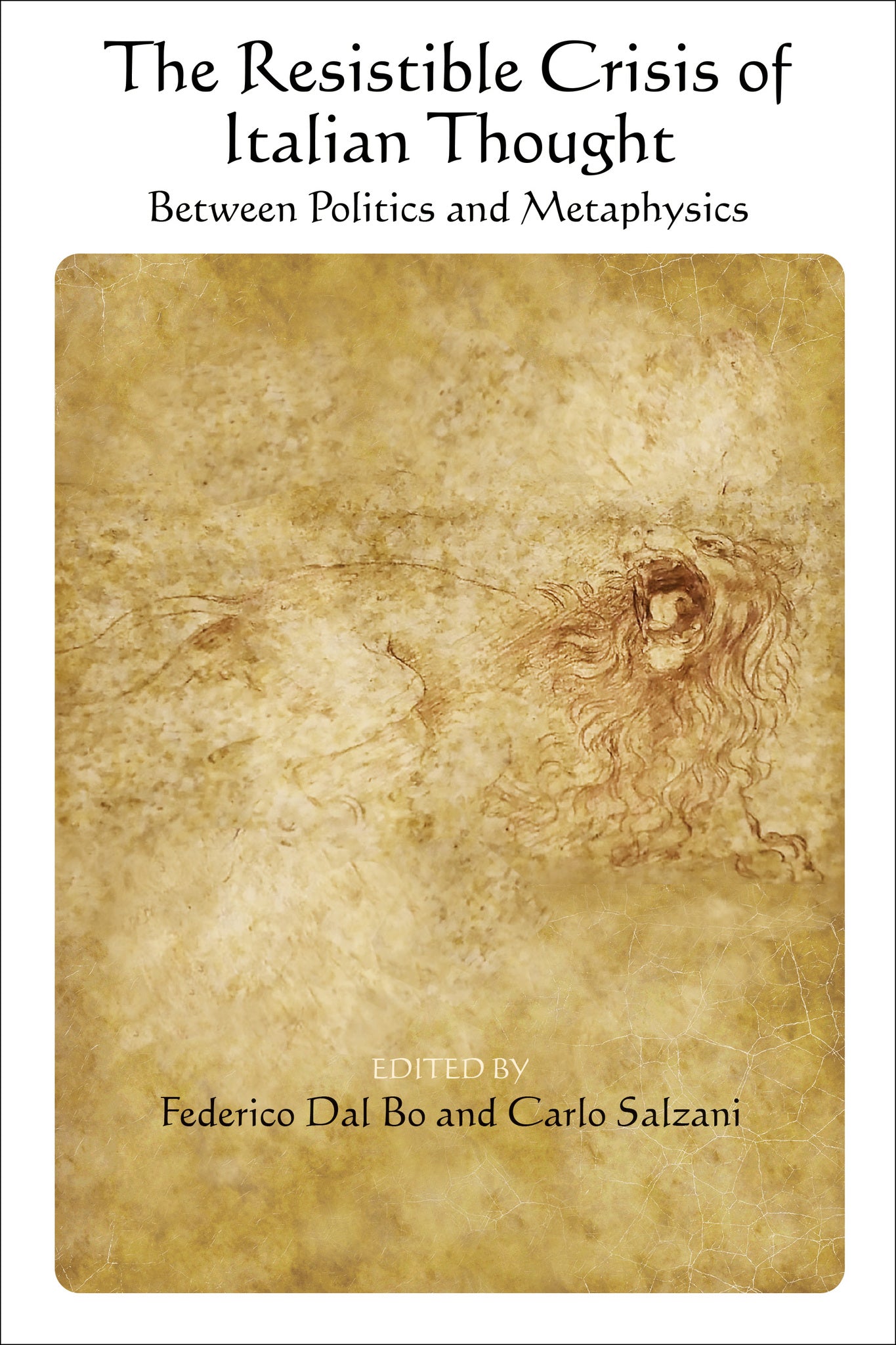
Offers a more complex picture of Roberto Esposito's notion of "Italian Thought" in order to examine the persisting crisis of contemporary Italian philosophy.
The present volume intends to offer new insight into Roberto Esposito's seminal notion of "Italian Thought." In Esposito's understanding, Italian Thought would offer an innovative bridge between French and German philosophy. As distinguished from French postmodernism and German transcendentalism in communication ethics, Italian Thought would allow for a better negotiation between power, history, and life. The essays within The Resistible Crisis of Italian Thought do not share Esposito's optimism but rather argue that the fascinating notion of Italian Thought unfortunately only provides a selective representation and neglects several portions of it, such as Italian metaphysicians, political scientists, feminists, and art theorists. Motivated by the ambition to address this neglect and to offer a more complex insight that does not necessarily end with the reassuring representation offered by Esposito, this volume points us toward an examination of the persisting crisis of contemporary Italian philosophy.


"The Resistible Crisis of Italian Thought makes a significant contribution to the study of Italian philosophy, notably by critically engaging with the dominant framework established by Roberto Esposito. The volume's individual chapters examine Italian political and metaphysical thought through a diverse array of themes, including political praxis, ontological personalism, biopolitics, aesthetics, and feminism. In doing so, it presents Italian philosophy as a more nuanced and pluralistic field than Esposito's framing allows." — Paolo Diego Bubbio, University of Turin
Federico Dal Bo is Senior Lecturer at the University of Modena and Reggio Emilia, Italy. He has published many books, including Judaism, Philosophy, and Psychoanalysis in Heidegger's Ontology: Harrowing the Heath. Carlo Salzani is Research Fellow at the Messerli Research Institute of Vienna. He is the author and editor of many works, including Agamben and the Animal.
Introduction: Complicating the Paradigm(s)
Federico Dal Bo and Carlo Salzani
Part 1 Metaphysics and Politics
1. The Society Without Government and the Recovery of Political Praxis: Alessandro Biral Between Crisis and Politics
Ivan Dimitrijevic´
2. Discomfort in the Italian Operaism: The Nietzschean Legacy in the Work of Nicola Massimo De Feo
Roberto Nigro
3. A Marxian Political Theology of Nihilism: Costanzo Preve and Domenico Losurdo on Marx's Historical Materialism
Federico Dal Bo
4. Ontological Personalism in Luigi Pareyson's Political Thought
Emanuele Curcio
5. Is Metaphysics Totalitarian? First Remarks on Politics and Metaphysics in Emanuele Severino
Antimo Lucarelli
Part 2 Metaphysics, Aesthetics, and Beyond
6. Italian Theory as Italian Cultural Studies: A Genealogical Perspective
Antonio Lucci
7. A Situationist in the Years of Lead: Gianfranco Sanguinetti's Theory of the State
Mia Gonan
8. An Inorganic Intellectual: Mario Perniola and the Aesthetic Horizon
Enea Bianchi
9. Against Emancipation and Revolution: Carla Lonzi's Feminist Political Theory
Olivia Guaraldo
10. Adriana Cavarero's Public Ethics of Care: Plural Uniqueness, Narratability, Vulnerability
Valentina Moro
Part 3 Metaphysics and Life
11. Use Without Care? Feminist Cautions Against Agamben's Call for "Politics as Intimacy"
Lucile Richard
12. The Crisis of a Paradigm: Agamben's Misunderstanding of the COVID-19 Pandemic
Carlo Salzani
13. Competitive Narratives of Life in Italian Thought: Affirmative Biopolitics as a New Humanism?
Oana S,erban
14. What the Thought Does Not Think: Roberto Esposito and Massimo Donà on Negation
Michele Ricciotti
Contributors
Index