





Some error occured while loading the Quick View. Please close the Quick View and try reloading the page.
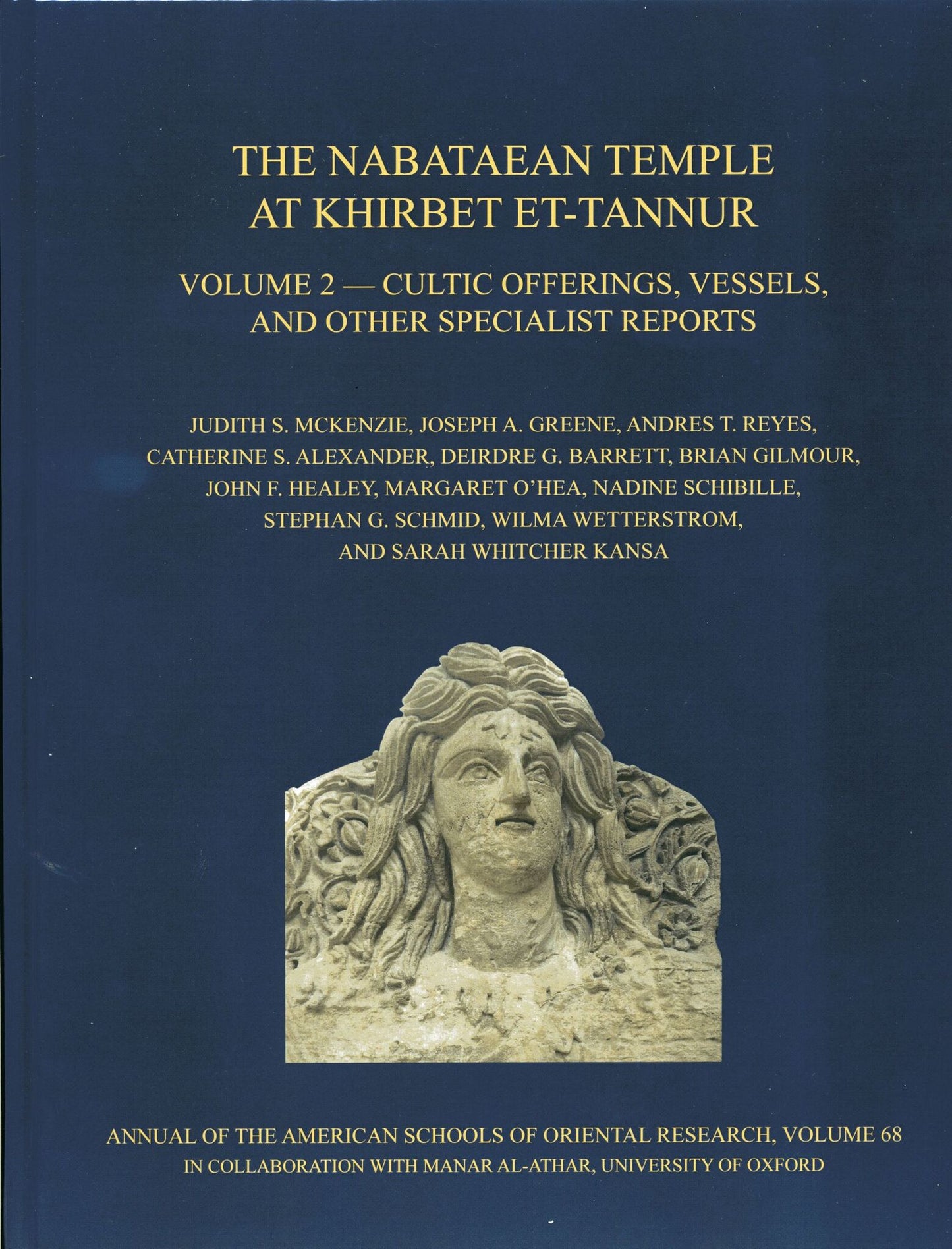
Khirbet et-Tannur is a Nabataean site dating from the second century B.C. to the fourth to sixth centuries A.D. located on a hilltop above the Wadi el-Hasa near Khirbet edh-Dharih, 70 km north of Petra along the King’s Highway. In 1937, Nelson Glueck excavated Khirbet et-Tannur on behalf of the American Schools of Oriental Research and the Department of Antiquities of Transjordan, but died before completing a final report. Now, in two extensively illustrated volumes, the results of Glueck’s excavations are finally published, based on previously unstudied excavation records and archaeological materials in the ASOR Nelson Glueck Archive at the Semitic Museum, Harvard University.
Volume 2 offers a systematic reorganization of Glueck’s original excavation records and presents detailed specialist analyses of the Khirbet et-Tannur faunal and botanical remains, metal, glass, lamps and pottery collected by Glueck in 1937 and now preserved in Semitic Museum’s ASOR Nelson Glueck Archive, along with fresh examinations of the Nabataean inscriptions and altars from the site.
Annual of ASOR 68


'Rarely has this reviewer seen so useful and attractive an excavation report. This is all the more impressive because of the viscissitudes of attempting to integrate the evidence for an excavation of 80 years ago, performed under the strictures of that era and whose records and material cultuire are widely dispersed, with teh present state of the site - an immense task admirably performed by the principla investigator and her colleagues. The hundreds of plans and illustrations, both contemporary and historic and many in color, enhance the report. The nbarrative is clear, concise and informative, and the cataloges are useuful but not intrusive. This is a model publication about a little-known yet essential part of teh ancinet world, revealing a aite whose interpretation has languished for half a century.'
Duane W. Roller, American Journal of Archaeology, Vol 120 No 3 (July 2016)
'All these studies are extremely useful because they make an enormous amount of old and often unknown material available to scholars, not only those interested in the Nabataeans but also those interested in the ancient Middle East in general, in religion and rituals, in technology and in various sorts of archaeological material.
'The enormous number of documents studied by the authors, their nature (an archive), and the fact that the excavation took place more than seventy years ago added to the complexity of the project and made this publication a real tour de force.' (Laila Nehme, Bryn Mawr Classical Review, June 2015)
Judith S. McKenzie won the Archaeological Institute of America Wiseman Book Award for The Architecture of Alexandria and Egypt, 300 B.C.–A.D. 700 (Pelican History of Art, Yale University Press, 2007). She was University Research Lecturer in Oriental Studies, University of Oxford, and Director of the Khirbet et-Tannur project.
Joseph A. Greene is Deputy Director and Curator of the Semitic Museum, Harvard University, and Series Editor of the Annual of the American Schools of Oriental Research.
Andres T. Reyes is member of Wolfson College, Oxford. He is an archaeologist who teaches Greek and Latin at Groton School. He is the author of Archaic Cyprus (Oxford University Press) and editor of C. S. Lewis’s Lost Aeneid (Yale University Press).
Catherine S. Alexander is an archaeological artist for the Archaeological Expedition to Sardis (Turkey), Harvard University.
Deirdre G. Barrett is a Research Associate of the Semitic Museum, Harvard University, and a specialist in ancient lamps.
Brian Gilmour is a metallurgist at the Research Laboratory for Archaeology and the History of Art, University of Oxford.
John F. Healey is Professor of Semitic Studies at Manchester University.
Margaret O’Hea is Senior Lecturer in Classics, University of Adelaide (Australia).
Nadine Schibille is Lecturer in Byzantine at History, University of Sussex (England), and was a research chemist at the Research Laboratory for Archaeology and the History of Art, University of Oxford.
Stephan G. Schmid is Professor of Classical Archaeology at the Winckelmann-Institut, Humboldt University, Berlin.
Wilma Wetterstrom is Research Associate in Botany in the Harvard University Herbaria.
Sara Whitcher Kansa is Executive Director of the Alexandria Archive Institute (Berkeley, CA), Editor of Open Context, and a specialist in zooarchaeology.
Contributors
Kate da Costa is Honorary Research Affiliate in Archaeology, University of Sydney, and a specialist in ancient lamps.
Patrick Degryse is Research Professor of Earth and Environmental Sciences at the Geology Centre for Archaeological Sciences, University of Leuven (Belguim).
The late Sheila Gibson was an archaeological artist best-known for her reconstruction drawings in J. B. Ward-Perkins’ Roman Imperial Architecture.
Owen Gingerich is Professor Emeritus of Astronomy and History of Science at Harvard University.
Elias Khamisis Research Associate in Classics, University of Oxford, and a specialist in ancient metal work.
Preface
PART 2: EXCAVATION RECORDS
6 Re-establishment of Loci from Glueck’s Excavation Records Judith S. McKenzie
Locations of Stone Architectural Fragments, Sculpture, Cult Statues, Altars, and Inscriptions
Locations of Other Finds (Pottery, Lamps, Glass, Metals, Animal Bones, Plants, and Gypsum)
Records in the Glueck Archive
Photographs in the Glueck Archive
Records in Jerusalem, Amman, and Cincinnati
Numbering System for Glueck Archive Units
Loci and Standardization of Names of Find-Locations
7 Glueck’s Excavation Journal
8 Glueck’s Registration Book
PART 3: SPECIALIST REPORTS
9 The Nabataean Inscriptions John F. Healey
10 The Altars Andres T. Reyes and Judith S. McKenzie
11 The Animal Bones Sarah Whitcher Kansa
12 The Plant Remains Wilma Wetterstrom
13 The Metals Judith S. McKenzie, Elias Khamis, and Andres T. Reyes
14 Ultra-high Carbon Steel Door Hinge: Microstructural Analysis Brian Gilmour
15 The Glassware: Typological Analysis Margaret O’Hea
16 The Glassware: Chemical Analysis Nadine Schibille and Patrick Degryse
17 The Lamps Deirdre G. Barrett
18 The Pottery Stephan G. Schmid, Catherine S. Alexander, and Judith S. McKenzie
Sources of Illustrations
Index