





Some error occured while loading the Quick View. Please close the Quick View and try reloading the page.
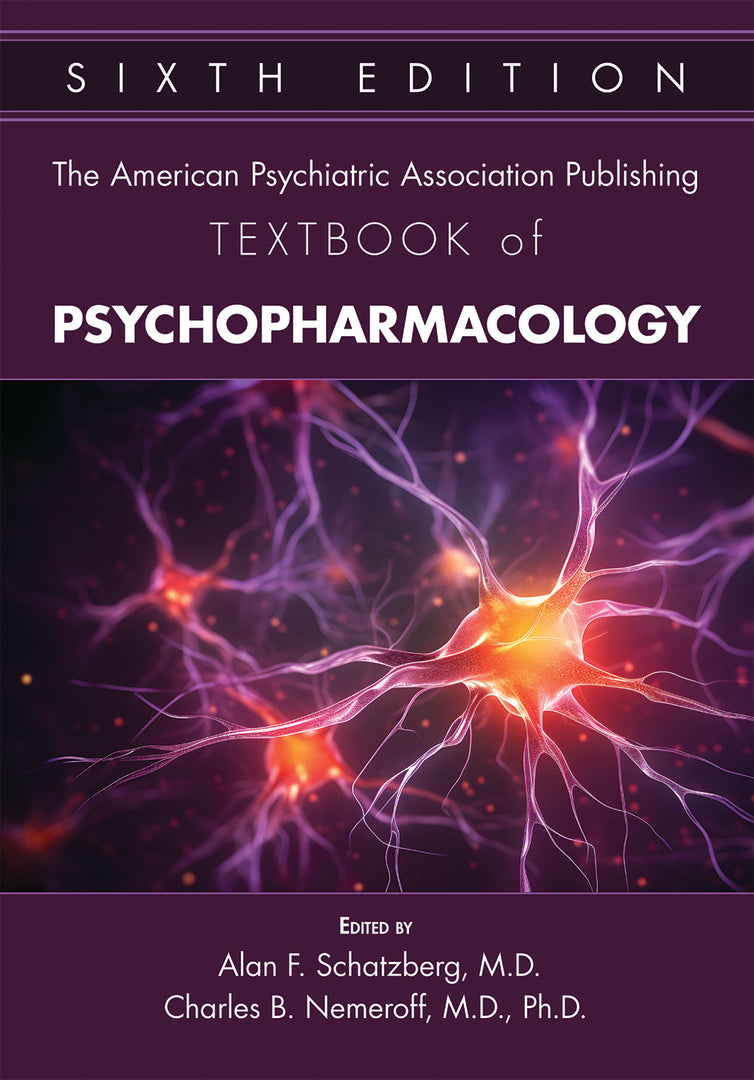
More than 160 authors—including more than 75 new contributors—lent their expertise to this sixth edition of The American Psychiatric Association Publishing Textbook of Psychopharmacology. Featuring 12 all-new chapters and fully aligned with the revised DSM-5-TR classification, this two-volume text offers an unrivaled, in-depth look at the rapidly evolving field of neuropsychopharmacology.
The opening chapters provide a whirlwind tour of the multiple disciplines that undergird the chapters to come, with topics extending from the principles of molecular biology and genomics to the rudiments of neuroimaging and personalized medicine in psychiatry. The main body of the Textbook features an examination of the medication classes that form the basis of psychopharmacological treatment. For each drug within a class, data are reviewed on history and discovery, preclinical and clinical pharmacology, pharmacokinetic parameters, mechanism of action, indications and efficacy, side effects and toxicology, and drug-drug interactions. The Textbook's second volume focuses on psychopharmacological approaches to treatment of patients with major psychiatric disorders (e.g., mood and anxiety disorders, schizophrenia, substance use disorders) as well as patients in specific populations (e.g., adults with ADHD, pediatric patients). For each specific condition, patient population, or setting, chapters provide guidance on topics such as medication selection, combination and maintenance dosing regimens, side-effect monitoring and management, and optimization of treatment response. Closing this volume is an Appendix of Psychiatric Medications with key information on each of the agents covered in the Textbook, presented in a convenient tabular format.
Noteworthy additions to this textbook include chapters addressing the following topics:
• The potential roles of
personalized medicine in psychiatry and of artificial intelligence and
machine learning in psychopharmacology
• New medications with novel
pharmacological mechanisms, including the neurosteroid antidepressant
brexanolone and the atypical antipsychotic pimavanserin
• Use of
investigational agents, such as psychedelics, in psychiatric treatment
•
Treatment of alcohol use disorder, PTSD, OCD, and autism spectrum
disorder
• Treatment of ADHD in adults
• Treatment of women in all
life phases, including during pregnancy and the postpartum period
•
Treatment of individuals with intellectual developmental disorder
With a level of detail not found in any other source, this new edition of The American Psychiatric Association Publishing Textbook of Psychopharmacology illuminates the path to effective evidence-based practice of psychopharmacology for novice and seasoned clinicians alike.


While there are many psychopharmacology texts on the market, few are as comprehensive or as authoritative as this book. The text's inclusion of updated chapters, which address DSM-5-TR updates, renders it both timely and invaluable to practicing clinicians.
— Timothy J. Legg, PhD, PsyD, MSN, PMHNP-BC
Alan F. Schatzberg, M.D., is Kenneth T. Norris Jr. Professor in the Department of Psychiatry and Behavioral Sciences at Stanford University School of Medicine in Stanford, California, where from 1991 to 2010 he was also Chair of Psychiatry. He is currently Director of the Stanford Mood Disorders Center.
Charles B. Nemeroff, M.D., Ph.D., is Matthew P. Nemeroff Professor and Chair of the Department of Psychiatry and Behavioral Sciences, Mulva Clinic for the Neurosciences; Director of the Institute of Early Life Adversity Research; and Co-Director of the Center for Psychedelic Research and Therapy at the Dell Medical School of The University of Texas at Austin.
Contents Contributors
Introduction
PART I
Principles of Pharmacology
Chapter 1. Basic Principles of Molecular
Biology and Genomics
Chapter 2. Neurotransmitters, Receptors, and
Transporters
Chapter 3. Genetics and Epigenetics
Chapter 4.
Psychoneuroendocrinology
Chapter 5. Brain–Immune System Interactions
Chapter 6. Pharmacokinetics, Pharmacodynamics, and
Pharmacogenomics
Chapter 7. Neuroimaging and Psychiatry
Chapter 8.
Personalized Medicine in Psychiatry
Chapter 9. Machine Learning in
Psychopharmacology
Chapter 10. Monoamine Oxidase
Inhibitors.
Chapter 11. Tricyclic and Tetracyclic Drugs
Chapter 12.
Fluoxetine and Fluvoxamine
Chapter 13. Sertraline and
Paroxetine
Chapter 14. Citalopram and Escitalopram
Chapter 15.
Trazodone and Nefazodone
Chapter 16. Vortioxetine
Chapter 17.
Mirtazapine
Chapter 18. Bupropion
Chapter 19. Venlafaxine and
Desvenlafaxine
Chapter 20. Duloxetine, Milnacipran, and
Levomilnacipran
Chapter 21. Ketamine and Esketamine
Chapter 22.
Benzodiazepines
Chapter 23. Buspirone
Chapter 24. Brexanolone and
Other Neurosteroids
Chapter 25. Classic Antipsychotic
Medications
Chapter 26. Clozapine
Chapter 27.
Olanzapine
Chapter 28. Quetiapine
Chapter 29. Risperidone and
Paliperidone
Chapter 30. Aripiprazole and Brexpiprazole
Chapter 31.
Ziprasidone and Asenapine
Chapter 32. Iloperidone
Chapter 33.
Lurasidone
Chapter 34. Cariprazine
Chapter 35. Pimavanserin
Chapter 36. Management of Psychiatric Medication–Induced Movement
Disorders
Chapter 37. Lithium
Chapter 38. Valproate
Chapter 39.
Carbamazepine, Oxcarbazepine, and Licarbazepine
Chapter 40. Gabapentin
and Pregabalin
Chapter 41. Lamotrigine
Chapter 42.
Topiramate
Chapter 43. Agents for Cognitive Disorders
Chapter 44.
Sedative-Hypnotics
Chapter 45. Psychostimulants and
Wakefulness-Promoting Agents
Chapter 46. Electroconvulsive Therapy and
Other Neuromodulation Therapies
Chapter 47. Psychedelic Drugs as
Treatments in Psychiatry
PART III Psychopharmacological Treatment
Chapter 48. Treatment of Depression
Chapter 49. Treatment of
Bipolar Disorder
Chapter 50. Treatment of Anxiety and Related Disorders
Chapter 51. Treatment of Posttraumatic Stress Disorder
Chapter 52.
Treatment of Obsessive-Compulsive Disorder
Chapter 53. Treatment of
Schizophrenia
Chapter 54. Treatment of Substance Use
Disorders
Chapter 55. Treatment of Alcohol Use Disorder
Chapter 56.
Treatment of Personality Disorders
Chapter 57. Treatment of Eating
Disorders
Chapter 58. Treatment of Insomnia
Chapter 59. Treatment
of Chronic Pain
Chapter 60. Treatment of Child and Adolescent
Disorders
Chapter 61. Treatment During Late Life
Chapter 62.
Treatment of Women Excluding Pregnancy and Postpartum
Chapter 63.
Treatment of Women During Pregnancy and Lactation
Chapter 64. Treatment
of Attention-Deficit/Hyperactivity Disorder in Adults
Chapter 65.
Treatment of Individuals With Intellectual Developmental
Disorder
Chapter 66. Treatment of Autism Spectrum Disorder
Chapter
67. Treatment of Psychiatric Emergencies.
Appendix
Psychiatric
Medications
Index