





Some error occured while loading the Quick View. Please close the Quick View and try reloading the page.
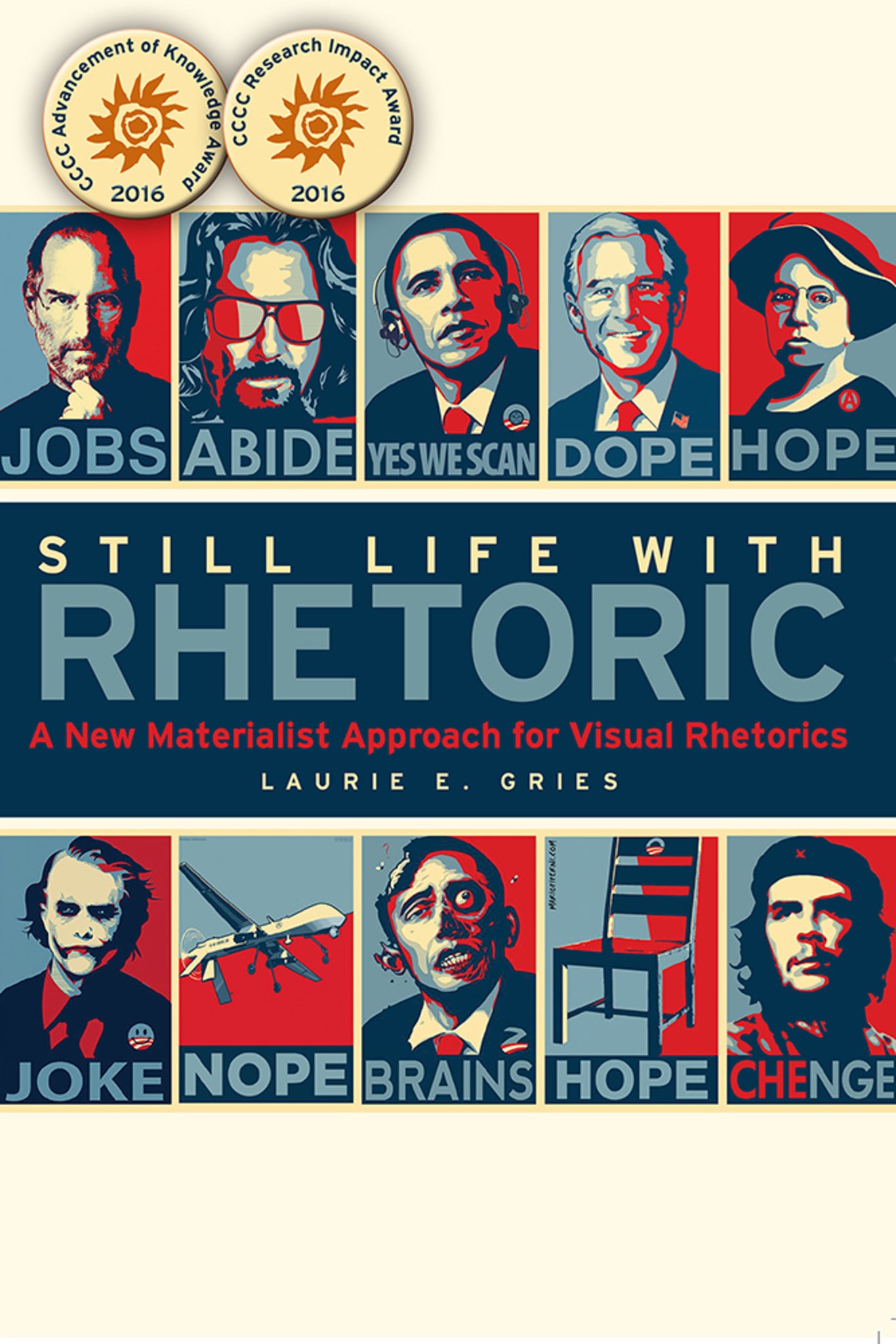
In Still Life with Rhetoric, Laurie Gries forges connections among new materialism, actor network theory, and rhetoric to explore how images become rhetorically active in a digitally networked, global environment. Rather than study how an already-materialized “visual text” functions within a specific context, Gries investigates how images often circulate and transform across media, genre, and location at viral rates. A four-part case study of Shepard Fairey’s now iconic Obama Hope image elucidates how images reassemble collective life as they actualize in different versions, enter into various relations, and spark a firework of activity across the globe.
While intent on tracking the rhetorical life of a single, multiple image, Still Life with Rhetoric is most concerned with studying rhetoric in motion. To account for an image’s widespread circulation and emergent activities, Gries introduces iconographic tracking—a digital research method for tracing an image’s divergent rhetorical becomings. Yet Gries also articulates a dynamic set of theoretical principles for studying rhetoric as a distributed, generative, and unforeseeable event that is applicable beyond the study of visual rhetoric. With an eye toward futurity—the strands of time beyond a thing’s initial moment of production and delivery—Still Life with Rhetoric intends to be taken up by those interested in visual rhetoric, research methods, and theory.


—Composition Studies
"[B]oth a rich case study and a theorized yet empirical methodology for creating new materialist rhetorical scholarship."
—College Composition and Communication
—Present Tense
"A well measured and deeply intriguing adventure into the impossible. . . . Gries, in this foray into the tangled web of public discourse and policy, has found a way to make the impossible, assailable."
—Computers and Composition Online
"Still Life... brings the reader closer to increasingly important posthuman, new materialist theoretical perspectives. But Gries is not satisfied to let theory stand alone; she also effectively brings these abstract principles to life and illuminates their practical, real-world ramifications."
—Technical Communication Quarterly
Laurie E. Gries is assistant professor in the Department of Communication and Program for Writing and Rhetoric at the University of Colorado-Boulder, where her courses focus on writing, rhetoric, and new media with a particular emphasis on theory and research.