





Some error occured while loading the Quick View. Please close the Quick View and try reloading the page.
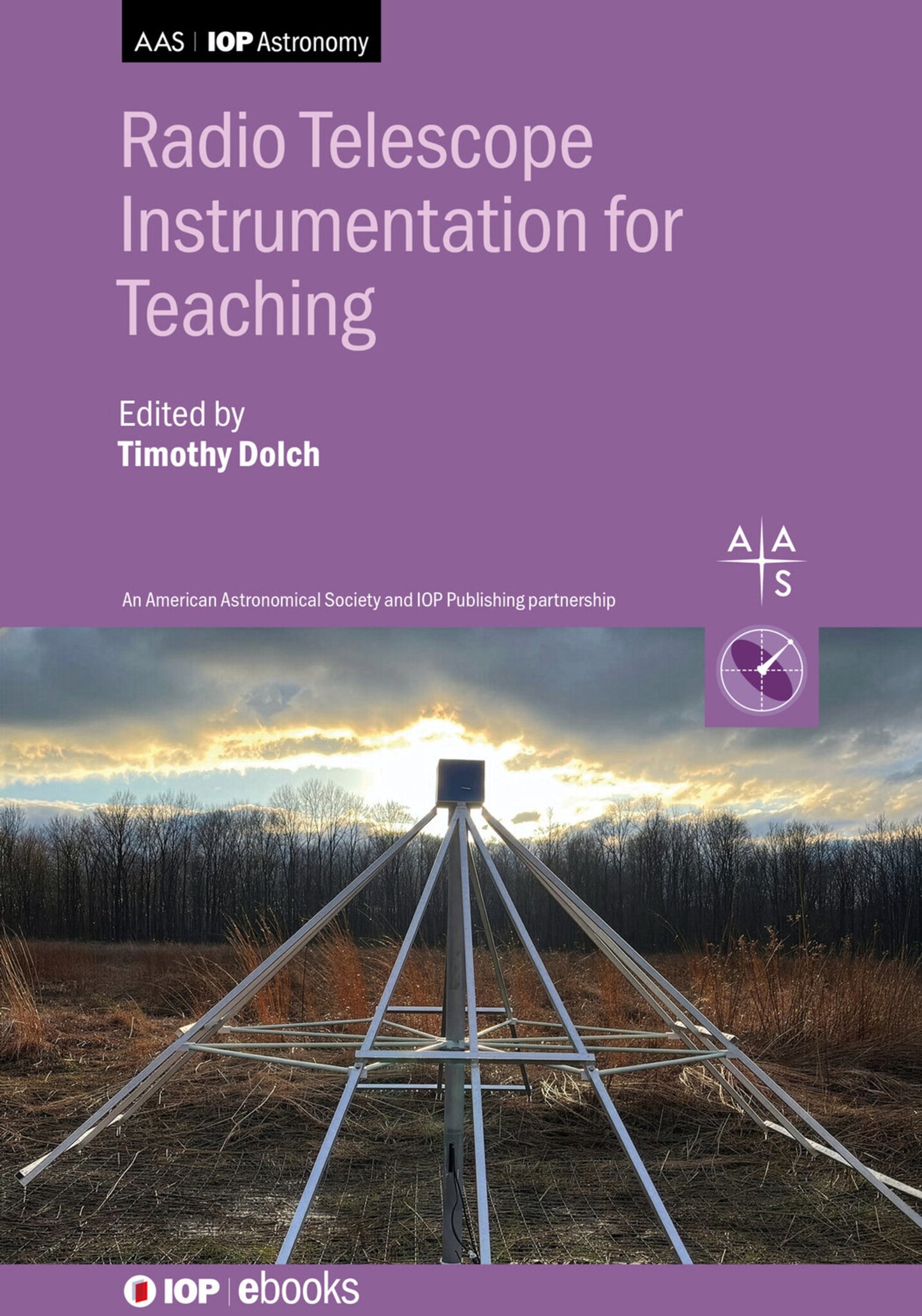
The book will provide detailed descriptions of radio astronomy instrumentation projects that have fared well in the classroom and/or in student research experiences. The projects will be easily replicable or directly accessible to the larger community. The focus of the book will be on undergraduate education, but the content will also have relevance for high-school education and for the amateur astronomy world. The target audience is researchers working with undergraduates, or other educational professionals working with students, who already have a basic familiarity with radio astronomy and radio telescopes. The text, then, is for educators, but not a textbook for the students involved in their research projects. For pedagogically-minded faculty who wish to embark on a radio astronomy instrumentation project in a lab course or in a summer research setting, it can be difficult to know where to start – as opposed to a more common laboratory procedure like setting up a laser experiment on an optical bench. Of course, radio telescope kits exist, but frequently change and/or become difficult to acquire. For those standalone systems, detailed descriptions will be presented in the text beyond what is currently publicly available, with procedures applicable beyond the immediately showcased telescopes.
Key Features:
- First book dedicated to developing radio astronomy projects in the classroom
- Gives the instructor a starting point for a variety of classroom projects
- Describes how rapid advances in computing have enabled locally-built radio telescopes to be accessible to undergraduate students
- Contains case studies, Jupyter notebooks and Interactive circuit diagrams


- Introduction
I. Standalone systems for the classroom - Solar Radiometry, HI Spectroscopy, and Galactic Kinematics Using a Small-Dish Radio Telescope
- BHARAT Setup for HI Pedagogy: The Radiometer
- BHARAT Setup for HI Pedagogy: HI Astrophysics
II. Local Stations That Are Part of Larger Network or Project - Hydrogen Map of Our Milky Way
- The Radio JOVE Project
III. Large facilities/missions that include student participation in instrumentation - The Long-Wavelength Array
- An Introduction to Solar Radio Bursts
- The Sun Radio Interferometer Space Experiment and Student-led Ground-based Observations
IV. Innovative Methods to Use across Various Radio Astronomy Teaching Projects - Interferometry with DLITE
- The Low-Frequency All-Sky Monitor