





Some error occured while loading the Quick View. Please close the Quick View and try reloading the page.
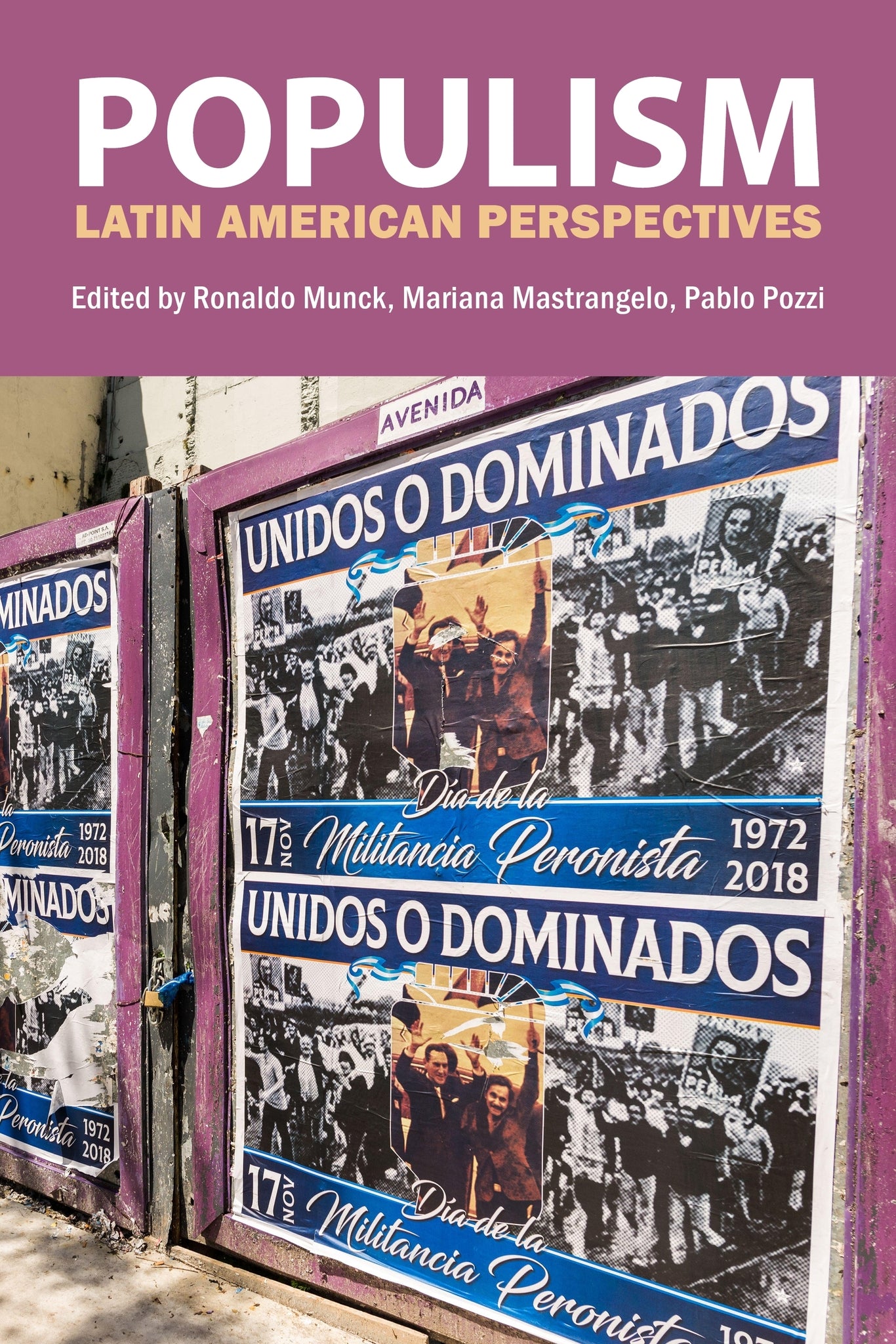
Populism has become one of the most overused terms in political discourse today. It can embrace authoritarian and nativist right-wing politicians but also those on the left who appeal for popular support for transformation. In its dominant usage it is seen as inimical to the values of liberal democracy. Yet others see it as part of the construction of a people-centred project that can realize true democracy.
What is clear is that much of the debate around populism has been from the perspective of the global North and the voice of the South has been largely missing. This volume addresses this absence and provides a Latin American perspective to the global study of populism.
It argues that Latin America in its rich and early experience of populism is a valuable laboratory to further our understanding and to address the question of whether populism now goes beyond the dichotomy of left and right and is a new political phenomenon.
The book presents a series of case studies with cross-cutting overview chapters that highlight the lessons to be learned from new research. Each chapter is set within a tight conceptual framework in order to better understand contemporary Latin American politics “after the pink tide” and to enrich the international debate on populism from a Latin American perspective.


This book makes a crucial point: Latin America’s long history of populism cannot be forgotten or brushed aside. This is true for both theoretical and empirical studies that aim at influencing global discussions or understandings of populism. As in so many areas of politics and International Relations, more attention needs to be given to the non-western world when it comes to understanding political phenomena.
— International Affairs
In a time where work on populism has become increasingly Euro- and US-centric, this excellent volume very welcomely restores Latin America to its rightful place at the centre of the analysis of populism. With a wide range of case studies, this book refuses to settle for easy answers when it comes to populism’s relationship to democracy, and as such, offers an important and nuanced counterpoint to much commentary on the phenomenon today.
— Benjamin Moffitt, Australian Catholic University
An ambitious effort to identify and analyze the disparate strands of populism in Latin America, utilizing country case studies, drawing on classical and contemporary forms, distinguishing right and left tendencies, and delving into theoretical and practical experience in the region. An anthology of great interest for both students and academics.
— Ronald H. Chilcote, Professor Emeritus of Economics and Political Science, University of California, Riverside, and Managing Editor of Latin American Perspectives
A timely reminder of the centrality of Latin America to theorizing populism. By foregrounding the variegated Latin American experiences, the essays challenge overly static, Eurocentric frameworks. Individually, the essays offer fascinating case studies of "actually existing" populism, while together they propose a deep and thoughtful lens to study complex political processes. An outstanding collection of essays that provides an insightful and challenging analysis of populism.
— Mo Hume, Professor of Latin American Politics, University of Glasgow
Debates on populism are not new in Latin America, but they have been updated in recent years due to the disputes surrounding the characterization of the progressive and popular governments that grew in Latin America and the Caribbean in the first decades of the twenty-first century, as well as by the conservative, retrograde and right-wing figures that have emerged more recently in the region and in the world.
This work has the courage to propose a rigorous and relevant perspective of populism from Latin America and the Caribbean. Likewise, this publication does not avoid disputes around its intellectual, historical, sociological and political dimensions. Undoubtedly, it is a book that will mark a milestone in the analysis of populism and its reading will be of benefit both for those who study this subject, and for those who settle their discussions in the political and social arena in the region and in the world.
— Pablo Vommaro, Research Director, Latin American Council for Social Studies
Ronaldo Munck is Head of Civic Engagement at Dublin City University and a Visiting Professor of International Development at the University of Liverpool and St. Mary's University, Nova Scotia. He has authored or edited more than 30 books on various topics related to globalization, international development and social movements, including Contemporary Latin America (third edition 2012).
Mariana Mastrangelo is Professor at Asociada Universidad Nacional de Chilecito, Argentina.
Pablo Pozzi is a Plenary Full Professor in the History Department of the University of Buenos Aires, Argentina, where he holds the Chair in United States History.
Foreword by Jean Grugel
1. Populism in Latin America: development, democracy and social transformation, Ronaldo Munck
2. Peronism in Argentina: left or right? Marcelo Raimundo
3. The populist left in Chile: socialists and communists from 1936 to 1973, Igor Goicovic
4. The left and the Workers’ Party in Brazil: a party between populism, social policies and the popular vote, Reinaldo Lindolfo Lohn and Silvia Maria Fávero Arend
5. Brazil, Bolsonaro and populism of the right, Victor de Oliveira Pinto Coelho
6. Political dilemmas of the government of Lopez Obrador: between populism, democracy and the left in Mexico, Patricia Pensado Leglise
7. The Bolivarian process in Venezuela: socialism, populism, or neoliberalism? Roberto López Sánchez
8. Populist responses to crises of market democracy: the case of Bolivia’s Evo Morales, John Brown
9. Ecuador: populism and the 2007–17 political cycle, Pablo Dávalos
10. The Nicaraguan crisis and the mirage of left populism, William I. Robinson
11. Populism and the right in Latin America, Barry Cannon
12. Populism and the left in Latin America, Mariana Mastrángelo and Pablo Pozzi
Afterword: a tale of two “people”: national popular and twenty-first-century Latin American populisms, Francisco Panizza