





Some error occured while loading the Quick View. Please close the Quick View and try reloading the page.
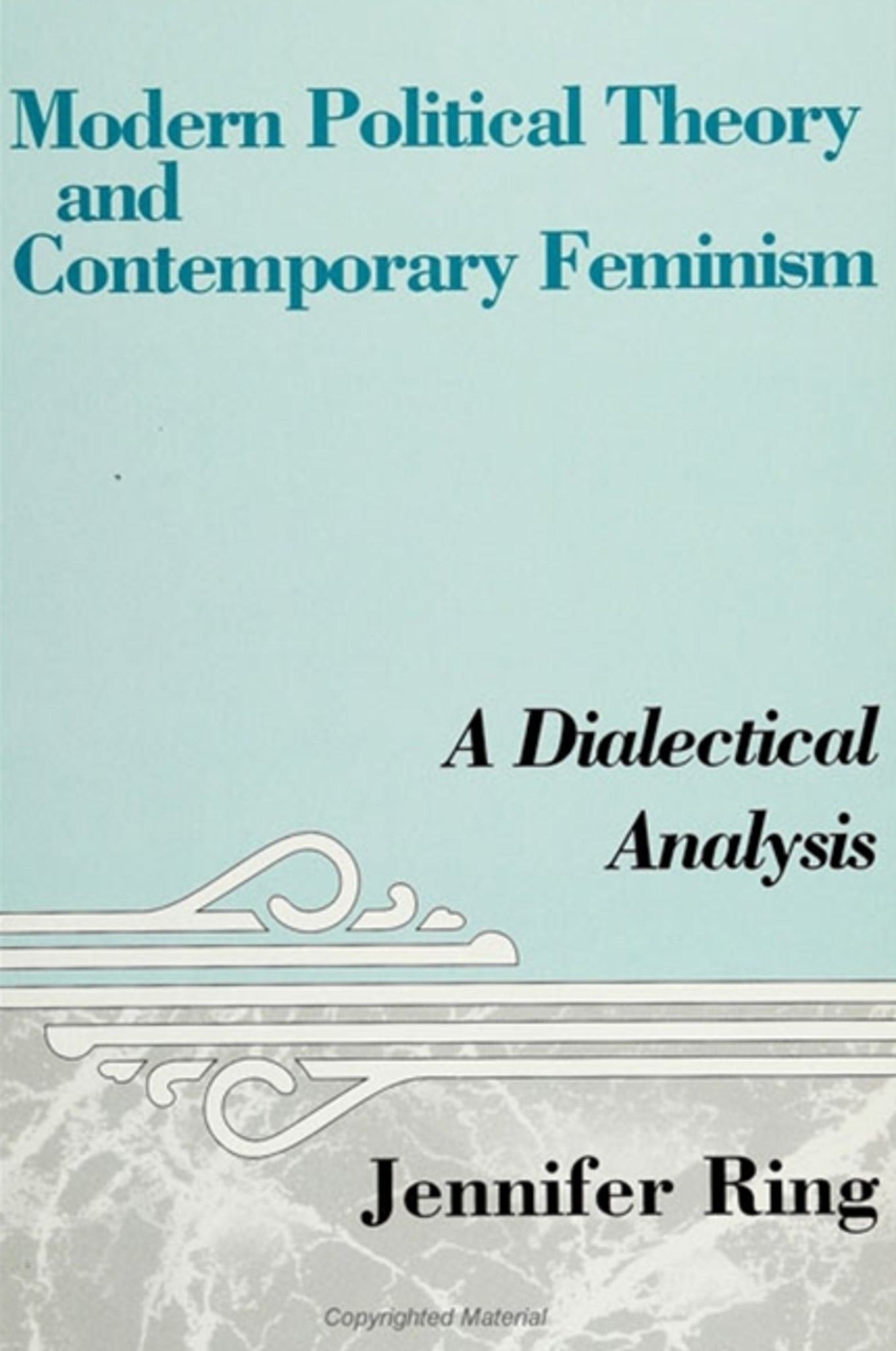
Rethinks feminist epistemology and political theory through a "minimalist dialectics" drawn from Hegel and Marx to move beyond entrenched theoretical oppositions.
In Modern Political Theory and Contemporary Feminism, Jennifer Ring offers a bold and original intervention in feminist political theory by challenging the entrenched oppositions that have long shaped the field. Moving beyond both rigid dichotomies and the rejection of dichotomies altogether, Ring develops a "minimalist dialectics" drawn from the philosophical traditions of Hegel and Marx.
Through careful engagement with John Stuart Mill, feminist epistemology, and classical dialectical thought, she reexamines foundational debates in political theory and feminist discourse. The result is a work that bridges historical philosophical insight with contemporary theoretical concerns, offering a nuanced framework that avoids both essentialism and radical subjectivism.
Scholarly yet accessible, this book speaks to political theorists, feminist scholars, and all readers interested in the evolving conversation about knowledge, power, and gender. Ring's approach is both critically engaged and intellectually generous, rethinking familiar arguments with clarity, rigor, and fresh perspective.
By reworking the tools of dialectical thought for contemporary feminist analysis, Jennifer Ring opens new possibilities for understanding political theory in a more integrated and conceptually balanced way.


"Jennifer Ring's book is a significant step in feminist theory. She moves beyond old dichotomies, and beyond the rejection of all dichotomies, by establishing the value of a 'minimalist dialectics' drawn from Hegel and from Marx. She recasts familiar debates with fresh insights. Her book is scholarly but clear and accessible; it deserves a wide audience among political theorists and all participants in feminist discourse." — Nannerl O. Keohane, President, Wellesley College
"This book is an intelligent, well-argued, articulate presentation of the problems with earlier feminist epistemologies that have adopted unsatisfactory stances for either observing or participating in the political world. Ring draws from both Hegel and Marx to propose a minimalist dialectic that requires neither essentialism nor a completely subjectivized stance. She speaks with elegance and clarity." — Arlene W. Saxonhouse, University of Michigan
"I admire this book. The stance it takes — neither liberal nor deconstructionist— seems to me both common sensible and rare. The author has a lively, engaged mind. Her approach is refreshingly rebellious, but she writes with great respect for the liberal and conservative traditions she criticizes, as she writes with great concern for the future of feminism." — Elisabeth Young-Bruehl, Wesleyan University
Jennifer Ring is Assistant Professor in the Department of Government and International Studies at the University of South Carolina.
Acknowledgments
1. Introduction
2. Contemporary Feminist Epistemology
3. John Stuart Mill—The Subjection of Women
4. John Stuart Mill—A System of Logic
5. Hegelian Dialectics
6. Marxian Dialectics
7. Conclusion
Notes
Index