





Some error occured while loading the Quick View. Please close the Quick View and try reloading the page.
A ground-breaking exploration of how art responds to democratic crisis.
Is democracy over? Did we ever really have it? Most people would agree that today democracy finds itself in crisis. As this crisis has intensified, art has emerged as an important means of experimenting with new democratic processes and possibilities.
In Model collapse, an incisive group of art historians and theorists investigate the relationship between art and democracy since the 1990s. Exploring a wide range of artistic responses, from interactive public sculptures to autonomous curatorial projects, critical engagement with electoral politics and creative street protest, they offer fresh insights into the limits of representation, the appeal of collaboration and the role of the nation-state in post-national frameworks.
‘Model collapse’ is what happens when large language models start learning from their own generated data and lose all connection to reality. This book examines the multiple, intersecting crises that shape the conditions for artistic practice and define its socio-political aims. It advances our understanding of how art can contribute to one of the most vital political issues of our time.


Lindsay Caplan is Andrea V. Rosenthal Assistant Professor of History of Art and Architecture at Brown University
Kerry Greaves is Associate Professor of Art History and Visual Culture at the Department of Arts and Cultural Studies at the University of Copenhagen
Introduction: Contesting models – art and democracy since the 1990s – Lindsay Caplan
Part I: Assembly: between intervention and institution
1 Performance and militant curating: rehearsing democratic imaginaries through critical spaces and publics – Gigi Argyropoulou
2 Nordic exceptionalisms: convivial curating and Denmark’s CAMP / Center for Art on Migration Politics – Kerry Greaves
3 Practices of avant-garde negation in Belarusian art during the 2020 anti-authoritarian uprising – Olga Kopenkina
4 From revolutionary art to democratic art: Oliver Ressler and Wolfgang Tillmans in the shadow of the Situationists – Mikkel Bolt Rasmussen
Part II: Party/people: forms of collective identity and their limits
5 Party formalism: formlessness and collective form in contemporary art – Julian Nykolak
6 I am one people: the demos as aporia and opera in the work of Christoph Schlingensief – Jonah Westerman
7 Re-citing, re-siting: art and the figural politics of ‘the people’ in Europe – Sudeep Dasgupta
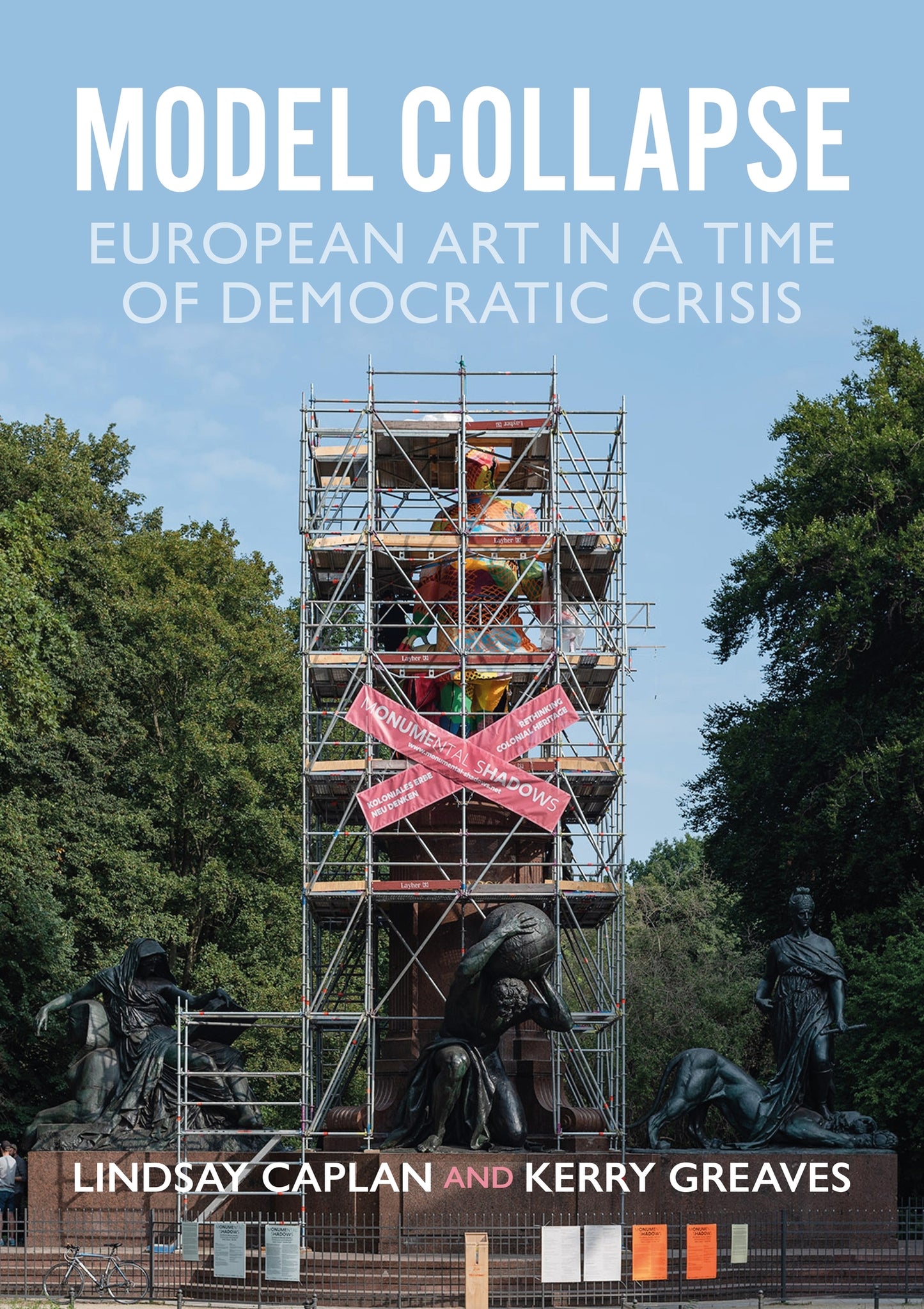
8 Monumental shadows: renegotiating public monuments and radicalising democracy in today’s culturally pluralised societies – Sabine Dahl Nielsen
9 Public art and democratic fallacies: patriarchal resilience in Erik A. Frandsen’s ‘toppled’ statue BAR ROMA – Mathias Danbolt and Amalie Skovmøller
Part III: The state: within, against, beyond
10 ‘BITTERFELD IS EVERYWHERE’: industrial hauntings in the former East Germany – Sara Blaylock
11 Contemporary necropolitical mafia structures or necrodemocracy and contemporary European art and culture – Marina Gržinic
12 The financial system as public resource: Núria Güell’s post-Indignados activist practice – Tatiana Rybaltchenko and Sophie Cras
13 Off-state relations as resilience: grassroots arts instituting in Hungary – Eszter Szakács
Index