





Some error occured while loading the Quick View. Please close the Quick View and try reloading the page.
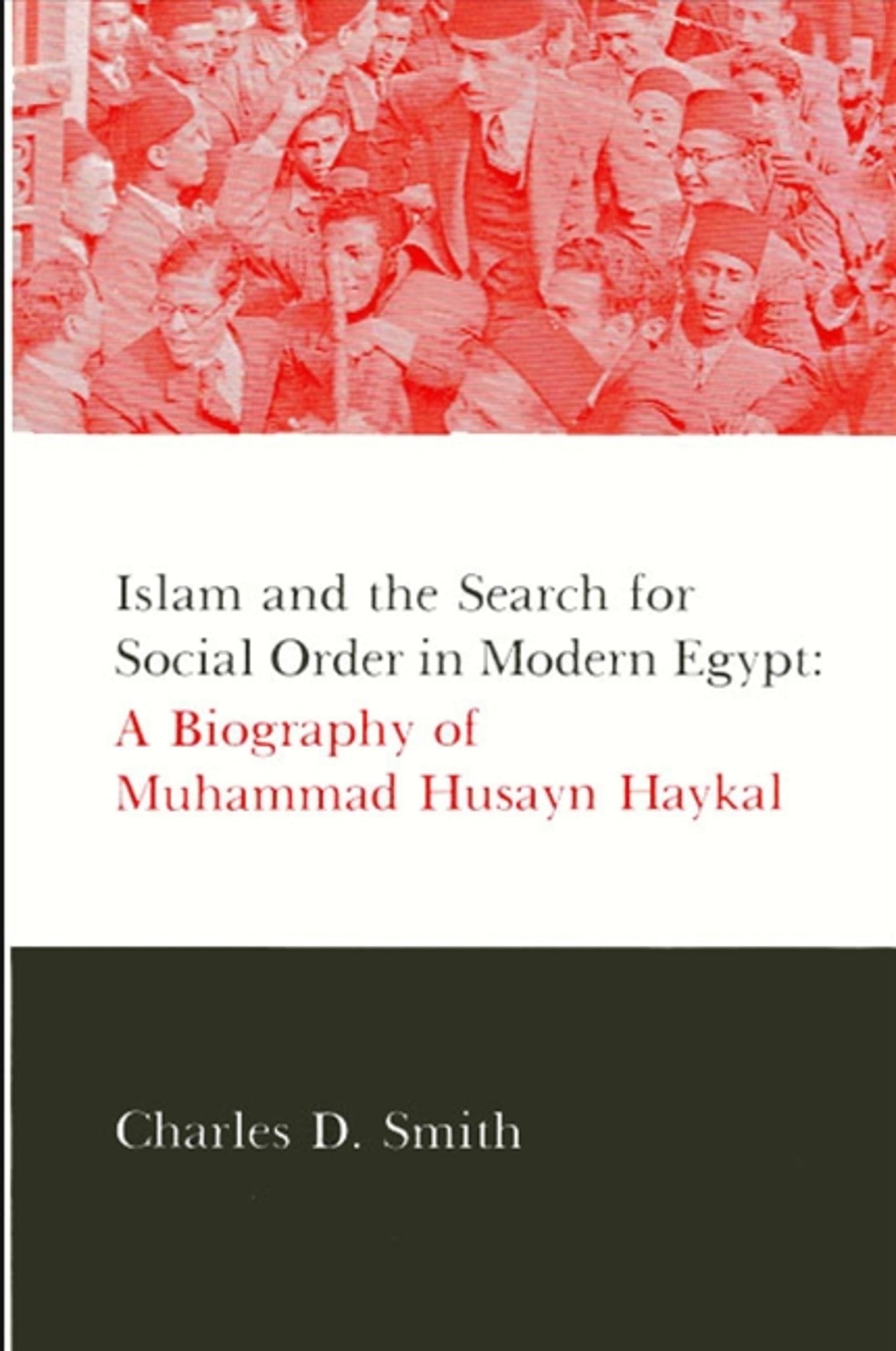
How did modern Egypt seek to reconcile Islam, political change, and the demands of social development?
Islam and the Search for Social Order in Modern Egypt examines the intellectual and political career of Muhammad Husayn Haykal, one of the leading Egyptian intellectuals and politicians of the first half of the twentieth century. In tracing Haykal’s intellectual development, Charles D. Smith places his ideas within the broader cultural, political, and social transformations that shaped modern Egypt.
Drawing on extensive Arabic-language sources, Smith follows Haykal's efforts to reconcile Islamic thought with the demands of political and social modernization. Haykal's writings and political activities reveal the difficulties confronting a generation of Egyptian intellectuals who sought to formulate an ideology of national development while negotiating the competing claims of Islam, nationalism, liberalism, and modernity.
The book is both an intellectual biography and a study of the political and cultural history of Egypt before the 1952 revolution. Haykal's eventual failure to achieve his political and intellectual objectives provides a revealing perspective on the weaknesses of the old political order and the forces that contributed to its collapse.
By examining the question of Islam and social development through the experience of a major Egyptian thinker, Smith illuminates issues that extend well beyond Haykal himself. The study offers an important framework for understanding the formation of modern Egyptian political thought and the continuing debate over the relationship between traditional culture, social change, and political authority.


"This is an outstanding piece of literary research and criticism. It is based on voluminous reading of difficult source material in Arabic, and on a rich and wise understanding of the cultural history of modern Egypt and of modern religious and civilizational issues. It is written in an erudite yet simple and relaxed style. And it tells us in great detail about the intellectual evolution of an outstanding cultural figure of the Arab and Muslim worlds. There are few others of these." — Malcolm H. Kerr, UCLA
"Islam and the Search for Social Order in Modern Egypt fills an important gap in Egyptian intellectual and political history. Muhammad Husayn Haykal was one of the leading intellectuals of his generation and an important politician as well. By showing the difficulties and eventual defeat that Haykal faced both as a thinker and as a politician, the book furthers our understanding of why the old regime failed in Egypt in 1952." — Donald M. Reid, Georgia State University
"This book succeeds in analyzing intellectual history of the pre-1952 period in Egypt 'from within,' so to speak. No other study approaches this period from Smith's perspective, treating the life of Haykal as a metaphor for a group of intellectuals and their attempt to fashion an ideology of development for modern Egypt. This study is more than a biography of Haykal, having the broader perspective of the problematic of 'Islam' in social development. The current evolution of society in Egypt continues to feature the exploration of many of the same issues that exercised Haykal. The care with which Smith has researched these issues imparts to the study a distinct aura of authenticity. But beyond that, he has given us a framework for understanding much of the present discourse in Egypt over the role of traditional culture and its interpretations of social reality for contemporary Egyptian politics and society. In short, far from being a strictly narrow-based study of one man's intellectual odyssey, the work has relevance for the larger issues of development for this critically important Arab state." — Shahrough Akhavi, University of South Carolina
Charles D. Smith is Professor of Islamic and Middle East History at San Diego State University
Preface
List of Abbreviations
Introduction
Chapter One
Egypt and the Idea of Modernity: 1870–1907
Chapter Two
The Formative Years: Haykal between Egypt and Europe, 1888–1922
Egypt as Seen from Paris
The Romantic Idea: Love and the Intellectual as Portrayed in Zaynab
The Fear of Social Entrapment
Chapter Three
Ideal and Reality: Egyptian Politics, 1918–1930
Haykal, the Wafd, and the Egyptian Democratic Party, 1918–1922
The Liberal Constitutionalists in Politics, 1923–1930
Chapter Four
The Road to Islam: Intellectual Developments, 1924–1933
Chapter Five
The Transformation of the Reformist Message and the Writing of Hayat Muhammad
Al-Azhar and Egyptian Politics: 1924–1930
Sidqi, al-Azhar, and Christian Missionary Activity
Hayat Muhammad
Sufism, Science, Spiritualism, and True Faith
Summation and Conclusion
Chapter Six
The Shift to Islam: Its Continuation and Significance
Fi Manzil al-Wahy
Abu Bakr and 'Umar
Haykal's Portrayal of Islam in the Egyptian Context
The Liberal Dilemma: Islam and Politics, 1933–1940
Chapter Seven
Haykal As Politician, 1940–1954: The Liberal Constitutionalists and the End of Party Politics
The War and Egyptian Politics
The Interregnum, 1945–1950
The Slide Toward Destruction, 1950–1952
Capitulation and Despair
Chapter Eight
Conclusion
Notes
Glossary
Bibliography
Index