





Some error occured while loading the Quick View. Please close the Quick View and try reloading the page.
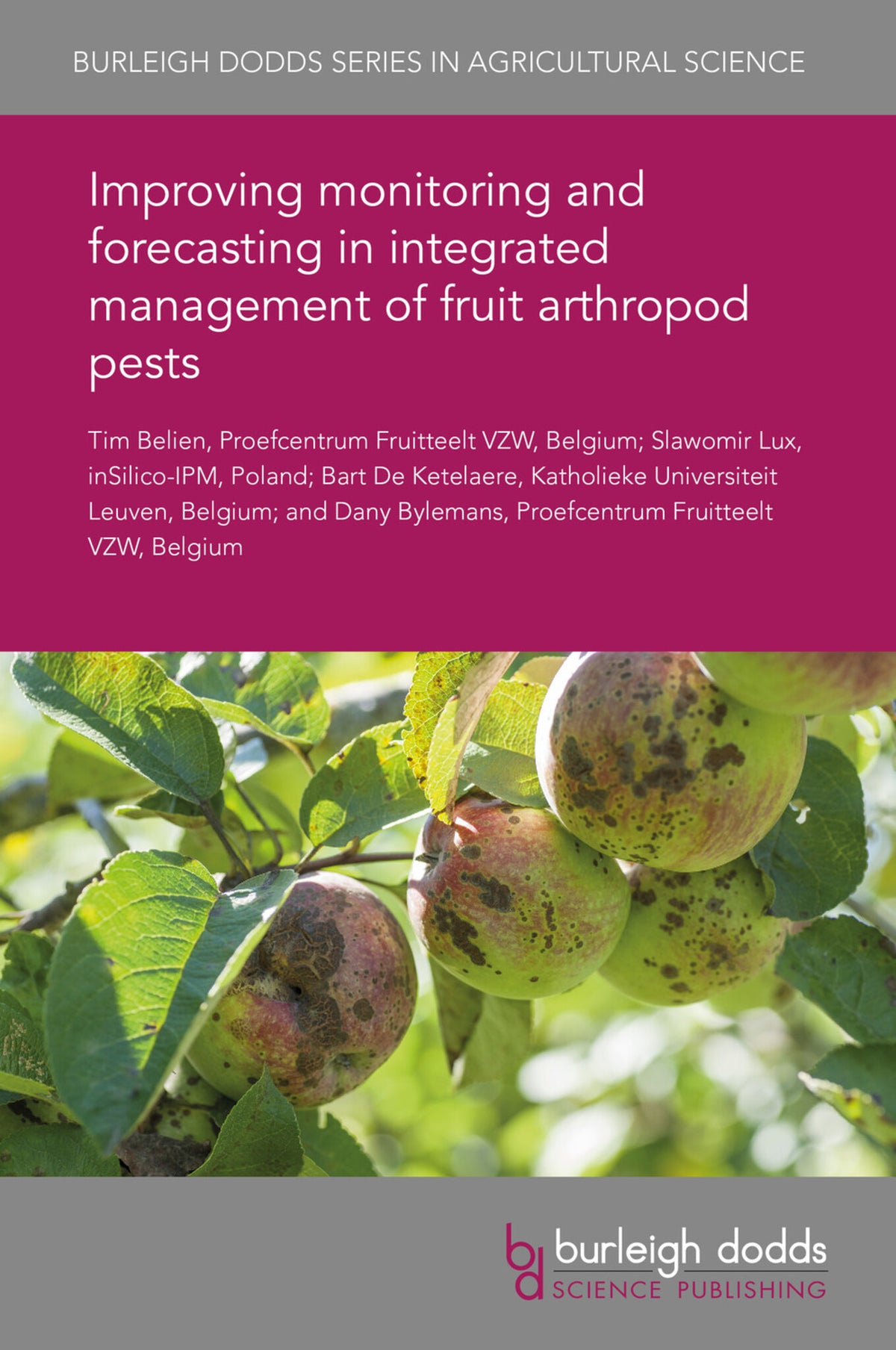
The efficient and accurate monitoring of insects and mites is a cornerstone of integrated pest management (IPM). Pheromone-baited traps are probably the best known, most convenient and specific method used for monitoring in orchards. However, mating disruption strategies have complicated the interpretation of monitoring via pheromone traps, leading to the development of alternative (bisexual/food-based) baits. This chapter describes both manual and automated monitoring systems (sensor and camera-based), models for forecasting the phenological dynamics and spatial distribution of insects and the challenge of understanding the relationships between monitoring data, absolute pest densities and economic threshold values. Finally, the chapter looks ahead to future research trends in this area and provides detailed guidance on further reading on the subject.

Price: £25.00
Publisher: Burleigh Dodds Science Publishing
Imprint: Burleigh Dodds Science Publishing
Series: Burleigh Dodds Series in Agricultural Science
Publication Date:
09 September 2019
ISBN: 9781838799151
Format: eBook
BISACs:

1 Introduction 2 Manual monitoring techniques and economic thresholds 3 Automatic monitoring of pests 4 Modelling of pest populations to support pest management 5 Conclusion and future trends 6 Where to look for further information 7 References