





Some error occured while loading the Quick View. Please close the Quick View and try reloading the page.
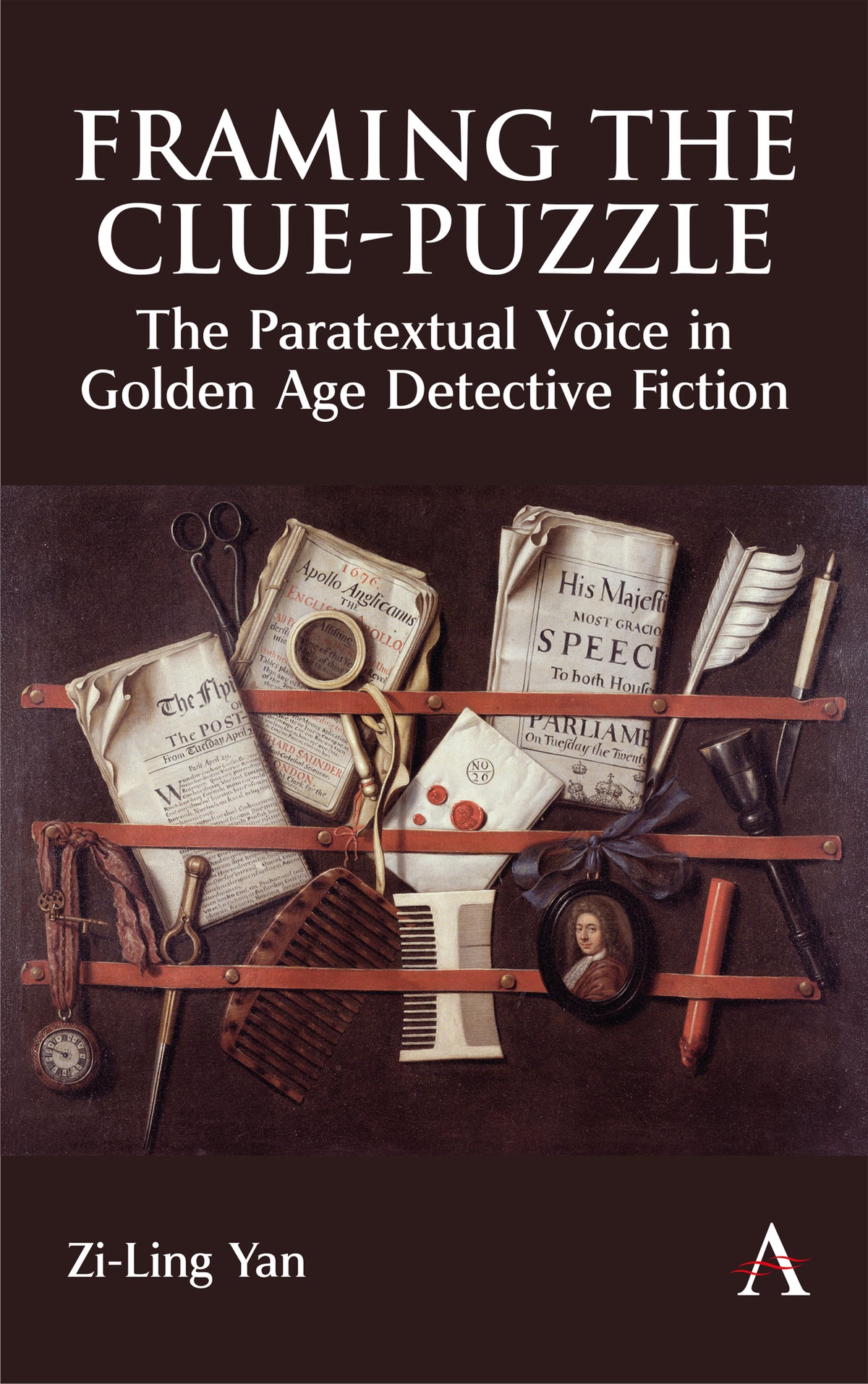
Explores how para texts in detective fiction impact the construction of meaning, revealing how narrative framing shapes knowledge, justice, and interpretation.
Zi-Ling Yan’s Framing the Clue Puzzle examines a familiar but unsystematically addressed and understudied feature of much Golden Age detective fiction: the conscious incorporation of paratexts into the mystery narrative. After examining Gérard Genette’s pioneering work on paratexts and recent criticism concerned with their literary applications, Yan draws upon Dan Sperber and Deidre Wilson’s Relevance Theory and Richard Walsh’s notion of fictionality to develop an approach in which paratexts are understood to exert framing functions by implicature while, because they are subsumed in the text, only mimicking metalepsis. This understanding of the fictive paratext is then applied to a data set consisting of 530 detective narratives divided into five core chapters covering prefaces, footnotes, maps, floorplans, and diagrammatic devices. The results disclose consistent patterns of development between para- or intra-textual types over time and within subgenres: a trickle of paratextual material in the late nineteenth-century Classical period of the genre, notable increases during the 1920s, which peak the 1930s and subside in the 1940s, bracketing the Golden Age clue-puzzle.
The chapter sequence is built upon several criteria: degree of paratextual independence or integration, physical placement, and the rhetorical aspects of voice evoked by the problem of the para-/intra-textual locus of enunciation.


‘This is a fascinating analysis of what Tzvetan Todorov once called the “geometric architecture” of the detective story. As much as detective fiction deals with crime, bodies, and emotions, it is also a profoundly intellectual and literary genre. This study examines the preponderance of paratexts—footnotes, maps, floorplans, etc.—in a very broad historical range of “clue-puzzle” detective fiction.’ —Bran Nicol, Professor of English Literature, University of Surrey, UK.
‘Zi-Ling Yan takes detective fiction seriously. Framing the Clue-Puzzle offers a fresh look at a familiar but critically neglected feature of Golden Age crime fiction: its footnotes, maps, diagrams, and other paratextual devices. Yan demonstrates that these elements are more than decorative or playful adornments; they construct narrative authority, guide interpretation, and illuminate historical and cultural contexts. Thorough and persuasive, this study repositions clue-puzzle detective narratives as culturally resonant, historically embedded, and theoretically rewarding.’ —Dr. Jamie Bernthal-Hooker, Visiting Fellow in English and Creative Writing, University of Suffolk, UK.
‘Golden Age detective fiction has long rewarded close reading, but Zi-Ling Yan shows us how much we have missed. Framing the Clue-Puzzle is a beautifully constructed work of original scholarship, bringing paratextual analysis to bear on the genre with precision and insight. Researchers will return to it again and again.’ —Dr. Rebecca Josephy, Associate Professor of French, Oakland University, Michigan, USA.
Zi-Ling Yan is professor of English at National University of Tainan.
List of Tables; Acknowledgements; Chapter One: Introduction; Chapter Two: Prefaces; Chapter Three: Footnotes; Chapter Four: Maps; Chapter Five: Plans; Chapter Six: Diagrammatic Figures; Chapter Seven: Conclusion; Appendix; References; Permissions; Index.