





Some error occured while loading the Quick View. Please close the Quick View and try reloading the page.
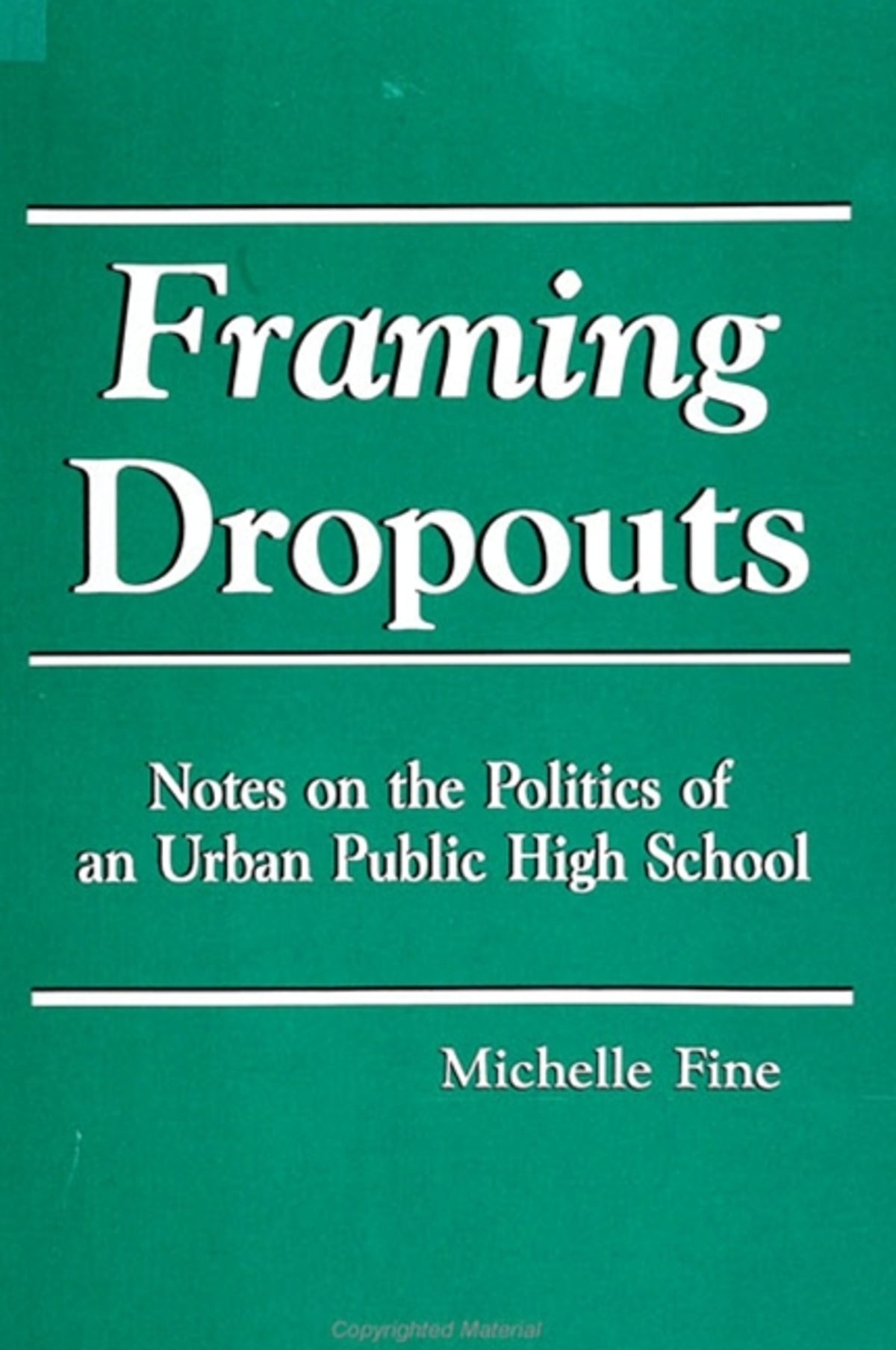
In Framing Dropouts, Michelle Fine challenges the dominant narratives surrounding school dropouts by turning our attention to the voices, bodies, and lived experiences of young people and educators inside an urban comprehensive high school. Through a critical ethnographic lens, Fine exposes the historic irony at the heart of public education: the promise of equal opportunity alongside the persistent production of unequal outcomes.
Blending vivid narrative with rigorous social theory, the book traces how race, class, gender, and power braid together to shape whose voices are nurtured, whose bodies are discharged, and whose critiques are silenced. Students labeled "at risk," low-income mothers struggling at the margins, and educators working within constrained institutions speak back to policies and practices that too often render their pain invisible. Rather than treating dropping out as an individual failure, Fine reframes it as a deeply social and political process—one rooted in the erosion of schools as democratic public spheres.
Moving from ethnographic detail to critical theory and activist politics, Framing Dropouts calls on readers to confront the harms produced by public institutions and to imagine how schools might once again serve as spaces of dialogue, critique, and collective possibility.
Provocative, compassionate, and transformative, this landmark study reshapes the field of dropout research and urban education. It is essential reading for educators, scholars, policymakers, and anyone committed to understanding—and changing—the conditions that place young people at risk.


"I think this is the most important work I have read in over a decade on the sociology and politics of school dropouts. Fine combines a narrative structure with a rigorous theoretical discourse that allows the reader to both hear the voices of those involved in the dropout situation as well as to have the opportunity to reflect critically on the ideological and material forces that structure the dropout issue as a social problem. I am convinced that it will be a major influence in the field and will establish a new theoretical standard for inquiry into the area of school dropouts." — Henry A. Giroux, Professor and Renown Scholar in Residence, Department of Educational Leadership, Miami University
"As a critical ethnography, this manuscript is thoughtful, compassionate, and compelling. Fine is able to document the 'braiding' of race, class, gender in sophisticated ways and this is one of the text's greatest strengths. The link between those who 'drop out' and the restriction of critique is powerfully achieved. Fine has successfully re-presented the complexities of urban education. She should be applauded for her integration of black and feminist theorists. I believe this text is pioneering. It opens the literature on adolescents placed at risk to include contexts previously ignored. This should be required reading for all school personnel, future teachers, and those associated with educational contexts." — Deborah P. Britzman, Department of Education, State University of New York, Binghamton
"What Fine does is show us in depth the reality of the situation we often wish would just go away. We are forced to confront what pain is engendered by our public institutions and consider how we might take up the challenge to do something about it." — Roger I. Simon, Ontario Institute for Studies in Education
Michelle Fine is Associate Professor of Psychology in Education at the Graduate School of Education, University of Pennsylvania.
Tables
Acknowledgments
Introduction
I. UNPACKING THE HISTORIC IRONY
II. CRITICAL ETHNOGRAPHIC SLICES OF COMPREHENSIVE HIGH: VOICES, BODIES, AND CRITIQUE
1. On Equal Educational Opportunities and Unequal Educational Outcomes
III. REFRAMING DROPOUTS: CRITICAL THEORY AND ACTIVIST POLITICS
2. Silencing and Nurturing Student Voices
3. Discharging the Student Bodies
4. Where Are You Going?
5. On Critical Consciousness
6. Educators' Experiences: On Being Heard (and More Often, Not)
7. Burning at Both Ends: Low-Income Mothers, Their Public Schools, and Their Adolescents
8. Public Schools as a Public Sphere
9. Reclaiming the Public Sphere
Appendix: The Cohort Study: Tracking the Bodies
Notes
Bibliography
Index