





Some error occured while loading the Quick View. Please close the Quick View and try reloading the page.
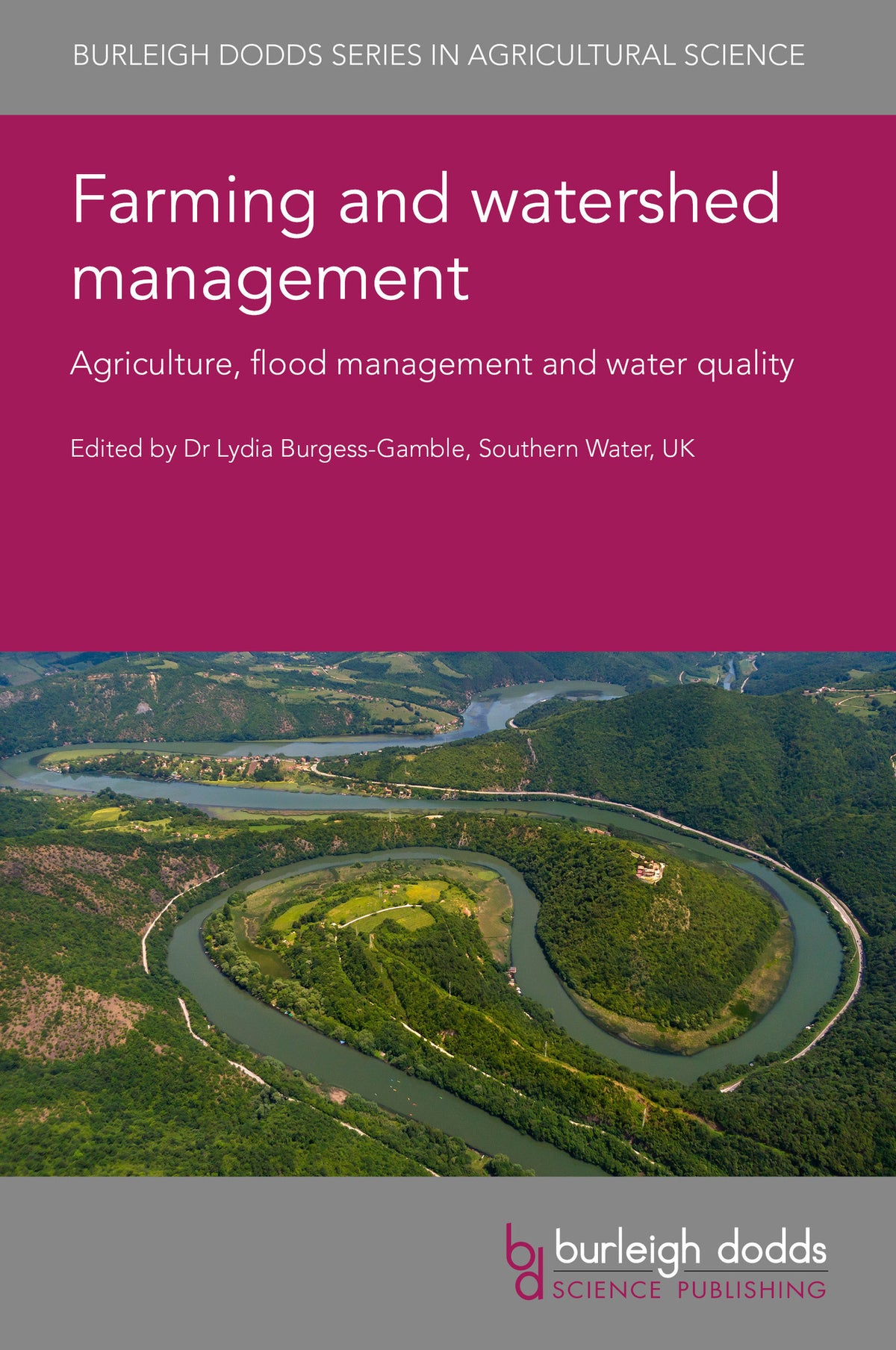
Climate change is increasing the frequency and severity of extreme rainfall, which, in turn, is challenging the effectiveness of traditional flood defence measures. Nature-based solutions, such as natural flood management (NFM) techniques which harness the capacity of landscapes to store water and control its flow, are emerging as a potential solution to managing flood risks.
Farming and watershed management: Agriculture, flood management and water quality provides a comprehensive overview of the principles of NFM, focussing on advances in modelling catchment hydrology and flood risk, as well as the role of governance structures and participatory approaches in the planning and implementation of NFM programmes. The book also explores the range of NFM techniques, including peatland restoration, leaky barriers, wetland creation and the use of floodplains and other riparian types of woodland.


Dr Lydia Burgess-Gamble is currently Biodiversity Net Gain Strategic Lead at Southern Water, a water utility company based in the South East of England. She was previously a Principal Nature-Based Solution specialist at JBA Consulting and, before then, Principal Flood Risk Scientist at the Environment Agency, responsible for the development of the UK’s Natural Flood Management Evidence Directory. She was a co-author of the International Guidelines on Natural and Nature-based Features Flood Risk Management.
- 1.Designing and implementing natural and nature-based feature (NNBF) approaches to flood management: where are we now?: Todd Bridges, University of Georgia, USA;
Part 1 Principles of natural flood management
- 2.Advances in modelling catchment hydrology: Tim Marjoribanks, Loughborough University, UK;
- 3.Understanding and analysing extreme rainfall: Haider Ali, University of Newcastle, UK;
- 4.Modelling extreme rainfall and flood risk: Haider Ali, University of Newcastle, UK;
- 5.Low-cost monitoring and modelling of natural flood management (NFM) interventions: Mark Mulligan, King’s College London, UK;
- 6.Developing governance structures for catchment-level natural flood management (NFM) programmes: Dennis Collentine, University of Gavle, Sweden;
- 7.Developing participatory approaches to natural flood management planning and implementation: Rosalind Bark, University of East Anglia, UK;
- 8.Assessing the economics and financing of natural flood management programmes: Mark Everard, University of the West of England, UK;
Part 2 Natural flood management techniques
- 9.Upland natural flood management (NFM) techniques: peatland restoration: Martin Evans, University of Manchester, UK;
- 10.Upland natural flood management (NFM) techniques: control of water flow: Mary Bourke, Trinity College Dublin, Ireland;
- 11.Natural flood management (NFM) techniques: use of upland and lowland woodland: Thomas Nisbet, Forest Research, UK;
- 12.Lowland natural flood management (NFM) techniques: constructed wetlands: Doug Spieles, Denison University, USA;
- 13.Natural flood management techniques: the case for living leaky barriers: Mike Norbury, University of Liverpool, UK;
Part 3 Protecting water quality: runoff management
- 14.Managing point-source pollution from agricultural sources using nature-based solutions: a case study: Simon Harrison, University College Cork, Ireland;
- 15.The use of riparian woodland and hedgerow buffers to reduce runoff: David Kennedy, Environment Agency, UK;
- 16.Techniques for runoff storage and attenuation: Alison Duffy, Abertay University, UK;