





Some error occured while loading the Quick View. Please close the Quick View and try reloading the page.
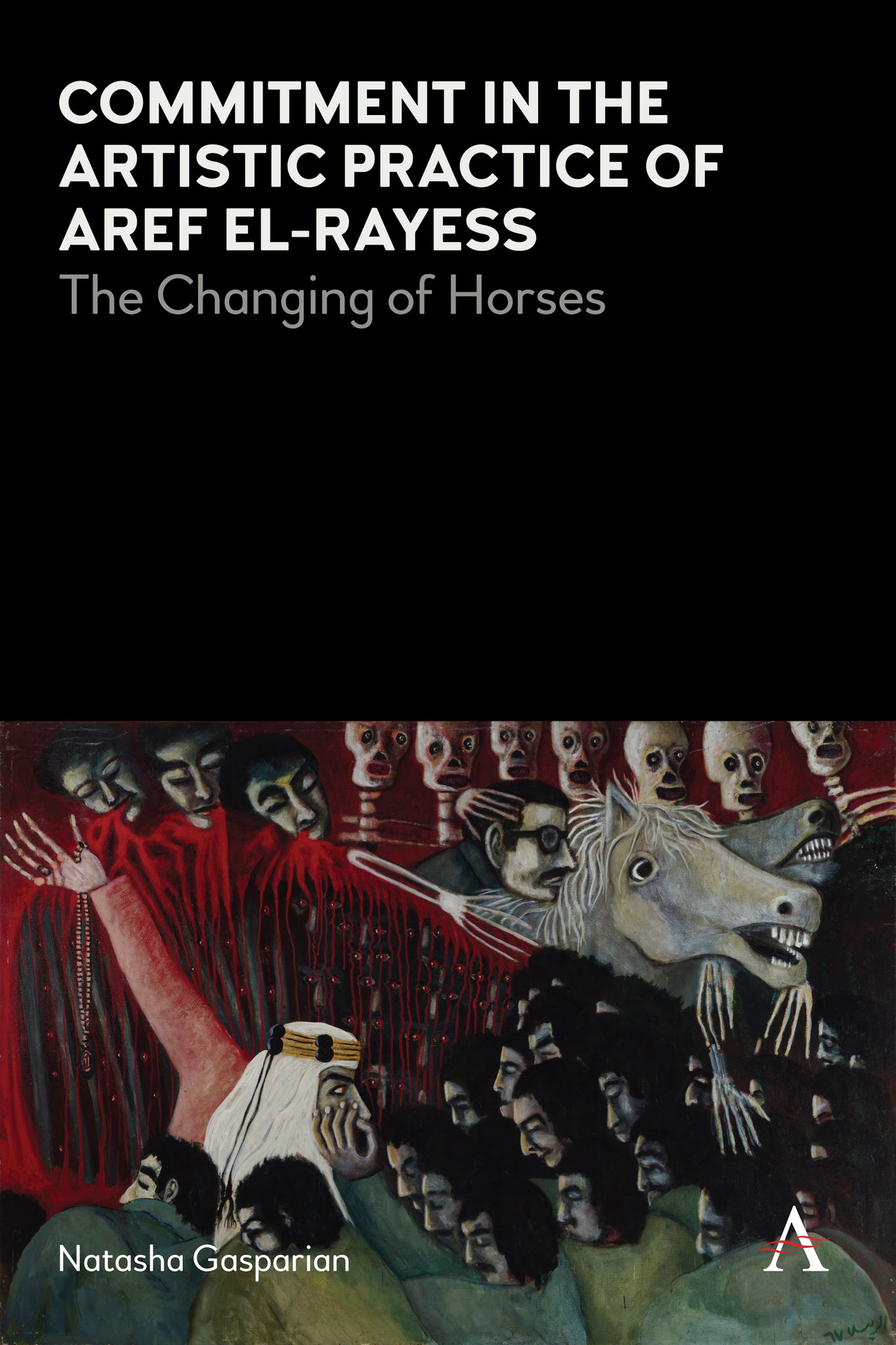
In April 1968, ten months after the Arab defeat of the 1967 June War, Aref El-Rayess’s Dimaʾ wa Hurriyya (Blood and Freedom) opened to the public in the exhibition hall of the L’Orient newspaper headquarters in Beirut, Lebanon. The 5th of June, or, The Changing of Horses, a realist mural painting on canvas, was the exhibition’s centerpiece. With this artwork, El-Rayess declared his commitment to national liberation and socialist revolution. The Changing of Horses was presented and received as an allegory of political commitment, but the slips, silences, and repetitions in the public reception point to its excessive, disturbing, and fundamentally uncanny character. In Commitment in the Artistic Practice of Aref El-Rayess, the first comprehensive study of the work, Natasha Gasparian weaves together a social art history from the artist’s writings, exhibition reviews, guestbook comments, personal correspondences and testimonies, as well as social, political, and aesthetic shifts, particularly as they related to the debates on commitment (iltizam) in the aftermath of the June 1967 war. By attempting to reconstruct this history of the artwork and tracing the caesuras in the discourse around it, Gasparian exposes the social antagonism that is repressed and obfuscated in the idealized narrative sustained by El-Rayess and his audiences. She argues that the oversight in the reception—the critics’ and audiences’ inability to see—attests to the delay in grasping the work historically and signals its avant-gardism.


“Starting from the micro-context (Aref El-Rayess’ 1967 painting “The Changing of Horses”), Gasparian retraces the big picture, in an original and brilliant way, using the artist’s metaphoric work in order to illustrate the new intellectual context that the 1967 defeat created.” — Silvia Naef, Professor, Department of Mediterranean, Slavonic and Oriental Languages, University of Geneva
List of Figures; Acknowledgments; Introduction; 1. The Exhibition; 2. The Artist; 3. The Reception; Conclusion; Notes; Bibliography.