





Some error occured while loading the Quick View. Please close the Quick View and try reloading the page.
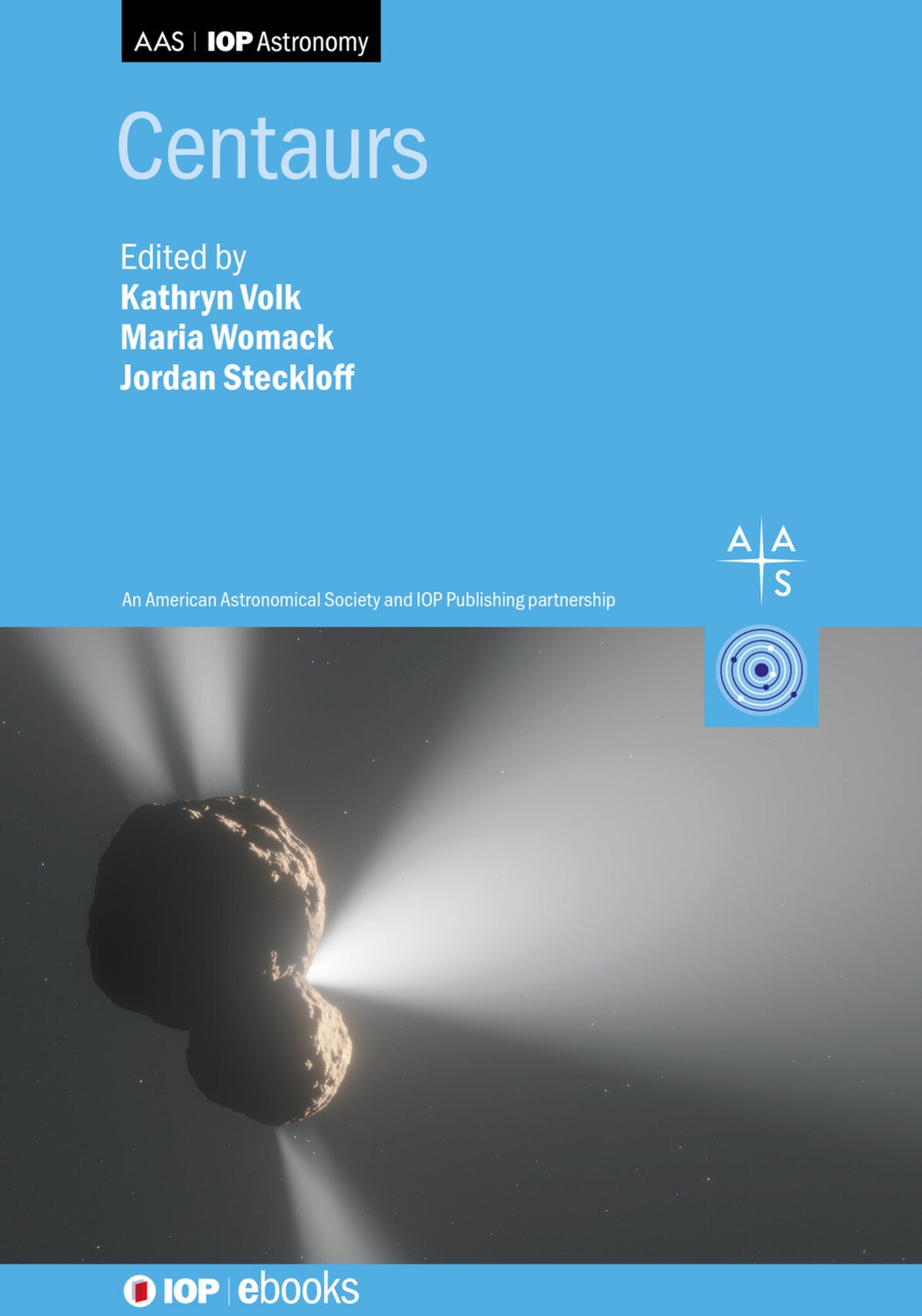
Centaur research is entering a transformative era. Centaurs are small, icy bodies in the solar system's giant planet region. They spent ~4.5 Gyr in cold storage in Trans-Neptunian populations before recently (~10 Myr ago) moving onto giant-planet-crossing orbits. Studying them helps us understand thermal and cometary processes from the early solar system. This is the first book dedicated to Centaurs, featuring contributions from over 60 experts. It covers their discovery, current knowledge on observations, modeling, experiments, and mission concepts. Highlighting their significance, the book discusses exciting developments from the Vera Rubin Observatory’s Legacy Survey of Space and Time (LSST), JWST, and other observatories, offering recommendations for future studies and exploration.
Key features:
- First comprehensive reference text on Centaurs.
- Fills the large gap in reference texts between TNOs and JFCs.
- Centaurs have been highlighted in the two most recent National Academy of Sciences planetary science decadal releases, were the main targets and focus of at least two space missions proposed in the last few years, and have just been added to the target list for NASA’s New Frontiers program.
- The study and knowledge of Centaurs will be transformed by new facilities and assets coming online such as JWST and the Vera Rubin Observatory.


Kat Volk received a Ph.D. in planetary science from the University of Arizona. She was awarded the American Astronomical Society Division on Dynamical Astronomy’s Vera Rubin Early Career Prize and is currently a Senior Scientist at the Planetary Science Institute.
Maria Womack received a Ph.D. in physics from Arizona State University. She received the NSF CAREER award for planetary astronomy. She serves as Affiliate Professor for the University of Central Florida and University of Victoria, and is on the American Astronomical Society’s Editorial Board. She is also employed by the U.S. National Science Foundation.
Jordan Steckloff received a Ph.D. in physics from Purdue University. He is currently a Research Scientist at the Planetary Science Institute in Tucson, Arizona, where he continues investigating the effects of sublimative processes and mass wasting on comet nuclei.
- Introduction
- Formation of Planetesimals in the Outer Solar System
- Dynamics of Centaurs and Links to Scattering and Comet Populations
- Centaur Nuclei: Sizes, Shapes, Spins, and Structure
- Surface Properties and Composition
- Volatiles
- Evolutionary Processes in the Centaur Region
- Activity, Outbursts and Explosions
- The Near-Centaur Environment: Satellites, Rings, and Debris
- Notable and Well-Studied Centaurs
- Observational Campaigns
- Centaurs’ Deep Interiors
- Laboratory Studies Applicable to Centaurs
- New Observational Studies: Early Results from JWST and Future Prospects with JWST and the Vera C. Rubin Observatory
- Cosmochemistry and Astrobiology of Centaurs as Remnants of Icy Planetesimals
- Centaur Missions
- Highlights and the Next Ten Years for Centaur Research