





Some error occured while loading the Quick View. Please close the Quick View and try reloading the page.
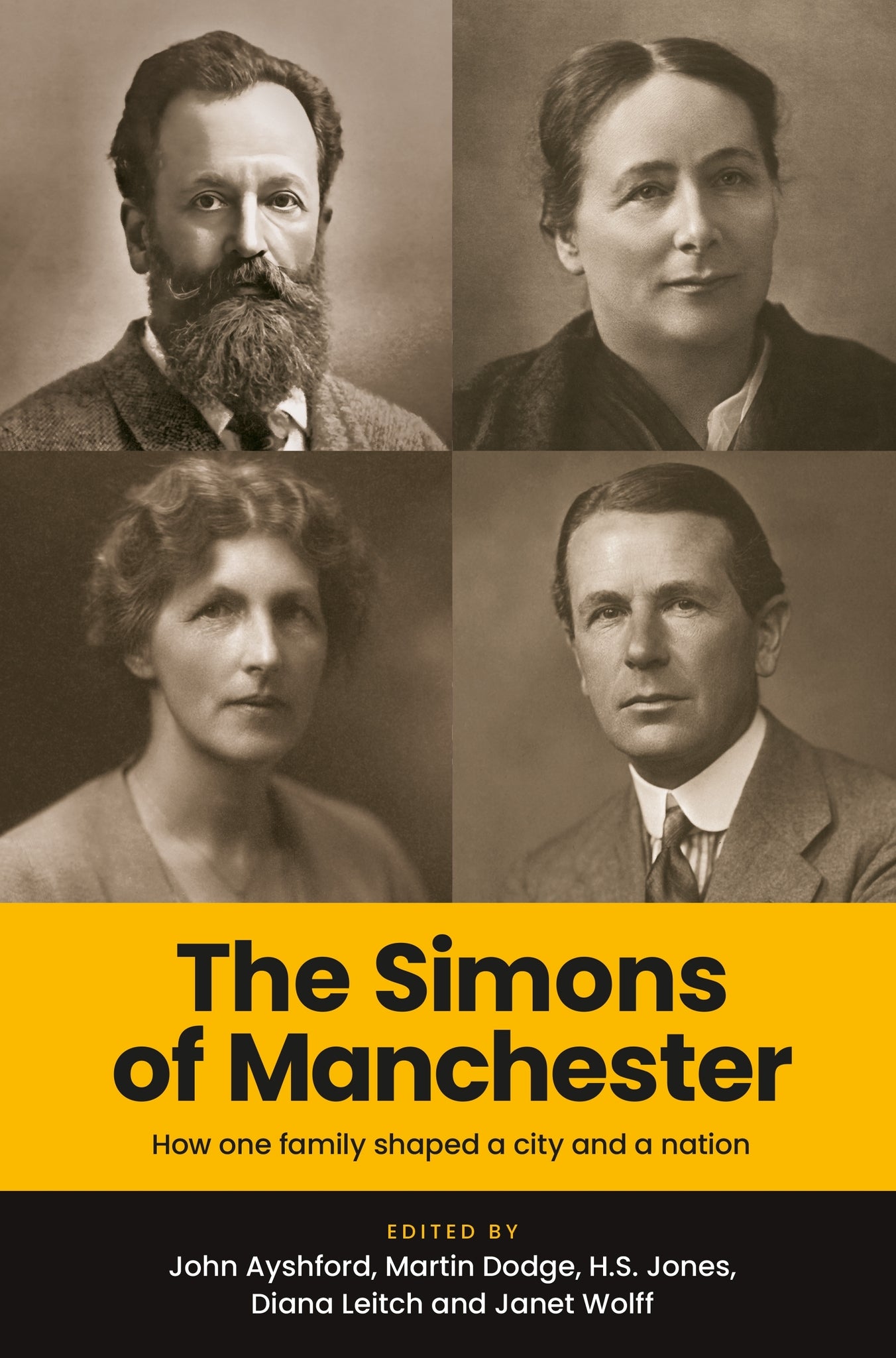
The Simons of Manchester revives the history of one of Manchester’s most influential families, the Simons. The book investigates the lives and public work of Henry and Emily Simon, and Ernest and Shena Simon. Through philanthropy and work in social reform, the two generations of the Simons greatly enriched Manchester’s cultural and civic institutions, worked to improve the lives of its citizens, and helped to spearhead profound national reforms in health, housing, planning and education. While many people in Manchester are familiar with the Simon name through Shena Simon College, Simonsway, and the Simon Building at the University of Manchester, there is scant public knowledge of who the Simons were and their legacy. As such, this edited volume of collected essays aims to illuminate their fascinating lives and public service to rehabilitate the Simons and examine their local and national significance.
An electronic edition of this book is freely available under a Creative Commons (CC BY-NC-ND) licence.


'Writing on British political history has, until recently, tended to fixate on Westminster, overlooking the importance of politics at the local level, especially in the period before 1915, when it was still a formidable force. The
Simons are notable amongst the victims of this neglect, so this copiously illustrated joint-volume by a group of Manchester-based academics, sponsored by the Simon Fund, is a valuable addition to the growing literature of political biography adopting a local perspective. It breaks new ground by approaching the Simons not just as individuals but as a family, projecting ‘a powerful family tradition of public service, deliberately transmitted’.'
Jamie Reynolds, Journal of Liberal Histories
John Ayshford is a Doctoral Researcher in History at the University of Manchester
Martin Dodge is a Senior Lecturer in Geography at the University of Manchester
Stuart Jones (H.S. Jones) is a Professor of Intellectual History at the University of Manchester
Diana Leitch MBE is a former Deputy University Librarian of the John Rylands University Library of Manchester
Janet Wolff is Professor Emerita in the School of Arts, Languages and Cultures at the University of Manchester
Foreword
Margaret and Matilda Simon
Introduction
The editors
Part I: Cosmopolitan Manchester and the Simons
1. Context, cosmopolitanism and connectivity: The German diaspora in Manchester
Margaret Littler
2. The appeal of a Buddha: Henry Simon, industrialist and philanthropist (1835–99)
Janet Wolff
3. Her compass always pointed to service: The life of Emily Simon (1858–1920)
Diana Leitch
4. The shy campaigner: The life of Ernest Simon, politician and social reformer (1879–1960)
John Ayshford and Brendon Jones
5. A confirmed outsider: The life of Shena Simon, feminist and education campaigner (1883–1972)
John Ayshford and Brendon Jones
Colour plates
Part II: The Simons’ contribution to society
6. Busy making good money: the development of the Simon engineering businesses
Martin Dodge
7. Shena Simon: Feminism, civic patriotism, and the strength of local government
Charlotte Wildman
8. Building Jerusalem: The Simons’ role in housing reform and town planning
Steven V. Ward and Martin Dodge
9. Burghers and citizens: The Simons and the University of Manchester
H.S. Jones and Chris Godden
Conclusion
The editors