





Some error occured while loading the Quick View. Please close the Quick View and try reloading the page.
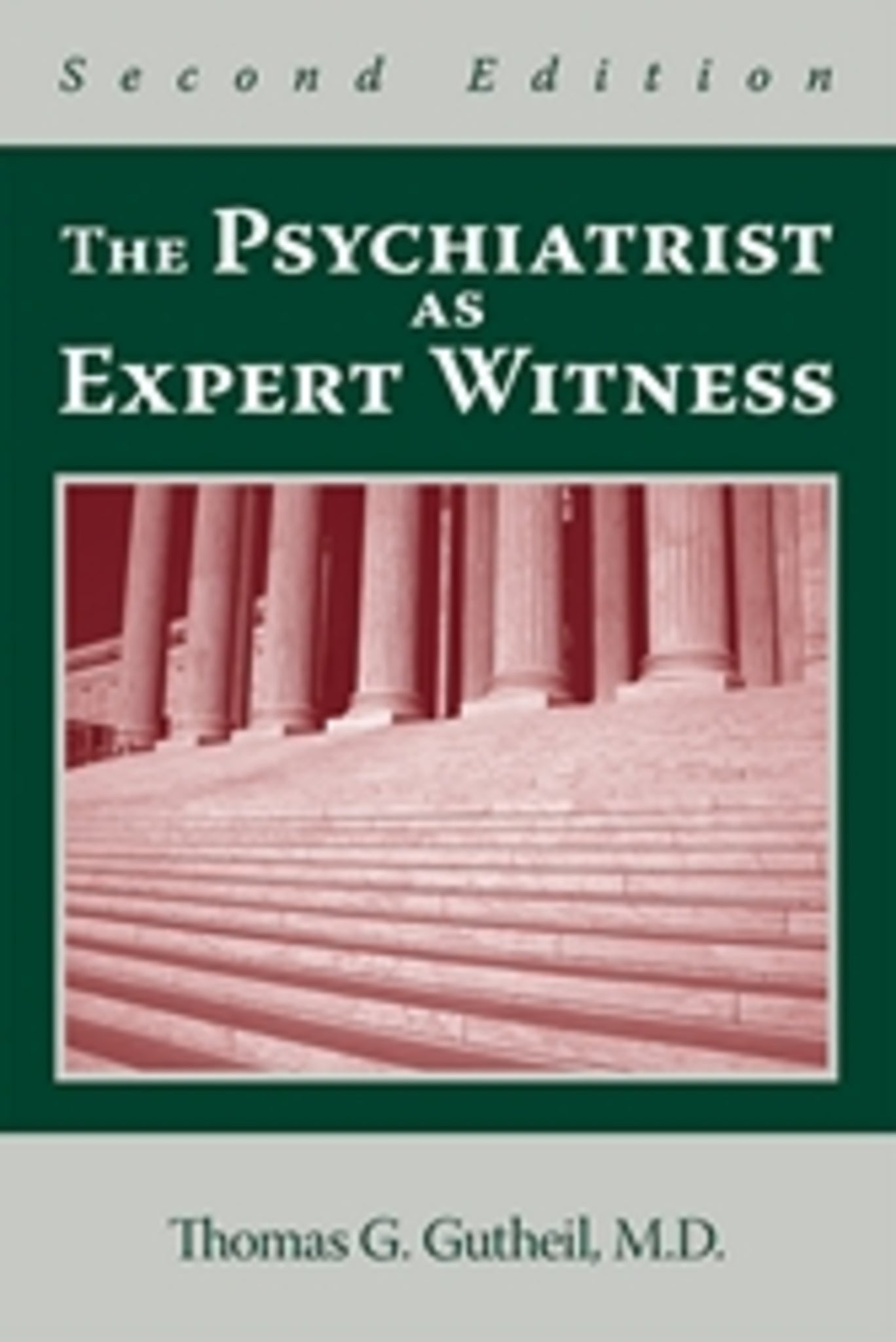
Forensic psychiatry is growing in popularity, and many a practitioner feels the urge to explore this fascinating realm of endeavor. The second edition of The Psychiatrist as Expert Witness, by Thomas G. Gutheil, M.D., is a highly readable and practical guidebook for those interested in entering the field while navigating the dangers inherent in courtroom testimony. This volume is a thoroughly revised and updated edition of his highly successful first edition. The earlier edition has been used in nearly all forensic psychiatric training programs in the U.S. and Canada since its publication in 1998.
A professor of psychiatry at the Beth Israel-Deaconess Medical Center-Harvard Medical School, Gutheil draws on his decades of experience in the courtroom and countless beginner's mistakes to help readers avoid the pitfalls of serving as an expert witness. While of great value to newcomers to the field, the book offers insight and guidance to early-career and seasoned expert witnesses as well.
As in the first
edition, this volume explores the role of the expert witness, moral issues,
basic principles, depositions and trials, writing for the court, and ethical
marketing. Besides the requisite updating of references and suggested
readings, this latest volume features expansions and additions of particular
benefit to prospective expert witnesses:
• A glossary of useful terms
• Expanded definitions of key
concepts
• A lengthened discussion of bias in testimony
• Additional
illustrative examples
• A model forensic consent form for
examination
• Cases and principles that have arisen since the first
edition
The Psychiatrist as Expert Witness provides the practical, hands-on mentoring and guidance that were not readily available in the past. Concrete advice replaces abstract theorizing, and informal discussion in a user-friendly tone replaces scholarly discourse. These attributes combine to make this a book that is highly accessible and usable in real world courtroom settings.
While some in society decry the expert witness function, the courts will continue, from all evidence, to require expert witness testimony in increasing numbers. The author seeks to help his colleagues meet the courts' needs with ethical, effective and helpful testimony through the publication of this revised volume. At the same time, Gutheil strives to make the often complex arena of forensic psychiatry more understandable to those who wish to enter the field and to seasoned experts eager to keep up with contemporary changes in forensic psychiatry.


The second edition seems to retain the best of the previous
edition, while updating and improving it extensively to mirror the current
environment for forensic practitioners. The author's writing style is both
entertaining and informative, and he has a unique ability to explain even
the most complex concepts in an easily digestible manner.
Readers
benefit extensively from his experience and comprehensive knowledge base. In
addition, the valuable appendixes contain sample fee agreements and consent
forms, which can be frustrating and time consuming to construct from
scratch. This should be on the reference shelf of both new and experienced
forensic practitioners.
The second edition of Dr. Gutheil's classic for nonforensic
and new forensic psychiatrists is
significantly revised and better than
the first, but retains its conveniently small size. The book is concise,
well organized, and eminently readable. The principles are clear and the
advice very practical, with many case illustrations and examples of the
author's dry wit (don't try that during testimony).
— William H. Reid, M.D., M.P.H.
Dr. Gutheil's guide for the expert witness is a bright lighthouse for practitioners who are eager to navigate the difficult yet exciting waters of forensic psychiatry. Psychiatrists new to the forensic arena ill greatly benefit from the author's exhaustive experiences and gain confidence in undertaking this type of work.
— Bradley W. Freeman, M.D.
Thomas G. Gutheil, M.D., is professor of psychiatry in the Department of Psychiatry at the Beth Israel-Deaconess Medical Center, Harvard Medical School; cofounder of the Program in Psychiatry and the Law at the Massachusetts Mental Health Center; and a Distinguished Life Fellow of the American Psychiatric Association. He is a past president of the American Academy of Psychiatry and Law and the current president of the International Academy of Law and Mental Health. The textbook, Clinical Handbook of Psychiatry and the Law, coauthored with Paul S. Appelbaum, M.D., and now in its fourth edition, received the Manfred S. Guttmacher Award as the outstanding contribution to forensic psychiatric literature.
About the Author
Preface to the Second
Edition
Acknowledgments
Chapter 1. Introduction: What makes an
expert?
Chapter 2. The expert's ethical universe
Chapter 3. First
principles
Chapter 4. Types of typical cases
Chapter 5. Discovery
and depositions
Chapter 6. The expert in trial
Chapter 7. Some
pointers on expert witness practice
Chapter 8. Writing to and for the
legal system
Chapter 9. Developing and marketing a forensic
practice
Chapter 10. The expert on the road: Some travel tips for
testifying away
Chapter 11. Epilogue
Appendix 1: Consent form for
forensic examination
Appendix 2: Standard fee agreement
Appendix 3:
Detailed fee agreement
Appendix 4: Suggested readings and web
sites
Glossary
Index