





Some error occured while loading the Quick View. Please close the Quick View and try reloading the page.
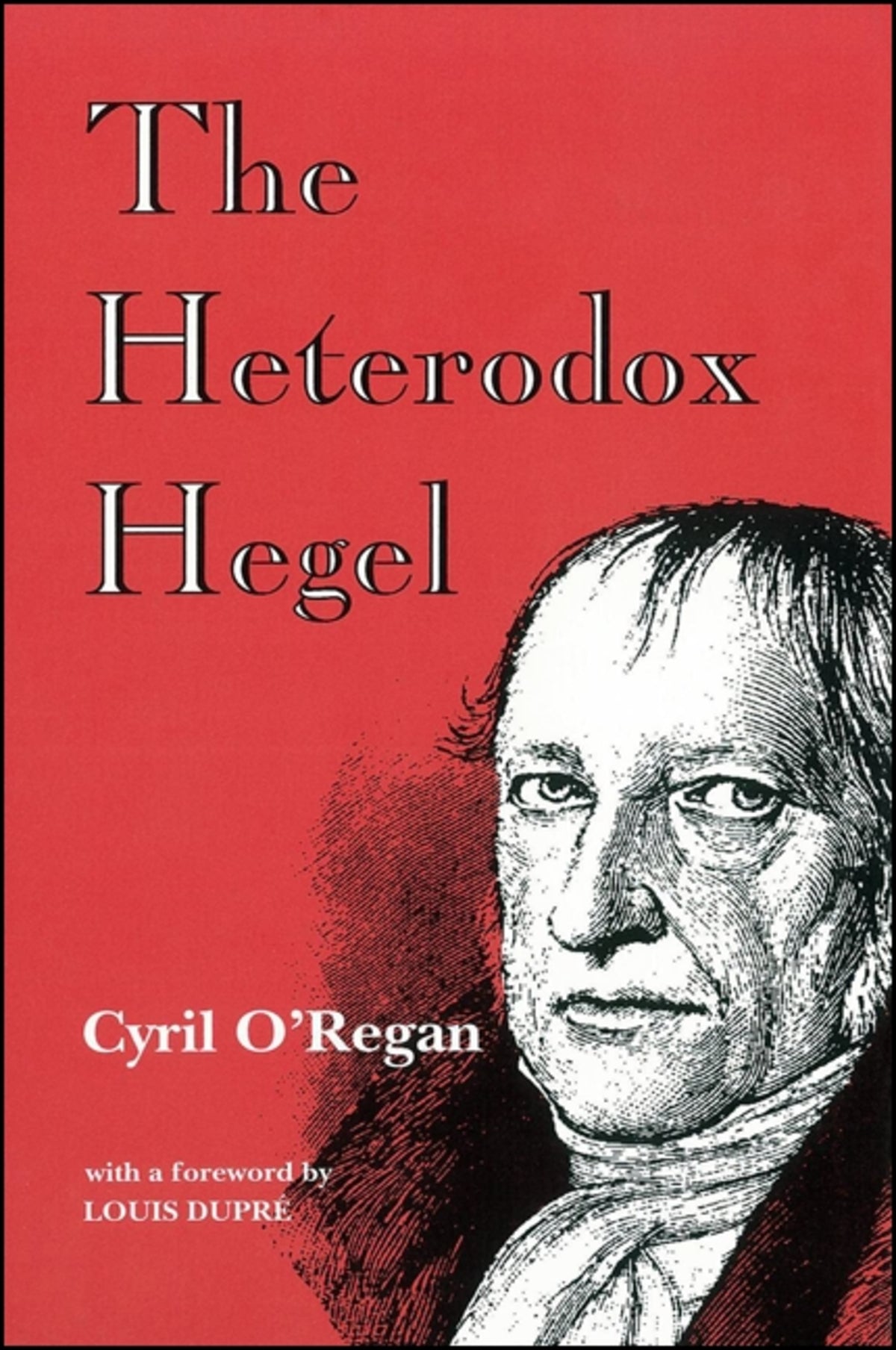
Reinterprets Hegel as a thinker grounded in Christian mystical and Trinitarian theology, showing how his philosophy integrates esoteric religious traditions with a sweeping metaphysical account of divine and spiritual development.
The Heterodox Hegel opens a new horizon in the study of Hegel by uncovering the mystical and Trinitarian foundations of his thought. For the first time, readers can explore Hegel not only as a philosopher of logic and history but also as a thinker deeply engaged with the esoteric currents of Christian mysticism, a dimension long overlooked by scholarship.
Through meticulous textual analysis, Cyril O'Regan traces Hegel’s intellectual journey across the epochs of the divine, from the immanent Trinity through creation, incarnation, and the kingdom of the Spirit, culminating in a comprehensive narrative of spiritual and speculative transformation. The Heterodox Hegel demonstrates how Hegel’s philosophy of religion, deeply embedded in mystical theology, continues to illuminate enduring questions of divinity, community, and metaphysical truth.
Featuring an erudite foreword by Louis Dupré, extensive notes, and an exhaustive bibliography, The Heterodox Hegel is essential reading for philosophers, theologians, and scholars seeking to understand Hegel in the fullness of his mystical and metaphysical vision.


"It is a work of great originality and enormous comprehension that imposes itself upon Hegel scholarship by its sheer intellectual power, its creative expression, and its staggering erudition." — Louis Dupré, Yale University
"This work is original and brilliant as the first full-length study of the mystical background to Hegel. Cyril O'Regan's work is a ground-breaking study that will enable readers of Hegel to understand him within the context of the mystical tradition that he claimed as his own. For he made no secret of his filiation with the esoteric strands of Christian mysticism and this was clearly the way he was understood by F. C. Bauer, as well as Feuerbach, Engels, Marx and many of his immediate successors. It has always struck me as a major lacuna in Hegel scholarship that such a study had not appeared. Now it has been filled in considerable measure." — David Walsh, The Catholic University of America
"I find this book utterly fascinating to read. In many respects it read like a detective novel. Hegel continues to grow in importance, and the metaphysical/theological aspect of his thought, which he places at the center, remains, indeed, central. There are a number of good books in the area in English, but nothing quite as ambitious and comprehensive as this study. It is a milestone in the study of Hegel's religious thought which no future work in the area will be able to ignore." — Merold Westphal, Fordham University
"This is an outstanding study of Hegel's philosophy of religion, exceptionally illuminating with respect to Hegel's account of the Trinity and the sources of Hegel's views. The author has an exceptional mastery of the entire tradition of speculative theology, a synoptic mastery of Hegel's texts and the major commentaries in English, German and French." — William Desmond, Loyola College
Cyril O'Regan is Assistant Professor of Religious Studies at Yale University.
Foreword by Louis Dupré
Acknowledgments
List of Abbreviations
Introduction
Part 1. Ontotheological Foundations
Chapter 1. Hegelian Rendition of the Deus Revelatus of Christianity
Section 1.1 Against Negative Theology
Section 1.2 Narrative and the Deus Revelatus
Section 1.3 Trinity as Adequate Theological Articulation
Part 2. The Trinitarian Structuration of the Epochal Divine
Chapter 2. The First Narrative Epoch: The "Immanent Trinity"
Section 2.1 Hegelian Logic as Logica Divina
Section 2.2 The "Immanent Trinity" as Speculatively Informed Vorstellung: LPR and Other Hegelian Texts
Section 2.3 Trinitarian Swerve: Dynamic, Narrative Modalism
Chapter 3. The Second Narrative Epoch: Creation and The Epoch of the Son
Section 3.1 Hegelian Legitimation of the Representation of Creation
Section 3.2 Creation as Fall and Evil
Section 3.3 Hegelian Swerve from the Normative Christian Tradition
Chapter 4. Epochal Overlap: Incarnation and the Passion Narrative
Section 4.1 Hegel's Mature Christological Position: Trinitarian Contextualization of Theologia Crucis
Section 4.2 Deus Patibilis: Hegel and Luther: Agreement and Swerve
Chapter 5. The Third Narrative Epoch: The Moment or Kingdom of the Spirit
Section 5.1 Spiritual Community (Gemeinde): Corpus Mysticum
Section 5.2 Complex Mystical Determination: Complex Mystical Inflection
Chapter 6. The Third Narrative Epoch: The Inclusive Trinity
Section 6.1 Holy Spirit—Spirit: Spirit—"Immanent Trinity"
Section 6.2 The Genre of Hegelian Apocalypse
Section 6.3 The Genre of Hegelian Theodicy
Part 3. Narrative and Logico-Conceptual Articulation
Chapter 7. Representation and Concept: Speculative Rewriting
Section 7.1 Representation and Concept in Hegel's Mature Works
Section 7.2 Agents of Speculative Rewriting
Section 7.3 Hegel and the Perdurance of Narrative
Notes
Bibliography
Indexes