





Some error occured while loading the Quick View. Please close the Quick View and try reloading the page.
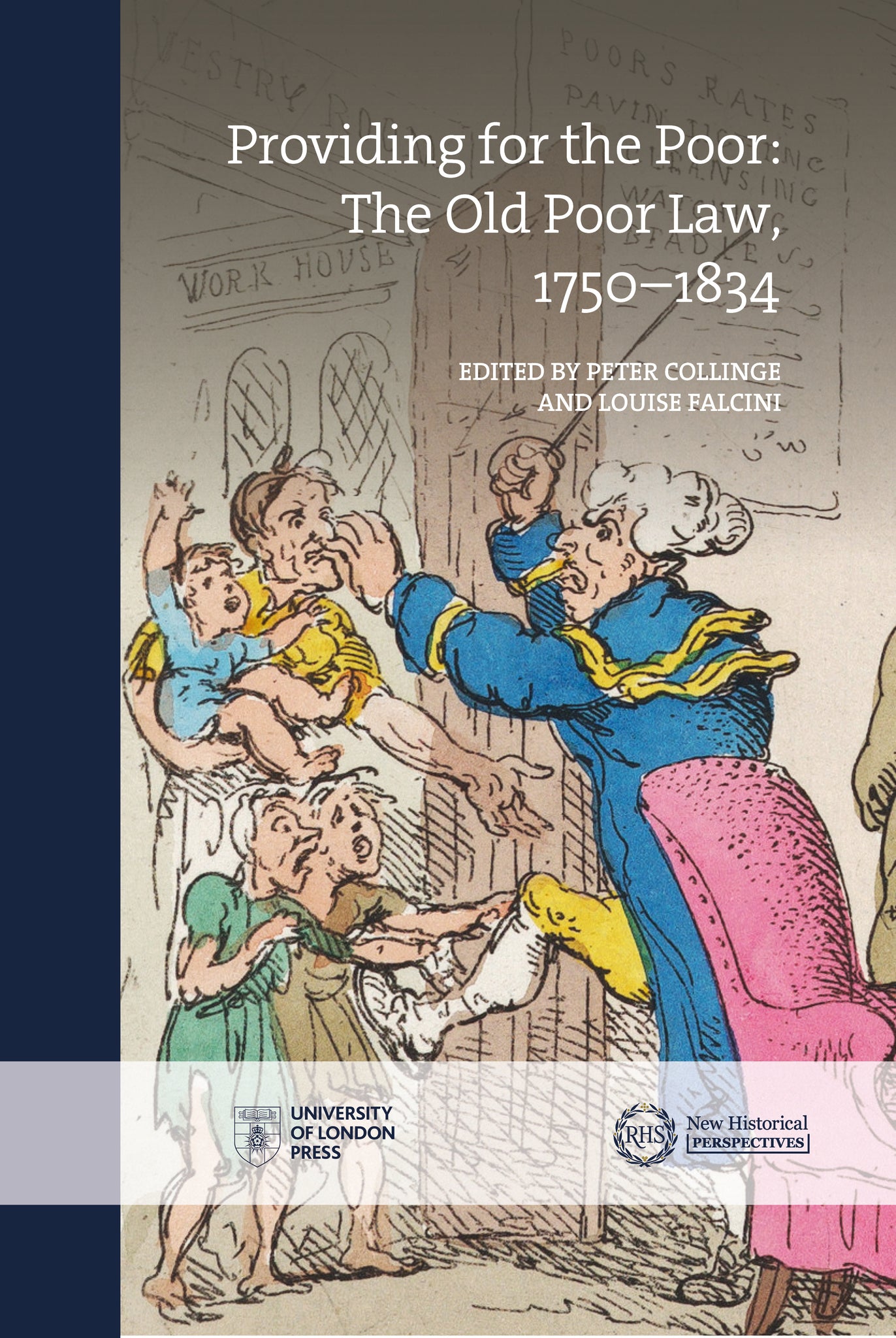
The Old Poor Law in England and Wales, administered by the local parish, dispensed benefits to paupers providing a uniquely comprehensive, pre-modern system of relief. Remaining in force until 1834, the law provided goods and services to keep the poor alive.
Combining short- and long-form articles and essays, Providing for the Poor brings together academics and practitioners from across disciplines to re-examine the micro-politics of poverty in the long eighteenth century through the eyes of the poor, their providers and enablers. From the providence of the parochial sixpence given in order to move a beggar on, to coercive marriages, plebeian clothing and the much broader implications of vagrancy towards the end of the long eighteenth century, this volume aims to bridge the gaps in our understanding of the experiences of people across the social spectrum whose lives were touched by the Old Poor Law. It brings together some of the wider arguments concerning the nature of welfare during economically testing times, and navigates the rising bureaucracy inherent in the system, to produce a radical new history of the Old Poor Law in astonishing detail.


...an intriguing and informative collection which certainly deserves to find a prominent place in the growing canon of parish- and union-level poor law literature … an enjoyable and instructive volume which will be appreciated by students and historians of welfare and, indeed, anyone with a keen interest in the lower reaches of Georgian society.
—Peter Jones, University of Glasgow, UK
— Peter Jones
This is an outstanding book. … We learn things that are genuinely new and from new or unfamiliar sources, throughout the volume. In turn, one of its strengths is that academic chapters are interleaved with micro-case studies of particular people or families by volunteers on the project. … Here we see those projects contextualised in the academic literature and making a genuine and refreshing contribution to the debate.
—Steven King, Nottingham Trent University, UK
This innovative and richly detailed volume builds on these foundations by using a new source – the vouchers or “small bills” that were used to record everyday poor law transactions – to shed new light on the role that the Poor Law played in supporting both claimants and the communities in which they lived … In restoring voice and agency to the lives of historical actors, the Small Bills project has also sought to democratise the practice of history itself.
—Bernard Harris, Department of Social Work and Social Policy, University of Strathclyde, Glasgow, United Kingdom
The book … represents a new iteration of a long-established pursuit, and it is both effectively embedded in that trad¬ition and up-to-the-minute in what it does and how it does it. Its authors dis¬play an authoritative grasp of law and practice, and of the historiography: the footnotes provide pointers to much recent work, and the research questions that the chapters pursue are deeply informed by it. … This is a book for researchers, not for beginners, lucid and well presented though it is: every chapter aims to, and does in fact, add to knowledge.
—Joanna Innes, Somerville College, Oxford, UK
Introduction Peter Collinge and Louise Falcini
Part I: Paupers and Vagrants
Chapter 1. Accounting for Illegitimacy: parish politics and the poor Louise Falcini
Interlude 1. Thomas Woolgar the Mystery Man Jean Irvin
Chapter 2. Clothing the Poor Elizabeth Spencer
Interlude 2. Elizabeth Overing in Bedlam Elizabeth Hughes
Chapter 3. Vagrancy, Poor Relief and the Parish Tim Hitchcock
Interlude 3. Elizabeth Malbon (c.1743–1801) Dianne Shenton
Part II: Providers and Enablers, and their Critics
Chapter 4. Women, Business and the Old Poor Law Peter Collinge
Interlude 4. The Wilkinsons and the Griffin Inn, Penrith Margaret Dean
Chapter 5. The Overseers’ Assistant: taking a parish salary, 1800–1834 Alannah Tomkins
Interlude 5. The Parochial Career of James Finlinson (1783–1847) William Bundred
Chapter 6. Who cares? Mismanagement, neglect and suffering in the final decades of the old poor laws Samantha Shave
Interlude 6. Abel Rooker (1787–1867), Surgeon Janet Kisz
Part III: Public Histories
Chapter 7. Public Histories and Collaborative Working Louise Falcini and Peter Collinge
Conclusion