





Some error occured while loading the Quick View. Please close the Quick View and try reloading the page.
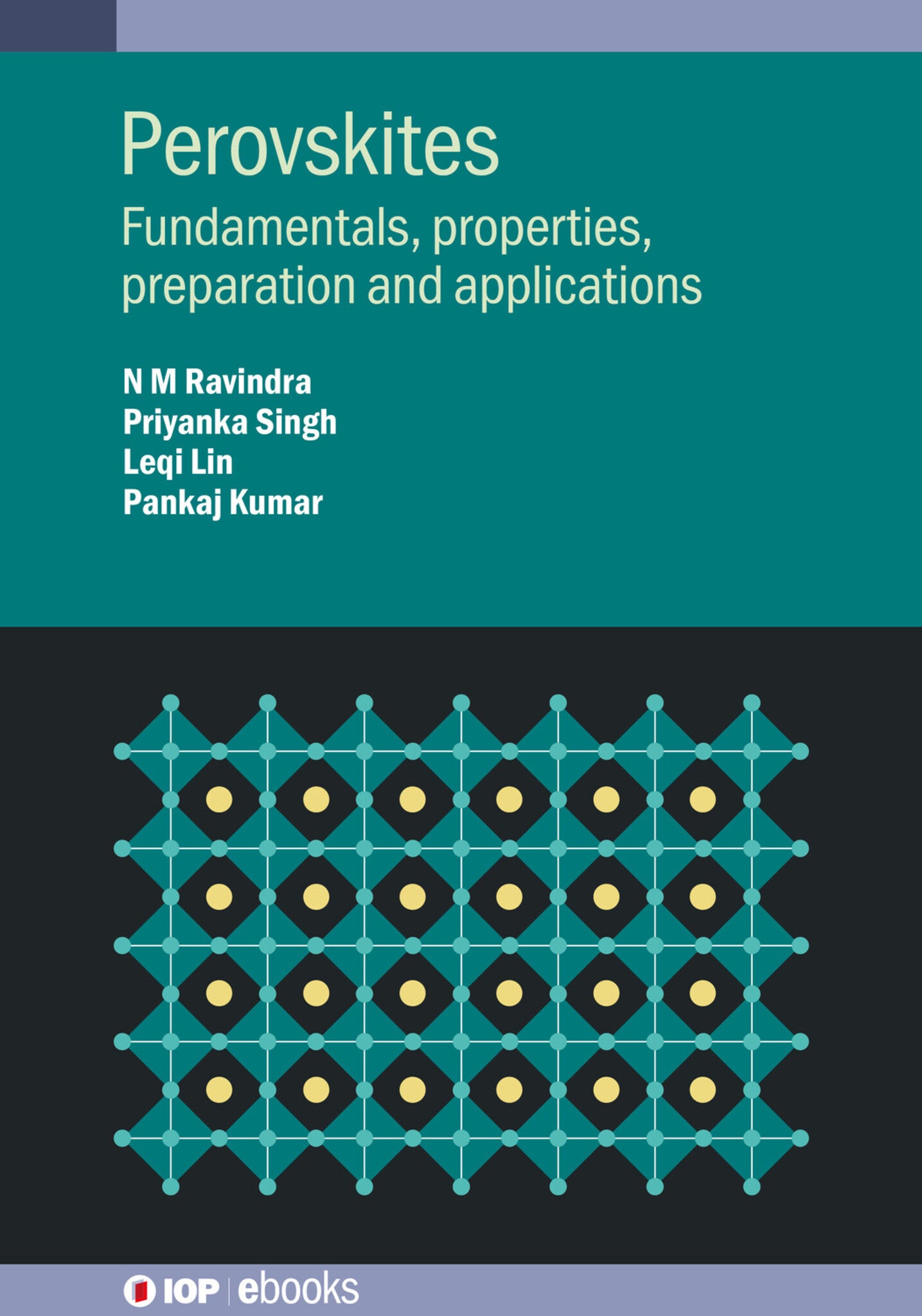
Perovskites represent one of the fastest emerging fields in the area of materials science and engineering. They offer a cost-effective and efficient alternative to conventional semiconducting materials and can be printed on various substrates using low-temperature, solution-based methods, making them suitable for various device applications such as solar cells, batteries, LEDs, sensors, memory devices, FETs etc. Inspite of their enormous potential, perovskites are faced with several challenges in terms of their stability, scalability and reproducibility. Recent research trends show significant global efforts to overcome these problems. This book is a compilation of the fundamentals, properties, processes, and applications of perovskites and their recent research trends. Furthermore, it explores the market opportunities, intellectual properties, and active global R&D efforts for academicians, researchers and industry professionals.
Key features:
- Perovskite semiconductors have emerged as cost effective alternatives to conventional semiconducting materials and devices.
- This book provides detailed information about perovskite materials and their applications.
- It explores the market opportunities, intellectual properties, and active global R&D efforts in the area of perovskites.
- It is a rich source of knowledge and reference guide for researchers, engineers, academicians and industry professionals.


Nuggehalli M. Ravindra (Ravi) is a physics professor at NJIT, where he previously served as Chair of Physics and Director of the Materials Science & Engineering program. He is the founding editor-in-chief of Emerging Materials Research and has guest-edited journals such as Polymers for Advanced Technologies, Journal of Electronic Materials, European Physical Journal Special Topics (EPJ-Special Topics), Metallurgical and Materials Transactions A, and JOM.
Dr. Priyanka Singh is a Scientist at the National Physical Laboratory, New Delhi, India. She previously worked as a Research Scientist with Professor N. M. Ravindra in the Department of Physics, New Jersey Institute of Technology (NJIT), USA. She has published several research papers and two books in the field of semiconductors and solar cells. Her research interests include silicon and perovskite solar cells.
Dr. Pankaj Kumar is a Senior Principal Scientist at CSIR-National Physical Laboratory (CSIR-NPL), New Delhi, India. His current research focus is on the development of large area printable flexible perovskite solar cells. He is the recipient of the prestigious CSIR-Young Scientist Award and Indo-Australia early carrier research fellowship of India. He has published over 100 research articles, two books and several book chapters.
Ms. Leqi Lin is a senior PhD student at Shanghai Jiao Tong University in China. Previously, Leqi obtained her Master’s degree in civil engineering at New Jersey Institute of Technology (NJIT) and mechanical engineering at State University of New York – Buffalo (SUNY). She has been working with Dr. N.M. Ravindra since 2019 at NJIT on the field of solar cells. Leqi is a coauthor of more than 15 papers in the areas of devices, semiconductors, and AI4S in process engineering optimization.
- Introduction
- Fundamentals of perovskites
- Properties of perovskites
- Processing methods and materials
- Characterization techniques
- Computational and analytical simulation techniques
- Current, emerging and frontier applications of perovskite materials
- Challenges, limitations, and sustainability considerations
- Future directions in perovskite materials and technologies
- Conclusion