





Some error occured while loading the Quick View. Please close the Quick View and try reloading the page.
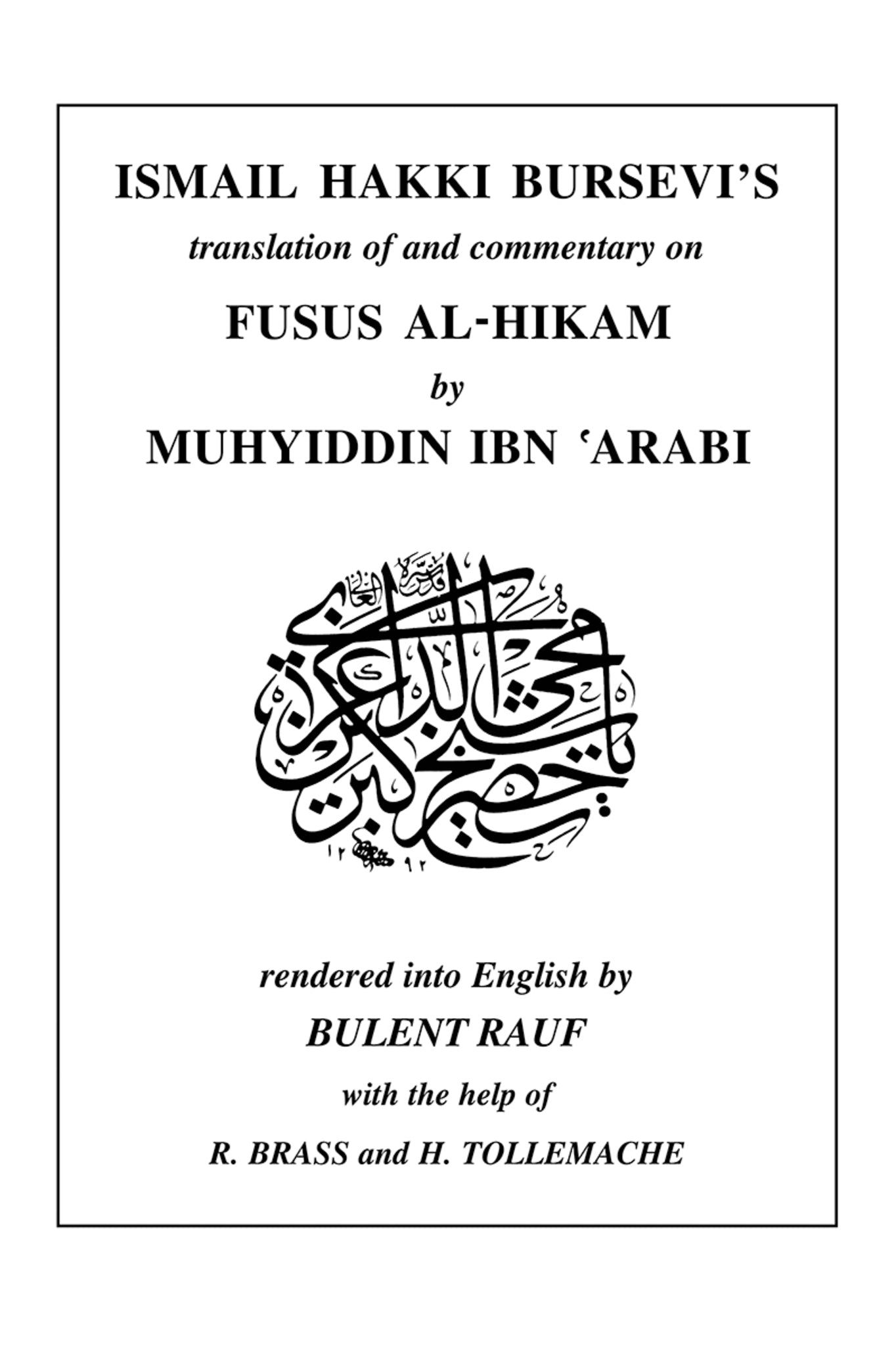
This is an English translation of the famous 17th-century Ottoman Turkish translation (from the original Arabic), with its extensive commentary, of Muhyiddin Ibn 'Arabi's Fusus al-Hikam. Muhyiddin Ibn 'Arabi, known as the ‘Greatest Shaykh’, considered the Fusus al-Hikam, his last major opus, to be the most important of his more than 350 books.
Muhyiddin Ibn 'Arabi was born in Andalusia, Spain, in 1165. From the age of thirty-two he travelled extensively throughout the Islamic world, conversing with the greatest mystics, divines and philosophers of his day. Although, as an outspoken critic of religious and philosophical dogmatism, he made many enemies, he was and is revered as a saint and as a teacher of incomparable stature. He died in Damascus in 1240.
The theme of the Fusus al-Hikam is the Infinite Wisdom that is at once unique in Itself and many-faceted in Its representation in the line of prophets from Adam to Mohammed. It is simultaneously an explanation of the profoundest meaning of man’s existence and perfectibility, and an esoteric exegesis of the Quran. In treating of the Divine Wisdom, it is so faithful to its subject that the book is itself a paradigm of its theme.
The reader does not require knowledge of Arabic or Turkish to benefit from reading this book. It is intended for anyone with an interest in the true meaning and purpose of their own existence and that of the cosmos. It is a work that can be returned to for a lifetime, and if the reader approaches it with sincerity and respect, it may yield new understandings with every visit.
This second edition has been revised and reset, using modern standard diacritics throughout.
Volume 4: Chapters on Solomon, David, Jonah, Job, John, Zachariah, Elijah, Loqman, Aaron, Moses, Khalid and Mohammed.


Muhyiddin Ibn 'Arabi was born in Andalusia, Spain, in 1165. From the age of thirty-two he travelled extensively throughout the Islamic world, conversing with the greatest mystics, divines and philosophers of his day. He wrote some five hundred books, of which he considered the Fusus al-Hikam to be the most important. Although as an outspoken critic of religious and philosophical dogmatism he made many enemies, he was and is revered as a saint and as a teacher of incomparable stature. His last major opus, the Fusus al-Hikam, should be read with a pre-understanding of the point of view and reference and the ensuing perspective, for which Ibn 'Arabi is unmatched. It is to Ibn 'Arabi, who speaks from objective vision of the Unique Existence, that the exposition of Its Self-revelation may be ascribed, as the first Sufi to correlate the ‘theory’ of wahdat-i-wujud, of which he is celebrated as the originator and most complete propounder of all time. He died in Damascus in 1240.
Ismail Hakki (1653–1725), known as the ‘Bursevi’ from his long association with Bursa in Turkey, was originally from Aydos, near Adrianople. He studied with Osman Fazli, the shaykh of the Sufi Order of the Jelvetis, and eventually became his successor. His knowledge of both Arabic and Turkish was superlative. His extensive commentary upon the Fusus al-Hikam, published here in full, is surely the best of the many commentaries which this book has inspired, being aligned perfectly and completely to the spirit of the original, whilst his Introduction, printed in Volume 1, is without doubt a masterpiece in itself.
Bulent Rauf was born in 1911 in Istanbul. He was educated first at home, where he had a classical Ottoman education, reading Turkish, Arabic and Persian, as well as three European languages, and then continued his studies at Robert College. He went to Cornell and Yale Universities, reading English literature in one and Hittite archaeology in the other. In 1945 he married Princess Faiza of Egypt, where they lived until Nasser came to power, when they moved to Paris. They were divorced in the early sixties. He settled in England in 1966 and married Angela Culme-Seymour. He then lived mostly in Scotland, engaged in research work and was Consultant to the Beshara Trust. His relationship with Ibn 'Arabi was atavistic, through his grandfather who is buried immediately behind the tomb of Ibn 'Arabi in Damascus, in compliance with his wish when he left Istanbul the last time for Mecca. Bulent Rauf died on 5 September 1987 and is buried at Chisholme House in the Scottish Borders.