





Some error occured while loading the Quick View. Please close the Quick View and try reloading the page.
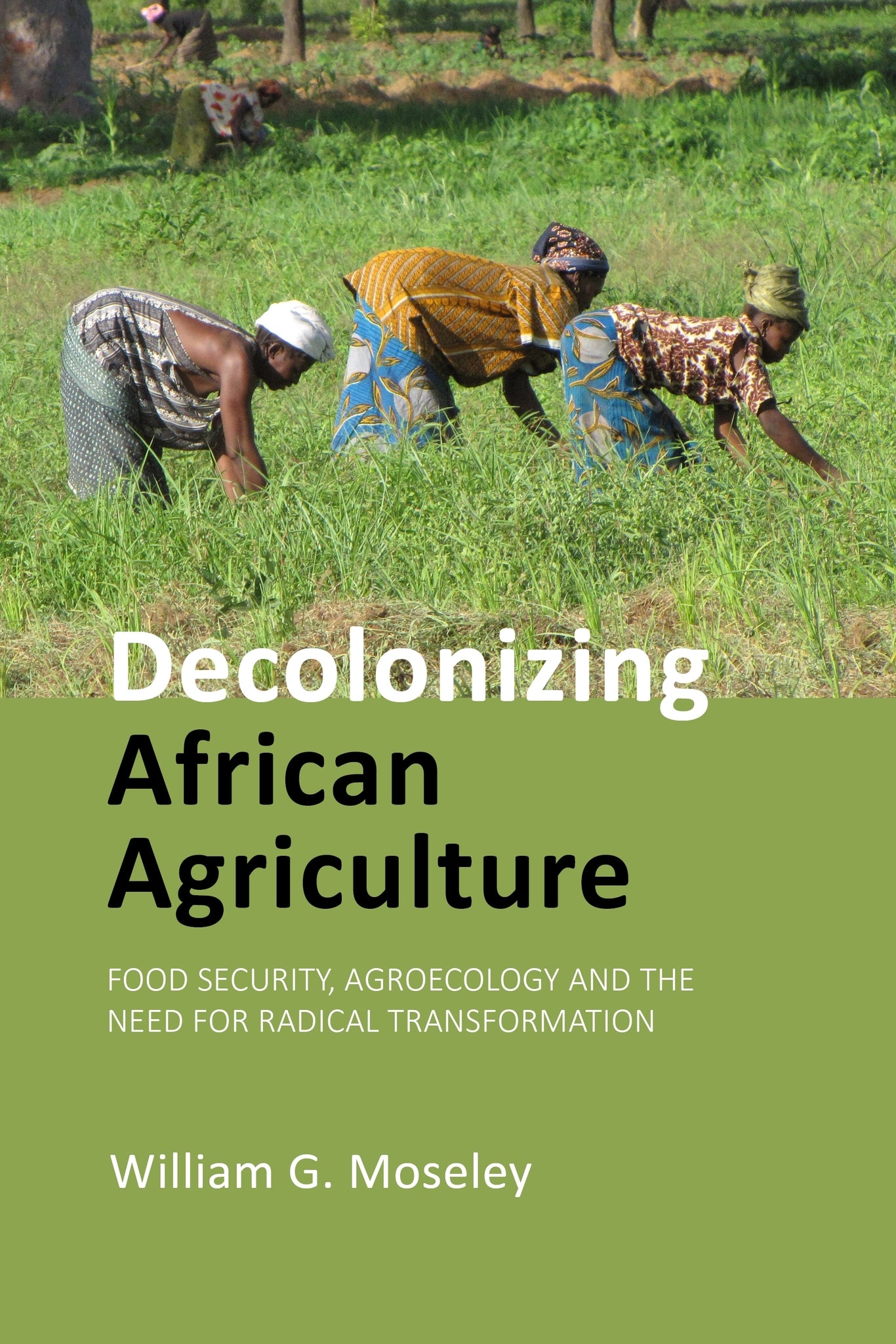
Why have so many approaches to farming and food policy failed in Sub-Saharan Africa? Because, argues William Moseley in this compelling analysis, of the shortcomings of a prevailing western, colonial agricultural science that is infused with power and politics. To tackle food security successfully, the book argues, we need a non-colonial, indigenous agronomy that creates the social innovation needed to support the livelihoods of small-scale farmers.
The book is organized in four sections: Part 1 provides a broad conceptual introduction emphasizing political agronomy, political ecology and agroecology. Part 2 evaluates past food security and agricultural development experiences in four countries where Moseley has undertaken extensive field research over several decades: Mali, Burkina Faso, South Africa and Botswana. Part 3 examines successful efforts in each of these countries and outlines future directions that emphasize the application of ecological principles to agricultural systems. In Part 4, Moseley advocates building more resilient food systems and a different kind of development that supports agroecology, vibrant rurality and networks of smaller cities. Achieving this transformation will require institutional reform at the global level, of those multilateral and bilateral agencies involved with farming and food policy.
Written for an academic and policy readership, as well those interested in international food security, the book is suitable for courses on food politics, agroecology and sustainable development.


Hunger and food insecurity persist across Africa despite decades of international agricultural development assistance. Food crises post-Covid, including grain and fertilizer disruptions with the Ukraine war, pose renewed challenges to conventional agricultural development policies. From a scholar with decades-long expertise in African agricultural systems comes this powerful call for a different agricultural paradigm in Africa. Drawing upon case studies of grass roots efforts across the continent to build resilient food systems, Moseley advances a road map for eliminating hunger and malnutrition at the local level. By making a compelling case for agroecological farming, he aligns the food sovereignty movement with agroecology. The book presents a thoughtful, clear-eyed analysis of the structural issues behind food insecurity on the continent and the key ingredients needed for a meaningful transformation of African agriculture and food systems. Essential reading for anyone interested in global food futures.
— Judith A. Carney, Professor of Geography, University of California, Los Angeles
Moseley draws on decades of research and policy experience to shed light not only on what is wrong with conventional approaches to agricultural development in Africa but also to bring forward stories of hope. Merging ecological, social, and political frameworks, the book’s excellent and highly engaging analysis maps out the required ingredients for an agroecological transformation in Africa.
— Jennifer Clapp, Canada Research Chair in Global Food Security and Sustainability, University of Waterloo
Moseley has stepped back to sketch out broad insights emerging from a long career of rich empirical field work... the result is a clear, carefully argued, expansive, yet concise examination of the failure of mainstream agricultural development in Africa, well suited to students and development practitioners alike... it charts an intellectual trajectory oriented by curiosity and practical relevance; Moseley recounts pursuing new research projects after he and his students sought to understand puzzling observations. It thus reads—tangentially—as a model of scientific curiosity and academic mentorship
— Jessie Luna, writing in AAG Review of Books
Decolonizing African Agriculture is a worthy successor to Paul Richards’ classic Indigenous Agricultural Revolution. Based on decades of on-the-ground research, Moseley offers a radically alternative way of thinking about recurring food insecurity and its quick fixes. He expertly shows that even under the most constraining of circumstances, it is possible to achieve food security through agroecology. Here is a challenge to anyone who dares say that African Indigenous agroecology is backward, unproductive, and needs colonial science. This book could not come at a more propitious moment, when progress toward the global zero hunger goal has lurched into reverse. A tour de force.
— Hanson Nyantakyi-Frimpong, Associate Professor of Geography, University of Denver
This book is a crucial contribution to the ongoing discourse in Africa about the impact of neocolonial policies on our agriculture. It compellingly argues that African agriculture cannot be fully understood without applying the lens of political ecology and political agronomy. With a strong emphasis on agroecology as the future of African farming, this work is both timely and essential. It stands as a vital resource for anyone advocating for an agricultural future in Africa where farming is viewed not merely as a stepping stone to industrial development, but as a pivotal force for sustainable growth in its own right.
— Million Belay, General Coordinator, Alliance for Food Sovereignty in Africa
William G. Moseley is DeWitt Wallace Professor of Geography, and Director of the Food, Agriculture and Society Program, at Macalester College, Saint Paul, Minnesota. He is the author of more than 100 peer-reviewed articles and book chapters, as well as nine books, including most recently Africa’s Green Revolution: Critical Perspectives on New Agricultural Technologies and Systems (2016) and Land Reform in South Africa: An Uneven Transformation (2015). He currently serves as President Elect of the Mande Studies Association and sits on the scientific advisory panel to the United Nations’ Committee on World Food Security.
Part I: The Big Picture
1. Introduction: decolonizing African agriculture
2. A brief history of African food security and agricultural development policies
3. Conceptualizing change
Part II: Country Studies of Failed Agricultural Development in the Colonial and Postcolonial Periods
4. Mali: from West African bread-basket to malnutrition and the cotton commodity trap
5. Planned and unplanned agricultural calamities in Burkina Faso: the new green revolution for Africa and proliferating herbicides
6. Problems with the Ricardian food security dream: Botswana’s challenge of growth with hunger
7. Big agriculture’s take-over of South Africa’s land redistribution programme
Part III: Reimagining African Food Systems
8. Farmer and consumer agency in Mali: food sovereignty and agroecology amidst global food price fluctuations and conflict
9. Burkina Faso: privileging food systems thinking
10. Gender matters: women farmers, water and climate change in Botswana
11. Agrarian justice in South Africa’s Western Cape
Part IV: African Agriculture and Global Political Economy
12. Feeding the fire or dousing the embers: interrogating the regional and international institutional architecture shaping African agriculture, food security and agroecology
13. Conclusion: aiding and abetting radical transformation