





Some error occured while loading the Quick View. Please close the Quick View and try reloading the page.
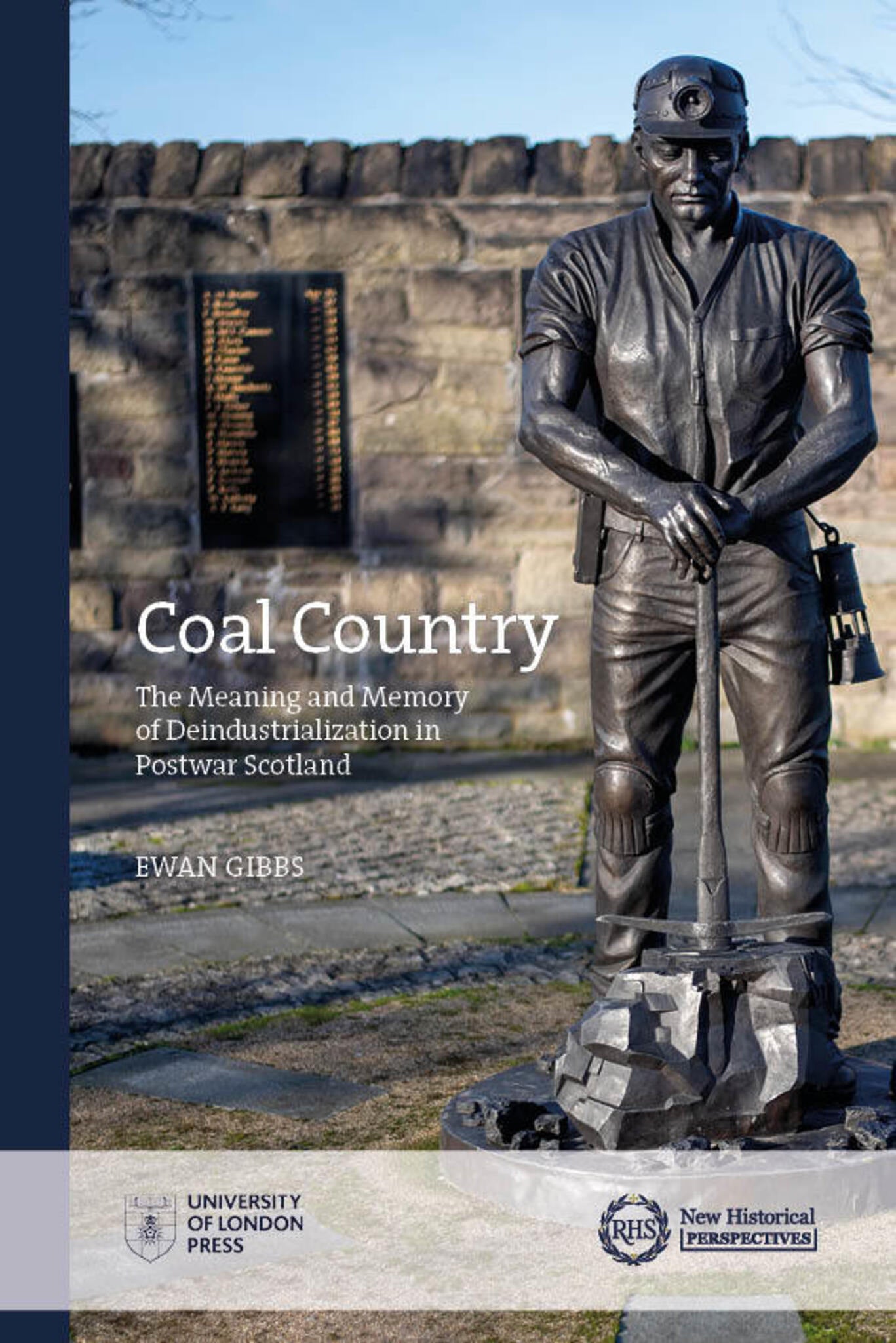
The flooding and subsequent closure of Scotland’s last deep coal mine in 2002 brought a centuries long saga to an end. Villages and towns across the densely populated Central Belt owe their existence to coal mining’s expansion during the nineteenth century and its maturation in the twentieth. Colliery closures and job losses were not just experienced in economic terms: they had profound implications for what it meant to be a worker, a Scot and a resident of an industrial settlement. Coal Country presents the first book-length account of deindustrialization in the Scottish coalfields. It draws on archival research using records from UK government, the nationalized coal industry and trade unions, as well as the words and memories of former miners, their wives and children that were collected in an extensive oral history project.
Deindustrialization progressed as a slow but powerful march across the second half of the twentieth century. In this book, big changes in cultural identities are explained as the outcome of long-term economic developments. The oral testimonies bring to life transformations in gender relations and distinct generational workplaces experiences. This book argues that major alterations to the politics of class and nationhood have their origins in deindustrialization. The adverse effects of UK government policy, and centralization in the nationalized coal industry, encouraged miners and their trade union to voice their grievances in the language of Scottish national sovereignty. These efforts established a distinctive Scottish national coalfield community and laid the foundations for a devolved Scottish Parliament. Coal Country explains the deep roots of economic changes and their political reverberations, which continue to be felt as we debate another major change in energy sources during the 2020s.


"Gibbs's prose is a joy to read, facilitating a real keen analytical edge without ever losing any degree of clarity and readability... Coal Country is a worthy addition to the field, a tour de force. It should be required reading for students and historians of the Scottish coal industry."
-Historical Studies in Industrial Relations
"An important and weighty contribution to understandings of Scottish experiences of industrial decline and and one which is a very welcome addition to the burgeoning field of scholarship focused on deindustrialisation."
-Contemporary British History
"The narratives in Coal Country are often so fascinating that they could be the basis of a short story."
-Journal of Working Class Studies
"Required reading for anyone who wants to understand the history of Scotland."
-Conrad Landin (The Guardian)
"Coal Country claims to be the first full length study of deindustrialisation in the Scottish coalfields. But its scope is actually broader and much more ambitious in its treatment of an age of massive social upheaval."
-The Drouth
"Coal Country is a compelling account of industrial transformation and the fall of the carbon economy."
-OpenDemocracy
"It’s notable that the two unanticipated successes in Scottish fiction last year – Shuggie Bain and Scabby Queen – both feature mining communities in a far from flattering light. [Coal Country] serves to counter the idea that working men are inherently violent, that pit closures must mean villages going to the dogs, that industrial workers must be sheep-like in their solidarity. This book adds much needed nuance to accounts of deindustrialisation in Scotland... Coal Country is a work of history which moves beyond the familiar symbols of deindustrialisation, and points instead to the rich legacy of mining in Scotland, an indelible stamp on the contemporary nation."
-Bella Caledonia
That I found this book a tough read is no criticism of the author but rather a reflection of the fact that I am of an age to have participated in and been influenced by some of the politics Ewan sets out in a work of history which, as he correctly observes, echo in and have resonance in today’s Scotland.
—Scottish Socialist Voice
"Ewan Gibbs excavates the deep history of coal mining in the Scottish central belt and his longer story of deindustrialisation in the Scottish coalfields is constructed from an impressive range of archival research as well as oral testimony, humanising a narrative that could be reduced to a mere accounting of the internecine struggles between industrial policy and unions. By giving voice to those on the ground, the workers are rescued from being mere bystanders to blind historical forces... This inherited past that Gibbs delineates could prove invaluable for building a just future."
-The Morning Star
A remarkable text that will be read widely, and deservedly so. Gibbs has delivered a work that sits worthily alongside key studies of deindustrialization.
—Antipode
Introduction: Those who walked in darkest valleys
Chapter 1 ‘Buried treasure’: industrial development in the Scottish coalfields, c.1940s–1980s
Chapter 2 Moral economy: custom and social obligation in colliery closures
Chapter 3 Communities: ‘it was pretty good’ in reconstructed locales
Chapter 4 Gendered experiences
Chapter 5 Generational perspectives
Chapter 6 Coalfield politics and nationhood
Chapter 7 Synthesis: ‘the full burden of national conscience’: class, nation and deindustrialization
Conclusion: The meaning and memory of deindustrialization
Appendix: Interviewee biographies
Bibliography